Stop by and learn about earning a graduate certificate with Pitt's University Center for International Studies (UCIS). Tailor a program of study based on your career interests that will enhance your GSPIA degree. Don't let this no cost opportunity pass. Center advisors will be available to discuss certificates, funding, resources, and more!
Tuesday, November 2nd, 2021
UCIS Graduate Certificate Offerings
Time:
11:45 am to 1:00 pm
Location:
Posvar, 3rd Floor Commons Area
Sponsored by:
Asian Studies Center, Center for African Studies, Center for Latin American Studies, Center for Russian East European and Eurasian Studies, European Studies Center and Global Studies Center along with Graduate School of Public and International Affairs (GSPIA)
Contact:
Elaine Linn
Contact Email:
eel58@pitt.edu
ESC Funding Opportunities Info Session
Time:
11:30 am
Location:
Global Hub in Posvar Hall
Sponsored by:
European Studies Center
Join the European Studies Center for an information session on student funding available at ESC. There will be two opportunities to attend a session.
In-person at the Global Hub in Posvar Hall:
Tuesday, November 2nd.
Graduate Students: 11:30am-12:15pm
Undergraduate Students: 12:30pm-1:15pm
Virtually via Zoom:
Monday, November 8th.
Graduate Students: 2:30-3:15pm
Undergraduate Students: 3:30-4:15pm
Thursday, October 28th, 2021
I Stand With Immigrants Day of Action

Time:
10:00 am to 2:00 pm
Location:
Global Hub - 1st Floor Posvar
Sponsored by:
Asian Studies Center, Center for African Studies, Center for Latin American Studies, Center for Russian East European and Eurasian Studies, Director's Office, European Studies Center, Global Studies Center, Global Hub, Nationality Rooms and Intercultural Exchange Programs, Office of International Services, Global Experiences Office and UCIS Engagement
The I Stand With Immigrants Initiative, powered by FWD.us, leads narrative campaigns that empower immigrants and their allies to share stories and drive action that demonstrate immigration is good for our communities, economy, and country. They do this with the goal of encouraging everyone to explore their individual heritage and celebrate both our distinct and shared experiences.
Join Pitt Global for a Day of Action and sharing how immigrants have inspired you. Stop by the Global Hub to participate in our photo booth and show your support for our immigrant community.
Wednesday, October 27th, 2021
International Relations Club First Meeting
Time:
8:00 pm to 9:00 pm
Location:
Global Hub - 1st Floor Posvar
Sponsored by:
Center for Russian East European and Eurasian Studies, European Studies Center and Global Hub
Contact:
Daniel Turillo
Contact Email:
djt59@pitt.edu
A discussion-based introductory gathering for those interested in joining the new IR Club.
Virtual Showcase: 2021 Interdisciplinary Global Educators

Time:
7:00 pm
Location:
Zoom
Sponsored by:
Asian Studies Center, Center for Russian East European and Eurasian Studies, European Studies Center and Global Studies Center along with National Consortium for Teaching about Asia (NCTA )
Cost:
Open to all K-12 educators and administrators, no registration required
Contact:
Maja Konitzer
Contact Email:
majab@pitt.edu
This past June, the Global Studies Center and the University Center for International Studies at the University of Pittsburgh hosted the Interdisciplinary Global Educators Working Group, where teachers came together virtually to design an interdisciplinary global unit or lesson. They were provided time, space, and materials to gather with like-minded colleagues and collaborate on unique and inspired lesson plans across subject areas.
Join us over Zoom for virtual presentations from our working groups on their newly designed projects and the process they went through in designing their interdisciplinary lessons. If you are interested in participating in this workshop in the future, this is an excellent opportunity to learn more!
This showcase is open to all K-12 educators and administrators. No registration is required, please join at the following link: https://pitt.zoom.us/j/91931181262
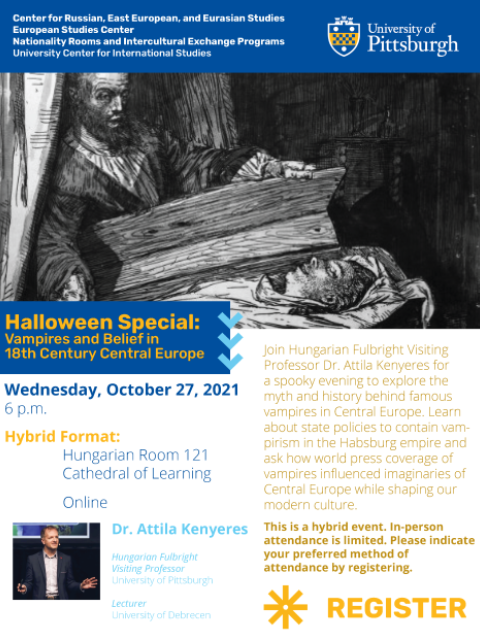
Halloween Special: Vampires and Belief in 18th Century Central Europe
Time:
6:00 pm to 7:00 pm
Presenter:
Dr. Attila Kenyeres
Location:
Zoom
Sponsored by:
Center for Russian East European and Eurasian Studies, European Studies Center and Nationality Rooms and Intercultural Exchange Programs
Contact:
Sera Passerini
Contact Email:
smp125@pitt.edu
Join Hungarian Fulbright Visiting Professor Dr. Attila Kenyeres for a spooky evening to explore the myth and history behind famous vampires in Central Europe. Learn about state policies to contain vampirism in the Habsburg empire and ask how world press coverage of vampires influenced imaginaries of Central Europe while shaping our modern culture.
This is a hybrid event. In-person attendance is limited. Please indicate your preferred method of attendance by registering.
Register here: https://pitt.zoom.us/meeting/register/tJcofuihrj4jGNFl4LoJUbFbMKje8HCUcEgv
Friday, October 22nd, 2021
Transforming Cities: Cities and Social Justice Mini Course
Mini Course

Time:
5:00 pm
Presenter:
Veronica Dristas
Location:
Zoom
Sponsored by:
Asian Studies Center, Center for Russian East European and Eurasian Studies, European Union Center of Excellence and Global Studies Center along with Carnegie Mellon University
Cost:
Free and Open to the Public w/ registration
Contact:
Veronica Dristas
Contact Email:
dristas@pitt.edu
Due to economic development and globalization, cities continue to grow with predictions that 70% of the world’s population will live in urban areas by the year 2050. This course, then, will view cities as hubs where patterns, connections, discussions, and the processes shape such issues as social justice, economic development, technology, migration, the environment among others. By examining cities as a lens, this sequence of weekend courses encourages students to examine cities as a system for discussing social processes being built and rebuilt. With an interdisciplinary focus, the course invites experts from the University of Pittsburgh, Carnegie Mellon, and relevant fields more broadly.
This iteration of the course will explore such topics as: the rapid growth of cities and their impact on fair housing, gentrification, and poverty; the role of human rights cities as models; the role of migration on cities; the role of governance addressing inequality; the need to have access to health care; among others.
The course will occur on Friday, October 22nd, Saturday, October 23rd, and Sunday, October 24th. Engagement in the course should be synchronous; accommodations for those in significant time zone differences will be provided to allow enrollment and completion of all elements of the weekend. A pre-course video review of the major course assignment will need to be completed prior to the course starting.
Learn more and register here! https://www.ucis.pitt.edu/global/transforming-cities-minicourse
Wednesday, October 20th, 2021
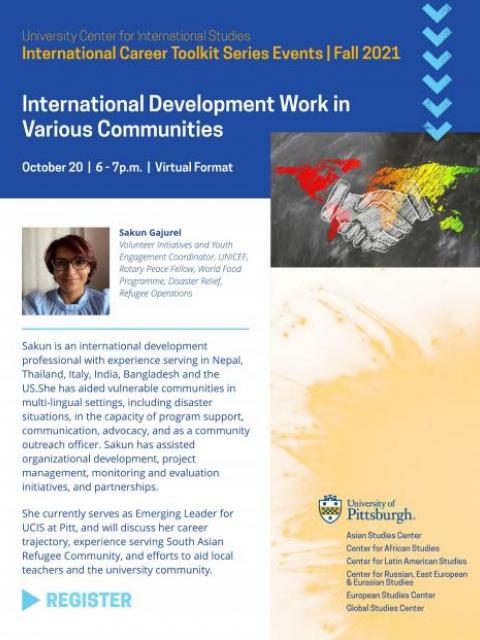
International Development Work in Various Communities
Time:
6:00 pm to 7:00 pm
Presenter:
Sakun Gajurel
Location:
Zoom Discussion
Sponsored by:
Asian Studies Center, Center for African Studies, Center for Latin American Studies, Center for Russian East European and Eurasian Studies, European Studies Center and Global Studies Center
Contact:
Angela Illig
Contact Phone:
412-726-7230
Contact Email:
ami17@pitt.edu
International Development Work in Various Communities
October 20th, 6pm-7pm, Virtual Format
Sakun Gajurel, Volunteer Initiatives and Youth Engagement Coordinator, UNICEFF
Rotary Peace Fellow, World Food Programme, Disaster Relief, Refugee Operations
Sakun is an international development professional with experience serving in Nepal, Thailand, Italy, India, Bangladesh and the US. She has aided vulnerable communities in multi-lingual settings, including disaster situations, in the capacity of program support, communication, advocacy, and as a community outreach officer. Sakun has assisted organizational development, project management, monitoring and evaluation initiatives, and partnerships. She currently serves as Emerging Leader for UCIS at Pitt, and will discuss her career trajectory, experience serving South Asian Refugee Community, and efforts to aid local teachers and the university community.
To Register:
https://pitt.zoom.us/meeting/register/tJcsdemupzkrG9cL-ZORMx6WJD6yDvGE9YEh
Sponsored by: Asian Studies Center, Center for African Studies, Center for Latin American Studies, Center for Russian, East European, & Eurasian Studies, European Studies Center, and Global Studies Center
Tuesday, October 19th, 2021
Conversations on Europe: Free Movement in the Time of COVID: the Economics and Ethics of Digital Vaccine Passports
Time:
12:00 pm
Location:
Zoom
Sponsored by:
European Studies Center along with Institute for Cyber Law, Policy, and Security, Center for Bioethics and Health Law, Jean Monnet in the USA Network, Jean Monnet Center of Excellence at Florida International University, Center for European Studies at University of Florida, European Union Center at University of Illinois Urbana-Champaign and Center for Transatlantic Studies at Georgia Tech
Cost:
Free
Contact:
Kenneth Reilly
Contact Email:
ker104@pitt.edu
For the 2021-22 academic year, the European Studies Center has announced its annual programmatic theme: “Recovering Europe.” As Europe recovers from COVID-19, the question of the viability of vaccine passports arises. This roundtable will address the ethical, legal, and digital plausibility of digital vaccine passports for travel across state borders in Europe. The roundtable will be hosted by European Studies Center Director Jae-Jae Spoon. Joining in the discussion will be: Sarah Chan, University of Edinburgh; Alex John London, Carnegie Mellon University; Ana Beduschi, University of Exeter.
Audience participation will be encouraged.
Panelists will be joining remotely.
#CoE
Thursday, October 14th, 2021
A New Era: Germany After Merkel

Time:
12:00 pm
Sponsored by:
European Studies Center along with Center for European Studies at the University of Florida
Contact:
Carla Ruffer
Contact Email:
rufferc@ufl.edu
Germany After Merkel
Panellists: Jana Puglierin, ECFR; Rafael Loss, ECFR; Marcel Lewandowsky, UF CES and DAAD
On September 26, Germany elected a new parliament. With it a new coalition government will come to power and Angela Merkel will depart the political stage after serving for 16 years as federal chancellor. Who might succeed her? What will be the foreign policy priorities of the new government? And how do Germany’s European partners view Merkel’s legacy and Germany’s role in Europe?
Dr. Jana Puglierin and Rafael Loss of the European Council on Foreign Relations (ECFR) and CES’ DAAD Visiting Assistant Professor Marcel Lewandowsky will discuss the results and implications of the German vote and the expectations of Germany’s European partners toward Berlin and its new leadership.
#JMintheUS
Tuesday, October 12th, 2021
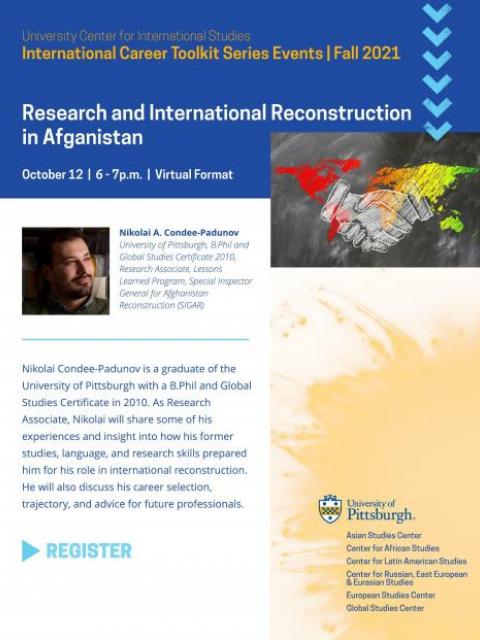
Research and International Reconstruction in Afghanistan
UCIS International Toolkit Series Event
Time:
6:00 pm to 7:00 pm
Presenter:
Nikolai Condee-Padunov
Location:
Zoom Discussion
Sponsored by:
Asian Studies Center, Center for African Studies, Center for Latin American Studies, Center for Russian East European and Eurasian Studies, European Studies Center and Global Studies Center
Contact:
Angela Illig
Contact Phone:
412-726-7230
Contact Email:
ami17@pitt.edu
Research and International Reconstruction in Afghanistan
October 12th, 6pm-7pm, Virtual Format
Nikolai A. Condee-Padunov
Research Associate, Lessons Learned Program, Special Inspector General for Afghanistan Reconstruction (SIGAR)
Nikolai Condee-Padunov is a graduate of the University of Pittsburgh with a B.Phil and Global Studies Certificate in 2010. As Research Associate, Nikolai will share some of his experiences and insight into how his former studies, language, and research skills prepared him for his role in international reconstruction. He will also discuss his career selection, trajectory, and advice for future professionals.
To Register:
https://pitt.zoom.us/meeting/register/tJcvfuuuqzojHdHD_9N62QTpwS6Wzob-YICB
Sponsored by: Asian Studies Center, Center for African Studies, Center for Latin American Studies, Center for Russian, East European, & Eurasian Studies, European Studies Center, and Global Studies Center
Thursday, October 7th, 2021
How Europe (Mis)Understands Black America
JMEUCE Distinguished Lecture
Time:
11:30 am to 1:00 pm
Presenter:
Gary Younge, Editor-at-Large, The Guardian
Sponsored by:
European Studies Center and International Week
Contact:
Kenneth Reilly
Contact Email:
ker104@pitt.edu
Europe's views on Black America are informed by a range of contradictory tendencies: amnesia about its own colonial past, ambivalence about its racial present, a tradition of anti-racism and international solidarity and an often fraught geo-political relationship with the United States itself. Europe both resents and covets American power, and is in little position to do anything about it. So African Americans represent to many a redemptive force– living proof that that US is both not all that it claims to be and could be so much greater than it is. This sense of superiority is made possible, in no small part, by a woefully, wilfully incomplete and toxically nostalgic understanding of Europoe's own history which has left significant room for denial, distortion, ignorance and sophistry. The result, in the post-war era, has been moments of solidarity often impaired by exocitisation or infantilisation in which Europe has found it easier to export anti-racism across the Atlantic than to practice it at home or export it across the Channel, the Mediterranean and beyond.
Gary Younge, author, broadcaster, and editor-at-large for The Guardian based in London, England will be delivering as talk on How Europe (Mis)Understands Black America as the 2021-22 Jean Monnet Center Distinguished Lecture. Gary Younge is a Professor of Sociology at the University of Manchester.
JMEUCE Distinguished Lecture Series.
This event is a part of International Week.
#JMintheUS
Tuesday, October 5th, 2021
The Nitty-Gritty of Applying for a Job in the EU/Europe: From Writing a Resume to a Successful Interview
Time:
11:00 am
Sponsored by:
European Studies Center along with Miami-Florida Jean Monnet European Union Center of Excellence
This panel is designed for students and alumni to apply successfully for a job in the EU/Europe.
European Human Resources experts and coaches will advise students on how to apply for an internship/job in a European company, in Europe and in the US, and how to be successful when working in EU/US relations.
PANELISTS:
Annabel Edo
Managing Director US
Ackermann International
Renata Urban
Intercultural Coach, Language and Communication Skills Trainer
URBAN Training and Services, Inc.
Stefano Vetralla
Managing Partner
AIMS International USA
MODERATOR:
Nelly Leon
Career Specialist
Presented & Hosted by The Miami-Florida Jean Monnet Center of Excellence, FIU & MEET EU
Co-sponsored by:
The Steven J. Green School of International & Public Affairs • European & Eurasian Studies Program • Career and Talent Development • the Center for European Studies at UNC-CH • the European Studies Center at the University of Pittsburgh • Jean Monnet in the USA #JMintheUS • The French-American Chamber of Commerce Florida, the German American Business Chamber of Commerce, the Italy-America Chamber of Commerce Southeast, The Spain-US Chamber of Commerce .
MEET EU is funded by a generous Getting to Know Europe (GTKE) grant from the Delegation of the European Union to the United States.
Steven J. Green School of International & Public Affairs - Florida International University
This is a part of International Week.
Thursday, September 30th, 2021
Protest as a Human Right in Hong Kong: A view from history
Time:
4:30 pm to 5:45 pm
Presenter:
Dr. Gina Anne Tam
Location:
Online-Zoom- https://pitt.zoom.us/j/91630703699
Sponsored by:
Asian Studies Center, Center for Russian East European and Eurasian Studies, European Studies Center and Global Studies Center
Contact:
Kat Lieder
Contact Email:
kal237@pitt.edu
In the summer of 2019, Hong Kong-- former British colony, current special administrative region of the People's Republic of China-- was swept up by a large, sustained protest movement. The spark that lit this "revolution of our time" as protestors have deemed it was an extradition treaty with China, but quickly evolved into a broader movement for a more democratically representative government and autonomy from the People's Republic of China. In a stunning backlash against the movement, the PRC government announced they would unilaterally enact a sweeping national security law, quickly marking much of the previous year's protest movement illegal. In the past year, activists, lawyers, elected officials have been arrested and NGOs and media outlets shuttered at a dizzying pace, fundamentally altering the civic, legal, and cultural landscape of the city. Drawing upon Hong Kong's long history of grassroots activism-- and backlash against it-- from the early twentieth century through the present, this talk will offer a historical view of how protest became a cherished human right and a locus of popular power in Hong Kong, using this history to discuss the implications of the national security law on human rights in the city today.
Technology, Trade, and the Transatlantic Relationship
Time:
11:00 am
Presenter:
Valdis Dombrovskis, Executive Vice President of the European Commission
Location:
Zoom
Sponsored by:
European Studies Center and European Union Center of Excellence along with Center for International Legal Education, Institute for Cyber Law, Policy, and Security, American University Transatlantic Policy Center, CUNY Graduate Center EU Studies Center, Miami-Florida Jean Monnet European Union Center of Excellence, Center for European and Transatlantic Studies at Georgia Tech University, Center for European Studies at the University of Florida, University of Colorado-Boulder Colorado European Union Center for Excellence, European Union Center at the University of Illinois, University of Miami Jean Monnet Chair/EU Center, University of North Carolina - Chapel Hill European Union Center of Excellence, Virginia Tech Center for European Union and University of Wisconsin-Madison European Union Center of Excellence
Contact:
Kenneth Reilly
Contact Email:
ker104@pitt.edu
Valdis Dombrovskis is the Executive Vice President of the European Commission for An Economy that Works for People and European Commissioner for Trade. On the heels of the EU-US Technology and Trade Council (TTC) meeting in Pittsburgh on September 29th, Executive Vice-President Dombrovskis will sit down with Pitt Associate Professor and Associate Dean of the Graduate School of Public and International Affairs, Erica Owens, for a conversation about the TTC, transatlantic trade, and the future of the EU-US relationship. Students and faculty are encouraged to participate. Audience questions are welcome. Students, please submit questions in advance to Iris Matijevic at irm24@pitt.edu to be sure they are included.
This event is co-sponsored by the network of Jean Monnet-funded Universities in the U.S. #JMintheUS
WATCH TALK HERE: https://audiovisual.ec.europa.eu/en/event/61556
Wednesday, September 29th, 2021
Book talk: Pax Transatlantica
Time:
10:00 am
Sponsored by:
European Studies Center along with American University Transatlantic Policy Center
Contact:
Garret Martin
Contact Email:
garretm@american.edu
Talk with Jussi Hanhimaki to discuss his latest book 'Pax Transatlantica' - https://global.oup.com/academic/product/pax-transatlantica-9780190922160...
#JMintheUS
Tuesday, September 28th, 2021
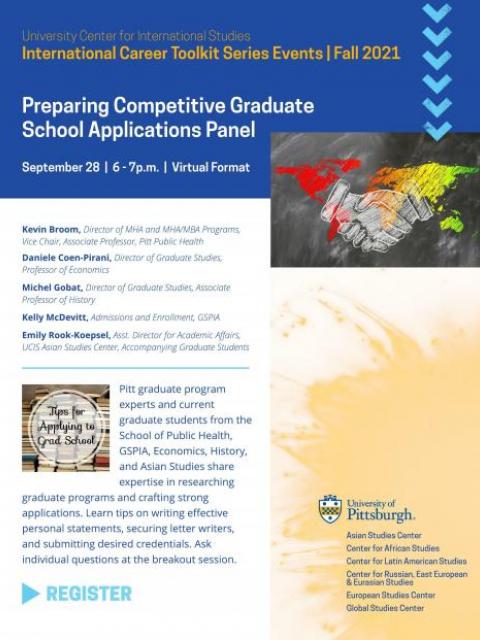
Preparing Competitive Graduate School Applications
Time:
6:00 pm to 7:00 pm
Presenter:
Various Graduate School Admissions Professionals
Location:
Zoom Discussion
Sponsored by:
Asian Studies Center, Center for African Studies, Center for Latin American Studies, Center for Russian East European and Eurasian Studies, European Studies Center and Global Studies Center
Contact:
Angela Illig
Contact Phone:
412-726-7230
Contact Email:
ami17@pitt.edu
Preparing Competitive Graduate School Applications Panel
28th, 6pm-7pm, Virtual Format
Pitt graduate program experts and current graduate students from the School of Public Health, GSPIA, Economics, History, and Asian Studies share expertise in researching graduate programs and crafting strong applications. Learn tips on writing effective personal statements, securing letter writers, and submitting desired credentials. Ask individual questions at the breakout session.
Dr. Kevin Broom, Director of MHA and MHA/MBA Programs, Vice Chair, Associate Professor, Pitt Public Health
Dr. Daniele Coen-Pirani, Director of Graduate Studies, Professor of Economics
Dr.Michel Gobat , Director of Graduate Studies, Associate Professor of History
Ms. Kelly McDevitt, Admissions and Enrollment, GSPIA
Dr. Emily Rook-Koepsel, Asst. Director for Academic Affairs, UCIS Asian Studies Center
Accompanying Graduate Students
To Register:
https://pitt.zoom.us/meeting/register/tJEuc-qsrj8uG9ZHyZhsVWeV6YftmvOBHyxC
Sponsored by: Asian Studies Center, Center for African Studies, Center for Latin American Studies, Center for Russian, East European, & Eurasian Studies, European Studies Center, and Global Studies Center
Thursday, September 23rd, 2021
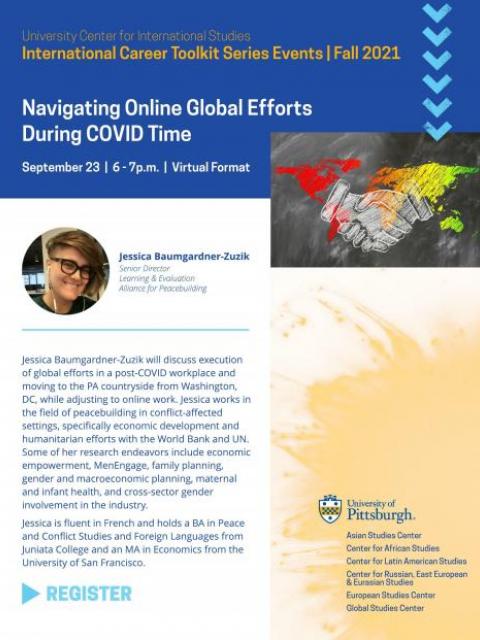
Navigating Online Global Efforts During Covid Time
Time:
6:00 pm to 7:00 pm
Presenter:
Jessica Baumgardner-Zuzik
Location:
Virtual Format - Zoom
Sponsored by:
Asian Studies Center, Center for African Studies, Center for Latin American Studies, Center for Russian East European and Eurasian Studies, European Studies Center and Global Studies Center
Contact:
Angela Illig
Contact Phone:
412-726-7230
Contact Email:
ami17@pitt.edu
Navigating Online Global Efforts During Covid Time
September 23rd, 6pm-7pm, Virtual Format
Jessica Baumgardner-Zuzik
Senior Director -Learning & Evaluation, Alliance for Peacebuilding
Jessica Baumgardner-Zuzik will discuss execution of global efforts in a post-covid workplace and moving to the PA countryside from Washington, DC, while adjusting to online work. Jessica works in the field of peacebuilding in conflict-affected settings, specifically economic development and humanitarian efforts with the World Bank and UN. Some of her research endeavors include economic empowerment, MenEngage, family planning, gender and macroeconomic planning, maternal and infant health, and cross-sector gender involvement in the industry.
Jessica is fluent in French and holds a BA in Peace and Conflict Studies and Foreign Languages from Juniata College and an MA in Economics from the University of San Francisco.
To Register: https://pitt.zoom.us/meeting/register/tJ0qduyvqD4uH9LdtI6bVecYsWVAPdKaIDhL
Sponsored by: Asian Studies Center, Center for African Studies, Center for Latin American Studies, Center for Russian, East European, & Eurasian Studies, European Studies Center, and Global Studies Center
Tuesday, September 21st, 2021
Conversations on Europe: Black, Red, Green: What to Expect in the German Federal Election
Time:
12:00 pm
Presenter:
Various
Location:
Zoom
Sponsored by:
European Studies Center and European Union Center of Excellence along with American Council on Germany, Jean Monnet in the USA Network, Jean Monnet Center of Excellence at Florida International University, Center for European Studies at University of Florida, European Union Center at University of Illinois Urbana-Champaign, Center for Transatlantic Studies at Georgia Tech and American University Transatlantic Policy Center
Cost:
free
Contact:
Iris Matijevic
Contact Email:
irm24@pitt.edu
On the eve of the German Federal Elections, our panel of experts will explore the issues concerning German voters, the legacy of outgoing Chancellor, Angela Merkel, and the potential impacts of this election on transatlantic relations and the European Union. Panelists: Jae-Jae Spoon, University of Pittsburgh; Marcel Lewandowsky, University of Florida; Kai Arzheimer, University of Mainz; and Jana Puglierin, European Council on Foreign Relations. Moderator: Steve Sokol, American Council on Germany.
Audience participation will be encouraged.
Panelists will be joining remotely.
Thursday, September 9th, 2021
Cities, City-Networks, and the Reception of Migrants: Focus on the European Union
Time:
4:30 pm to 5:45 pm
Location:
Zoom
Sponsored by:
European Studies Center and Global Studies Center
Contact:
Kenneth Reilly
Contact Email:
ker104@pitt.edu
Cities are terrains of social and political contestation. It is projected that 70% of the world’s population will live in cities by 2050, and cities are major engines of both economic growth and socio-economic inequality. They are central nodes in networks of translocal and transnational migration, including immigration, gentrification, and trafficking; they are at the forefront of efforts to adapt to anthropogenic climate change and address environmental injustices; they are, increasingly, arenas in which people mobilize to demand human rights to food, water, health, housing, education, and more. In this one-credit pop-up course, students will study cities around the world as sites where contemporary struggles for social justice and human dignity unfold.
Lecture open to all.
Co-Sponsored by the Global Studies Center.
Thursday, September 2nd, 2021
France Today
Time:
11:00 am
Presenter:
François Penguilly, Consul General of France
Location:
TBA
Sponsored by:
European Studies Center and European Union Center of Excellence along with Department of French & Italian
Contact:
Iris Matijevic
Contact Email:
irm24@pitt.edu
Friday, August 27th, 2021
Welcome Week: Be Global Ready
Time:
12:00 pm to 1:00 pm
Location:
Global Hub - 1st Floor Posvar Hall
Sponsored by:
Asian Studies Center, Center for African Studies, Center for Latin American Studies, Center for Russian East European and Eurasian Studies, Director's Office, European Studies Center, Global Studies Center, Global Hub, Nationality Rooms and Intercultural Exchange Programs, Office of International Services, Global Experiences Office and UCIS Engagement along with Student Affairs
Contact:
Karen Lue
Contact Email:
karen.lue@pitt.edu
Join Karen Lue, Pitt Global Hub Manager, for an information session on how you can Be Global Ready. Learn about all of the international and global opportunities Pitt has to offer: on-campus co-curricular activities, study abroad programs, international studies certificates, foreign languages, overseas internships, and more! Students looking to internationalize their Pitt experience are encouraged to attend. First and second year students are invited, and parents and family members are also welcome to attend.
Monday, August 23rd, 2021
Welcome Week: Global Carnival 2021
Time:
5:00 pm to 7:00 pm
Location:
William Pitt Union
Sponsored by:
Asian Studies Center, Center for African Studies, Center for Latin American Studies, Center for Russian East European and Eurasian Studies, European Studies Center, Global Studies Center, Global Hub, Nationality Rooms and Intercultural Exchange Programs, Office of International Services and Global Experiences Office along with Student Affairs and Office of Cross Cultural and Leadership Development
Contact:
Kyoungah Lee
Contact Email:
kyoungahlee@pitt.edu
Global Carnival is a cultural festival that brings Pitt and community together to celebrate diversity and global opportunities. Join us to learn about our international and global student organizations and departments, view performances, and taste our international food trucks!
Friday, July 30th, 2021
Summer Institute for Global Educators
Time:
(All day)
Presenter:
Susan Dawkins
Location:
Zoom
Sponsored by:
Asian Studies Center, Center for African Studies, Center for Latin American Studies, Center for Russian East European and Eurasian Studies, European Studies Center and Global Studies Center along with Institute for International Studies in Education, College in High School Program, Longview Foundation and U.S. Department of Education Title VI Program
Contact:
Susan Dawkins
Contact Phone:
4127422866
Contact Email:
susan.dawkins@pitt.edu
Thursday, July 29th, 2021
Summer Institute for Global Educators
Time:
(All day)
Presenter:
Susan Dawkins
Location:
Zoom
Sponsored by:
Asian Studies Center, Center for African Studies, Center for Latin American Studies, Center for Russian East European and Eurasian Studies, European Studies Center and Global Studies Center along with Institute for International Studies in Education, College in High School Program, Longview Foundation and U.S. Department of Education Title VI Program
Contact:
Susan Dawkins
Contact Phone:
4127422866
Contact Email:
susan.dawkins@pitt.edu
Wednesday, July 28th, 2021
Summer Institute for Global Educators
Time:
(All day)
Presenter:
Susan Dawkins
Location:
Zoom
Sponsored by:
Asian Studies Center, Center for African Studies, Center for Latin American Studies, Center for Russian East European and Eurasian Studies, European Studies Center and Global Studies Center along with Institute for International Studies in Education, College in High School Program, Longview Foundation and U.S. Department of Education Title VI Program
Contact:
Susan Dawkins
Contact Phone:
4127422866
Contact Email:
susan.dawkins@pitt.edu
Tuesday, July 27th, 2021
Summer Institute for Global Educators
Time:
(All day)
Presenter:
Susan Dawkins
Location:
Zoom
Sponsored by:
Asian Studies Center, Center for African Studies, Center for Latin American Studies, Center for Russian East European and Eurasian Studies, European Studies Center and Global Studies Center along with Institute for International Studies in Education, College in High School Program, Longview Foundation and U.S. Department of Education Title VI Program
Contact:
Susan Dawkins
Contact Phone:
4127422866
Contact Email:
susan.dawkins@pitt.edu
Monday, July 26th, 2021
Summer Institute for Global Educators
Time:
(All day)
Presenter:
Susan Dawkins
Location:
Zoom
Sponsored by:
Asian Studies Center, Center for African Studies, Center for Latin American Studies, Center for Russian East European and Eurasian Studies, European Studies Center and Global Studies Center along with Institute for International Studies in Education, College in High School Program, Longview Foundation and U.S. Department of Education Title VI Program
Contact:
Susan Dawkins
Contact Phone:
4127422866
Contact Email:
susan.dawkins@pitt.edu
Sunday, June 27th, 2021 to Saturday, July 3rd, 2021
Brussels Study Tour (2021 Cohort)
Time:
(All day)
Location:
Brussels, Belgium
Sponsored by:
European Studies Center and European Union Center of Excellence
Contact:
Samantha Moik
Contact Email:
smm302@pitt.edu
Friday, June 25th, 2021
Interdisciplinary Global Educators Working Group for K-12 Educators

Time:
10:00 am to 2:00 pm
Presenter:
David Tenorio, Assistant Professor, Department of Hispanic Languages and Literature, University of Pittsburgh
Location:
Virtual - Register Online!
Sponsored by:
Center for African Studies, Asian Studies Center, Center for Latin American Studies, Center for Russian East European and Eurasian Studies, European Studies Center and Global Studies Center along with National Consortium for Teaching about Asia (NCTA )
Have you wished for the opportunity to work with colleagues at your school to globalize a unit, lesson, or module? Are you looking for an opportunity to have your students examine political, economic, social, cultural, ecological questions from multiple lenses? Then this is a great chance to draw on the expertise of your colleagues, collaborate (and model collaborative learning for your students!), and produce a truly unique and inspired lesson plan. At the University Center for International Studies, we are excited to offer you the space and resources in this paid opportunity to do such work!
Science and French teachers might team up to offer a lesson on global warming in the francophone world; or Art, English, and Social Studies teachers might develop a unit on responses to the global refugee crisis in art and literature. We are looking forward to hearing your ideas!
What K-12 educators will receive:
· Time, space, and material support to gather with like-minded colleagues and (re)design an interdisciplinary, global unit or lesson.
· Act 48 credit hours and a $300 stipend.
· A mini-grant (up to $200) for your team to purchase curricular materials to teach your new lesson/unit.
What Pitt’s Graduate and Undergraduate Teacher Education Students will receive:
· An opportunity to observe and contribute to (re)designing an interdisciplinary, global lesson/unit.
· Tuition remission for a 1-credit course during the Summer I term is available upon request.
Logistics:
Workshop Dates: June 21, 23, 25, 2021, 10:00am – 2:00pm (lunch break from 12:00pm – 12:30pm), and new content must be taught in the 2021-2022 academic year. *Attendance at all sessions is required.
Working Group for K-12 educators: Apply as a team of 2-4 teachers from different subject areas at the same school. This opportunity is open to elementary, middle, and high school teachers. At each meeting, you will work with your teammates, receive feedback from other participants, and learn about strategies for interdisciplinary teaching. We welcome teams that include teachers, librarians, curriculum development specialists, and/or administrative personnel. Ideally, each member of the team should interact with the same group of students.
Graduate and Undergraduate Teacher Education students: This opportunity is open to current Graduate and Undergraduate Teacher Education students. You will be assigned to a team of K-12 educators currently teaching in a school working on (re)designing an interdisciplinary, global lesson/unit based on your interest in the topic/theme/discipline of available projects.
To Apply (K-12 Educators): Submit your application by May 17. Accepted applications will be notified by May 21. Direct any questions to Maja Konitzer.
To Apply (Teacher Education students): Register here. Direct any questions to Maja Konitzer.
Wednesday, June 23rd, 2021
Interdisciplinary Global Educators Working Group for K-12 Educators

Time:
10:00 am to 2:00 pm
Presenter:
David Tenorio, Assistant Professor, Department of Hispanic Languages and Literature, University of Pittsburgh
Location:
Virtual - Register Online!
Sponsored by:
Center for African Studies, Asian Studies Center, Center for Latin American Studies, Center for Russian East European and Eurasian Studies, European Studies Center and Global Studies Center along with National Consortium for Teaching about Asia (NCTA )
Have you wished for the opportunity to work with colleagues at your school to globalize a unit, lesson, or module? Are you looking for an opportunity to have your students examine political, economic, social, cultural, ecological questions from multiple lenses? Then this is a great chance to draw on the expertise of your colleagues, collaborate (and model collaborative learning for your students!), and produce a truly unique and inspired lesson plan. At the University Center for International Studies, we are excited to offer you the space and resources in this paid opportunity to do such work!
Science and French teachers might team up to offer a lesson on global warming in the francophone world; or Art, English, and Social Studies teachers might develop a unit on responses to the global refugee crisis in art and literature. We are looking forward to hearing your ideas!
What K-12 educators will receive:
· Time, space, and material support to gather with like-minded colleagues and (re)design an interdisciplinary, global unit or lesson.
· Act 48 credit hours and a $300 stipend.
· A mini-grant (up to $200) for your team to purchase curricular materials to teach your new lesson/unit.
What Pitt’s Graduate and Undergraduate Teacher Education Students will receive:
· An opportunity to observe and contribute to (re)designing an interdisciplinary, global lesson/unit.
· Tuition remission for a 1-credit course during the Summer I term is available upon request.
Logistics:
Workshop Dates: June 21, 23, 25, 2021, 10:00am – 2:00pm (lunch break from 12:00pm – 12:30pm), and new content must be taught in the 2021-2022 academic year. *Attendance at all sessions is required.
Working Group for K-12 educators: Apply as a team of 2-4 teachers from different subject areas at the same school. This opportunity is open to elementary, middle, and high school teachers. At each meeting, you will work with your teammates, receive feedback from other participants, and learn about strategies for interdisciplinary teaching. We welcome teams that include teachers, librarians, curriculum development specialists, and/or administrative personnel. Ideally, each member of the team should interact with the same group of students.
Graduate and Undergraduate Teacher Education students: This opportunity is open to current Graduate and Undergraduate Teacher Education students. You will be assigned to a team of K-12 educators currently teaching in a school working on (re)designing an interdisciplinary, global lesson/unit based on your interest in the topic/theme/discipline of available projects.
To Apply (K-12 Educators): Submit your application by May 17. Accepted applications will be notified by May 21. Direct any questions to Maja Konitzer.
To Apply (Teacher Education students): Register here. Direct any questions to Maja Konitzer.
Monday, June 21st, 2021
Interdisciplinary Global Educators Working Group for K-12 Educators

Time:
10:00 am to 2:00 pm
Presenter:
David Tenorio, Assistant Professor, Department of Hispanic Languages and Literature, University of Pittsburgh
Location:
Virtual - Register Online!
Sponsored by:
Center for African Studies, Asian Studies Center, Center for Latin American Studies, Center for Russian East European and Eurasian Studies, European Studies Center and Global Studies Center along with National Consortium for Teaching about Asia (NCTA )
Contact:
Maja Konitzer
Contact Phone:
412-726-7230
Contact Email:
majab@pitt.edu
Have you wished for the opportunity to work with colleagues at your school to globalize a unit, lesson, or module? Are you looking for an opportunity to have your students examine political, economic, social, cultural, ecological questions from multiple lenses? Then this is a great chance to draw on the expertise of your colleagues, collaborate (and model collaborative learning for your students!), and produce a truly unique and inspired lesson plan. At the University Center for International Studies, we are excited to offer you the space and resources in this paid opportunity to do such work!
Science and French teachers might team up to offer a lesson on global warming in the francophone world; or Art, English, and Social Studies teachers might develop a unit on responses to the global refugee crisis in art and literature. We are looking forward to hearing your ideas!
What K-12 educators will receive:
· Time, space, and material support to gather with like-minded colleagues and (re)design an interdisciplinary, global unit or lesson.
· Act 48 credit hours and a $300 stipend.
· A mini-grant (up to $200) for your team to purchase curricular materials to teach your new lesson/unit.
What Pitt’s Graduate and Undergraduate Teacher Education Students will receive:
· An opportunity to observe and contribute to (re)designing an interdisciplinary, global lesson/unit.
· Tuition remission for a 1-credit course during the Summer I term is available upon request.
Logistics:
Workshop Dates: June 21, 23, 25, 2021, 10:00am – 2:00pm (lunch break from 12:00pm – 12:30pm), and new content must be taught in the 2021-2022 academic year. *Attendance at all sessions is required.
Working Group for K-12 educators: Apply as a team of 2-4 teachers from different subject areas at the same school. This opportunity is open to elementary, middle, and high school teachers. At each meeting, you will work with your teammates, receive feedback from other participants, and learn about strategies for interdisciplinary teaching. We welcome teams that include teachers, librarians, curriculum development specialists, and/or administrative personnel. Ideally, each member of the team should interact with the same group of students.
Graduate and Undergraduate Teacher Education students: This opportunity is open to current Graduate and Undergraduate Teacher Education students. You will be assigned to a team of K-12 educators currently teaching in a school working on (re)designing an interdisciplinary, global lesson/unit based on your interest in the topic/theme/discipline of available projects.
To Apply (K-12 Educators): Submit your application by May 17. Accepted applications will be notified by May 21. Direct any questions to Maja Konitzer.
To Apply (Teacher Education students): Register here. Direct any questions to Maja Konitzer.
Sunday, June 20th, 2021 to Saturday, June 26th, 2021
Brussels Study Tour (2020 Cohort)
Time:
(All day)
Location:
Brussels, Belgium
Sponsored by:
European Studies Center and European Union Center of Excellence
Contact:
Samantha Moik
Contact Email:
smm302@pitt.edu
Sunday, June 13th, 2021
World Square
Time:
12:00 pm to 6:00 pm
Location:
Market Square
Sponsored by:
Asian Studies Center, Center for African Studies, Center for Latin American Studies, Center for Russian East European and Eurasian Studies, European Studies Center, Global Studies Center and Nationality Rooms and Intercultural Exchange Programs along with Welcoming Pittsburgh and Pittsburgh Downtown Partnership
Welcoming Pittsburgh and the Pittsburgh Downtown Partnership are teaming up to host World Square, a platform to celebrate, promote, and welcome our local international communities.
Friday, June 11 – Sunday, June 13, 2021
Market Square, Downtown Pittsburgh
Free admission
Hours
Friday, June 11: 5 – 10 p.m.
Saturday, June 12: 12 – 8 p.m.
Sunday, June 13: 12 – 6 p.m.
Across three days in June during the Dollar Bank Three Rivers Arts Festival, Market Square will become a showcase for businesses, artists, makers, performers, food purveyors, and more from across the various international and newcomer communities.
World Square is presented by Welcoming Pittsburgh and the Pittsburgh Downtown Partnership. For more information, visit the Pittsburgh Downtown Partnership website.
Saturday, June 12th, 2021
World Square
Time:
12:00 pm to 8:00 pm
Location:
Market Square
Sponsored by:
Asian Studies Center, Center for African Studies, Center for Latin American Studies, Center for Russian East European and Eurasian Studies, European Studies Center, Global Studies Center and Nationality Rooms and Intercultural Exchange Programs along with Welcoming Pittsburgh and Pittsburgh Downtown Partnership
Welcoming Pittsburgh and the Pittsburgh Downtown Partnership are teaming up to host World Square, a platform to celebrate, promote, and welcome our local international communities.
Friday, June 11 – Sunday, June 13, 2021
Market Square, Downtown Pittsburgh
Free admission
Hours
Friday, June 11: 5 – 10 p.m.
Saturday, June 12: 12 – 8 p.m.
Sunday, June 13: 12 – 6 p.m.
Across three days in June during the Dollar Bank Three Rivers Arts Festival, Market Square will become a showcase for businesses, artists, makers, performers, food purveyors, and more from across the various international and newcomer communities.
World Square is presented by Welcoming Pittsburgh and the Pittsburgh Downtown Partnership. For more information, visit the Pittsburgh Downtown Partnership website.
Friday, June 11th, 2021
World Square
Time:
5:00 pm to 10:00 pm
Location:
Market Square
Sponsored by:
Asian Studies Center, Center for African Studies, Center for Latin American Studies, Center for Russian East European and Eurasian Studies, European Studies Center, Global Studies Center and Nationality Rooms and Intercultural Exchange Programs along with Welcoming Pittsburgh and Pittsburgh Downtown Partnership
Cost:
Free and Open to the Public
Welcoming Pittsburgh and the Pittsburgh Downtown Partnership are teaming up to host World Square, a platform to celebrate, promote, and welcome our local international communities.
Friday, June 11 – Sunday, June 13, 2021
Market Square, Downtown Pittsburgh
Free admission
Hours
Friday, June 11: 5 – 10 p.m.
Saturday, June 12: 12 – 8 p.m.
Sunday, June 13: 12 – 6 p.m.
Across three days in June during the Dollar Bank Three Rivers Arts Festival, Market Square will become a showcase for businesses, artists, makers, performers, food purveyors, and more from across the various international and newcomer communities.
World Square is presented by Welcoming Pittsburgh and the Pittsburgh Downtown Partnership. For more information, visit the Pittsburgh Downtown Partnership website.
Friday, June 4th, 2021
What's in a Name: Breaking the Bias
Time:
12:00 pm to 1:00 pm
Location:
Zoom
Sponsored by:
Asian Studies Center, Center for Latin American Studies, Center for Russian East European and Eurasian Studies, Director's Office, European Studies Center, Global Studies Center, Global Hub, Nationality Rooms and Intercultural Exchange Programs, Office of International Services, Global Experiences Office and UCIS Engagement
Contact:
Gisselle Arce
Contact Email:
gissellearce@pitt.edu
Names carry a lot of weight, including people's opinion of you before having the chance to meet you. We will explore unconscious bias and its impacts on different aspects of life ranging from social, professional, and academic spaces.
Zoom link: https://pitt.zoom.us/j/92860659129
Learn more about the "What's in a Name?" series: https://www.globalhub.pitt.edu/programming/whats-in-a-name
Wednesday, May 26th, 2021
What's in a Name Series: A Thousand Paper Cuts
Microaggressions and Names
Time:
12:00 pm to 1:00 pm
Location:
Zoom
Sponsored by:
Center for African Studies, Asian Studies Center, Center for Latin American Studies, Center for Russian East European and Eurasian Studies, Director's Office, European Studies Center, Global Studies Center, Global Hub, Office of International Services, Global Experiences Office and UCIS Engagement
Contact Email:
karen.lue@pitt.edu
This event is part of the What's in a Name Series. What are microaggressions? How do microaggressions associated with names affect marginalized groups, and what can we do to ensure that everyone feels respected, supported, and included in our communities? In this workshop, we will discuss how to identify microaggressions and provide tools for how to address them in the context of name pronunciation.
Thursday, May 20th, 2021
JMintheUS: Pride amid Prejudice: The Impact of the First Pride in Sarajevo

Time:
3:00 pm
Location:
Zoom
Sponsored by:
European Studies Center along with University of Washington
Contact Email:
plyon@uw.edu
EU DEMOCRACY FORUM – IMAGINE THE FUTURE
Democracy cannot be taken for granted -- not in Europe, not anywhere. With this series of talks by experts on European politics and society we want to encourage discussion about the future of democracy in the European Union, its member states, and the neighborhood. As the EU Commission launches its Conference on the Future of Europe in 2021, we invite you to imagine this future with us. Our contributors will reflect on the EU’s achievements and challenges. We will hear their reflections on how to strengthen and expand democratic processes and institutions, both in Brussels and in Europe more broadly.
Thursday, May 13th, 2021
Global Knowledge and Competency in Your Career
European and Eurasian Undergraduate Research Symposium Keynote
Time:
12:30 pm
Location:
Register online via Zoom
Sponsored by:
Center for Russian East European and Eurasian Studies and European Studies Center along with Consortium for Educational Resources on Islamic Studies (CERIS)
Contact:
Susan Dawkins
Contact Phone:
4126484433
Contact Email:
sad96@pitt.edu
UCIS alumni Dr. Aaron Abbarno (Facebook) and Jessica Kuntz (Department of State) will discuss the value of global education in their professional experience in government, non-profit, and corporate sectors.
Wednesday, May 12th, 2021
Crisis and Reimagining of Democracy
European and Eurasian Undergraduate Research Symposium Keynote
Time:
11:30 am
Location:
Register online via Zoom
Sponsored by:
Center for Russian East European and Eurasian Studies and European Studies Center along with Consortium for Educational Resources on Islamic Studies (CERIS)
Contact:
Susan Dawkins
Contact Phone:
4126484433
Contact Email:
sad96@pitt.edu
Dr. Anna Grzymala-Busse (Stanford University) and Dr. Graeme Robertson (University of North Carolina) will speak on past and present challenges and developments in democracy, particularly in post-communist nations in Europe and Eurasia.
Tuesday, May 11th, 2021 to Thursday, May 13th, 2021
European & Eurasian Undergraduate Research Symposium
Time:
8:00 am to 5:00 pm
Location:
Zoom
Sponsored by:
Center for Russian East European and Eurasian Studies and European Studies Center
Contact:
Susan Dawkins
Contact Phone:
4126484433
Contact Email:
susan.dawkins@pitt.edu
The Undergraduate Research Symposium is an annual event since 2002 designed to provide undergraduate students, from the University of Pittsburgh and other colleges and universities, with advanced research experiences and opportunities to develop presentation skills. The event is open to undergraduates from all majors and institutions who have written a research paper from a social science, humanities, or business perspective focusing on the study of Eastern, Western, or Central Europe, the European Union, Russia, or Central Eurasia. The 2021 Symposium will be online.
Wednesday, May 5th, 2021
JMintheUS: Re-inventing the Transatlantic Relationship for the 21st Century

Time:
1:00 pm
Presenter:
David O'Sullivan
Location:
Zoom
Sponsored by:
European Studies Center along with University of Colorado-Boulder Colorado European Union Center for Excellence
After the difficulties of the last four years, the arrival of President Biden in the White House offers new hope for transatlantic relations. He and his very impressive team have always been committed Atlanticists. This presents a unique opportunity to redefine the relationship and, above all, to reshape it in a way which provides bulwarks against future shocks. But the challenges are considerable. On both sides of the Atlantic, domestic issues are to the fore: the pandemic, economic recovery and the need to build greater social consensus. And the US and the EU do not always share either a common analysis of global trends such as the rise of China or a common prognosis of how to respond. So, what will this new relationship look like, what will be its principal components and what are the chances of success?
This event is co-sponsored by the Santa Fe World Affairs Forum and the German American Chambers of Commerce-CO. We hope that you will join us. The Zoom meeting link will be emailed to you prior to the event after you register.
1pm EST.
#JMintheUS
Thursday, April 29th, 2021
JMintheUS: Economists, Global Travel, and German Imperial Politics

Time:
12:30 pm
Presenter:
Erik Grimmer-Solem (Wesleyan University)
Location:
Zoom
Sponsored by:
European Studies Center along with Center for European Union, Transatlantic, and Trans-European Space Studies (CEUTTSS) and Virginia Tech
Join us on April 29, 2021 when Erik Grimmer-Solem (Wesleyan University) will speak on his most recent book Learning Empire: Globalization and the German Quest for World Status, 1875-1919 (Cambridge UP, 2019). His book examines the process of German globalization---a process that began in the 1870s, well before Germany acquired a colonial empire or extensive overseas commercial interests and comes to a dramatic end with the outbreak of World War I. Structured around the figures of five influential economists who shaped the German political landscape, Learning Empire explores how their overseas experiences shaped public perceptions of the world and Germany's place in it. Looking closely at German worldwide entanglements, Learning Empire recasts how we interpret German imperialism, the origins of the First World War, and the rise of Nazism and invites reflection on the challenges of globalization in the current century.
Erik Grimmer-Solem received his D.Phil. in economic and social history from Nuffield College, Oxford University and was a postdoctoral Harper Fellow at the University of Chicago before joining Wesleyan University’s History Department in 2002. He is the author of The Rise of Historical Economics and Social Reform in Germany (Oxford UP, 2003), Learning Empire: Globalization and the German Quest for World Status, 1875-1919 (Cambridge UP, 2019), and over thirty other publications. He has received awards from the Fritz Thyssen Foundation, German Academic Exchange Service (DAAD), and Leverhulme Trust, as well as two distinguished teaching prizes from Wesleyan University. His research on the Wehrmacht’s involvement in the Holocaust was discussed in the newsweekly Der Spiegel and debated in German parliament in 2014. He is currently finishing a book on this topic entitled Operation Barbarossa, the Crimes of the Wehrmacht, and the Politics of Remembrance in Contemporary Germany.
#JMintheUS
Thursday, April 22nd, 2021
Mobility and Human Rights in European Integration: Perspectives from the Past

Time:
11:30 am to 1:00 pm
Location:
Zoom
Sponsored by:
European Studies Center along with Department of German
Contact:
Kenneth Reilly
Contact Email:
ker104@pitt.edu
Chair: John Lyon, Chair of the German Department, University of Pittsburgh
Speakers:
Schengen’ in fin de siècle Europe? Borderless Mobility in the Nineteenth Century - Jan Musekamp, DAAD Associate Professor of History, University of Pittsburgh
Salvador de Madariaga and the ‘Solidarity of Being’: Limits and potential of an imagined ‘free movement of persons’ in Europe - Cristina Blanco Sío-López, Marie Skłodowska-Curie Senior Global Fellow, University of Pittsburgh / Ca' Foscari University of Venice.
Organized by the European Studies Center and the Marie Sklodowska Curie Global Fellow in residence at the University of Pittsburgh, Cristina Blanco Sio-Lopez
A Grubhub credit will be available to the first 20 people to register (only available within the U.S.)
JMintheUS:Developing Transatlantic Digital Trade: What are the obstacles

Time:
11:00 am
Location:
Zoom
Sponsored by:
European Studies Center along with Center for European Union, Transatlantic, and Trans-European Space Studies (CEUTTSS) and Virginia Tech
Thursday, April 22, 2021, 11:00 AM – 12:30 PM EST for this event on Digital Trade and Taxation held jointly by the Center for European Union, Transatlantic, and Trans-European Space Studies and the European Parliament Liaison Office, Washington DC.
Andreas Schwab (Germany-EPP), Member of European Parliament, will open the event with a short keynote address. The subsequent panel, moderated by Besnik Pula (CEUTTSS), will will address the ways in which the rise of the digital economy has generated new questions over the governance of transatlantic trade. It features Benjamin Angel, European Commission, TAXUD; Francesco Duina, Bates College & Jean Monnet Network on Transatlantic Trade Politics; and Urška Petrovčič, of the Hudson Institute.
Digital services, e-commerce, and other technology-intensive trade in services have become critical drivers of international trade in recent decades, with
digital services assuming even greater importance to economies across the world in the Covid era. In addition to more familiar questions of data security
and privacy, the digital economy is also presenting challenges to other areas of international economic relations and governance. National differences over
taxation of digital services are also producing confrontation over competition for innovation and international market access by technology firms.
Nowhere have these issues emerged more strongly than in trade and economic relations between the United States and the European Union. In 2017, US
digital services exports amounted to over $400 billion, estimated to directly and indirectly support over 1.4 million American jobs. The EU is one of the top markets for US digital exports as well as the largest provider of digital services to the US economy. The great importance of transatlantic digital trade to the US and the EU has generated a number of critical policy issues in bilateral
economic relations, such as questions of data privacy and security, the regulation of business cross-border activities of digital service providers, and the taxation of digital services. Questions of data regulation and taxation have spilled over into issues of competition and innovation and market access for firms on both sides of the Atlantic.
#JMintheUS
Tuesday, April 20th, 2021
JMintheUS: Success and Challenges for the EU External Cultural Relations

Time:
10:30 am
Location:
Zoom
Sponsored by:
European Studies Center along with Center for European Studies at the University of Florida
Contact Email:
corie@ufl.edu
Success and Challenge for the EU External Cultural Relations with Guillaume Decot (European External Action Service), Damien Helly (Culture Solutions), Elke Selter (SOAS)
Moderator: Kristin Hausler, Center for International Law, British Institute of International and Comparative Law
Speakers will consider the possible opportunities in the EU-US relations offered by the new US presidency and the multi-year EU budget programming, including opportunities for dialogue and combined action in the field of cultural heritage in transatlantic relations and worldwide.
#JMintheUS
Friday, April 16th, 2021
JMintheUS: The demise of the left and growth of rightwing populism in Europe: Foreign policy implications

Time:
12:00 pm
Location:
Zoom
Sponsored by:
European Studies Center along with Center for European Union, Transatlantic, and Trans-European Space Studies (CEUTTSS) and Virginia Tech
Please join the Atlantic Council’s Europe Center on Friday, April 16, from 12:00 p.m. to 1:30 p.m. ET for a discussion on the decreased support for leftwing parties and the rise of rightwing populism in Europe. The event– co-sponsored by the Center for European Union, Transatlantic & Trans-European Space Studies (CEUTTSS) at Virginia Tech– will be based on Dr. Maria Snegovaya’s paper How ex-Communist left parties reformed and lost, and will explore the connection between neoliberal economic policies and the rise of rightwing populism in Europe among economically diverse social classes, as well as the foreign policy implications of this trend.
The panel will be moderated by Mr. Ben Haddad, Director, Europe Center, Atlantic Council, and will feature the author of the paper Dr. Maria Snegovaya, Research Fellow, Center for European Union, Transatlantic & Trans-European Space Studies (CEUTTSS) at Virginia Tech. The other three panelists will be Dr. Sheri Berman, Professor of Political Science, Barnard College, Columbia University; Dr. Yascha Mounk, Associate Professor of the Practice of International Affairs, School of Advanced International Studies (SAIS), Johns Hopkins University; and Dr. Dalibor Rohac, Resident Scholar, American Enterprise Institute (AEI).
A Zoom link will be sent to those who register. The event is open to the press and on the record.
Featuring
Dr. Sheri Berman, Professor of Political Science, Barnard College, Columbia University
Dr. Yascha Mounk, Associate Professor of the Practice of International Affairs, School of Advanced International Studies (SAIS), Johns Hopkins University
Dr. Dalibor Rohac, Resident Scholar, American Enterprise Institute (AEI)
Dr. Maria Snegovaya, Research Fellow, Center for European Union, Transatlantic & Trans-European Space Studies (CEUTTSS) A Jean Monnet Center of Excellence, Virginia Tech; Nonresident Fellow, Eurasia Center, Atlantic Council
Moderated by
Mr. Ben Haddad, Director, Europe Center, Atlantic Council
#JMintheUS
Thursday, April 15th, 2021
JMintheUS: The Formation and Institutionalization of New Parties in EU Member States

Time:
3:00 pm
Presenter:
Kristina Weissenbach
Location:
Zoom
Sponsored by:
European Studies Center along with University of Washington
Contact Email:
plyon@uw.edu
EU DEMOCRACY FORUM – IMAGINE THE FUTURE
Democracy cannot be taken for granted -- not in Europe, not anywhere. With this series of talks by experts on European politics and society we want to encourage discussion about the future of democracy in the European Union, its member states, and the neighborhood. As the EU Commission launches its Conference on the Future of Europe in 2021, we invite you to imagine this future with us. Our contributors will reflect on the EU’s achievements and challenges. We will hear their reflections on how to strengthen and expand democratic processes and institutions, both in Brussels and in Europe more broadly.
CoE: Creating Europe Through Creative Europe
Time:
12:00 pm to 1:30 pm
Location:
Zoom
Sponsored by:
European Studies Center
Contact:
Kenneth Reilly
Contact Email:
ker104@pitt.edu
The ESC’s 2020-21 theme, Creating Europe, explores both the political, social, cultural, and geographical forces that have given shape to contemporary Europe and also individuals who create and are creative in their daily or artistic expressions of what it means to be European.
Audience participation is encouraged.
Event information will be updated to include panelists and moderator.
The Alternative for Germany (AfD) in a European context
Time:
9:25 am to 10:40 am
Presenter:
Marcel Lewandowsky
Location:
Zoom
Sponsored by:
European Studies Center along with Department of German, Department of History and DAAD German Academic Exchange Service
For the first time after World War II, a radical right party is represented in the German federal parliament. In this regard, the Federal Republic has finally ‘caught up’ with other European countries who have witnessed the ongoing success of radical right pariahs. The presentation will analyze the ideology of the AfD in this context and reflect on the causes and consequences of its electoral success.
Marcel Lewandowsky is a DAAD Visiting Assistant Professor at the Center for European Studies, University of Florida.
Wednesday, April 14th, 2021
JMintheUS: The EU economy and the pandemic: short-term pain and long-term gain?

Time:
3:00 pm
Location:
Zoom
Sponsored by:
European Studies Center along with American University Transatlantic Policy Center, CUNY Graduate Center EU Studies Center, University of Washington, University of Colorado-Boulder Colorado European Union Center for Excellence and Virginia Tech Center for European Union
Contact:
Kenny Reilly
Contact Email:
ker104@pitt.edu
The pandemic has hit Europe hard. Tough shutdowns and social distancing measures have caused an unprecedented drop in economic contraction, while the recovery has been slowed down by the surge in new variants. Despite a rocky start, however, vaccines are now being rolled-out and the EU is starting to see the light at the end of the tunnel. Large fiscal transfers and supportive monetary policy have cushioned the economic blow and the EU economy is expected to come out of this new crisis with a few scratches, but hopefully not the deep scars that characterised the European Debt Crisis. This is also thanks to innovative tools developed by the EU to support its weakest Member States. Despite these efforts, there is a material risk that not all Member States would recover at the same pace. Through its Next Generation package the EU is aiming at boosting green and digital investments to address risks of economic divergence and fragmentation. At the same time it is preparing the EU economy for the challenges of decarbonisation and digital transformation. Join us for a webinar with Mr. Moreno Bertoldi, Mr. Kristian Orsini and Mr. Ben Carliner to discuss how the pandemic is reshaping EU economic governance and preparing Europe for the key challenges of the 21st century.
#JMintheUS
JMintheUS: PROMOTING EUROPE: FROM FILMS AND NEWSREELS TO STREAMING MEDIA 1945-2020

Time:
12:00 pm
Sponsored by:
European Studies Center along with University of North Carolina at Chapel HillCenter for European Studies A Jean Monnet Center of Excellence
After Brexit and in the middle of pandemic borders being raised, this presentation offers a historic review of the moving images of the European Project. Even as the German troops were withdrawing from occupied countries, the resistance started to produce newsreels, and this postwar media generally presented Europe as a project of hope for the future. As the 50s began the European project gained momentum and the work of promoting Europe extended into short film, documentary and even feature film. With the establishment of the European Community new resources for media production emerged along with a more organized European information policy. Nevertheless national, regional and private production contributed visual material to the European project. And in the critical spirit of the 1960s and 1970s media projects started to explore the more difficult aspects of European open markets like unemployment and labor migration.
From surrealist Italian bureaucrats, to radioactive French scientists, to Churchill’s pro-Europeanism, these projects offer often surprising insights. Reviewing this work we not only see the struggles of the European project, but we follow changes in format and technology. Newsreels gave way to television style reporting give way to the satellite and streaming distribution of the European Commission’s Audiovisual Services.
This presentation will review the history of the moving images of Europe from those early postwar days to the present. It will rely on clips to provide the audience a chance to see for themselves. And it will offer a set of links to foster further viewing and exploration.
Monday, April 12th, 2021
2021 Euro Challenge
Regional Competition
Time:
9:00 am
Sponsored by:
European Studies Center and European Union Center of Excellence
Contact:
Samantha Moik
Contact Email:
smm302@pitt.edu
The Euro Challenge is a national competition for cash prizes where 9th and 10th grade high school students test their knowledge and understanding of the European economy and the Euro, the currency shared by many of the 28 countries of the European Union. The European Studies Center is proud to host the Western Pennsylvania regional competition for Euro Challenge at the University of Pittsburgh.
This year's competitions will be held virtually. The top team(s) from the regional competition will advance to the national competition.
To learn more about Euro Challenge and register for the 2021 competition, please visit www.euro-challenge.org.
Thursday, April 8th, 2021
JMintheUS: The Role of lifelong learning, languages, and trainings in transatlantic work contexts

Time:
2:00 pm
Location:
Zoom
Sponsored by:
European Studies Center along with Miami-Florida Jean Monnet European Union Center of Excellence
This panel promotes and discusses the need for educational work components, such as life-long learning in rapidly changing fields, or European language learning, with participating European-focused language education professionals and faculty.
LOOKING BACK TO SEE BEYOND: Rediscovering empowering historical legacies on the EU’s Free Movement of Persons
Time:
12:00 pm
Location:
Zoom
Sponsored by:
European Studies Center
Contact:
Kenneth Reilly
Contact Email:
ker104@pitt.edu
This talk will explore the transnational roots, debates, and conditions for the diachronic implementation of a game-changing policy: The EU’s Free Movement of Persons. Indeed, historical analysis and the normative legacies on human mobility rights can provide a deeper understanding of European integration and of current challenges related to EU migration and asylum policymaking.
A Grubhub credit will be available to the first 20 people to register (only available within the U.S.)
Tuesday, April 6th, 2021
JMintheUS: Spotlight on the Eastern Mediterranean

Time:
2:00 pm
Location:
Zoom
Sponsored by:
European Studies Center along with American University Transatlantic Policy Center
Over the past year, the Eastern Mediterranean has become a hotbed of geopolitical tensions. Long-established local rivalries have attracted new players and have become increasingly entangled with other major disputes, including those over gas discoveries in the Eastern Mediterranean and continued instability in Libya. H.E. Alexandra Papadopoulou, Greece’s ambassador to the United States, and H.E. Marios Lysiotis, the Republic of Cyprus’ ambassador to the United States, and Matthew Palmer, Deputy Assistant Secretary at the Bureau of European and Eurasian Affairs for the US State Department, will discuss these subjects and more during a virtual conversation. SIS professor Doga Eralp will moderate the discussion, followed by a Q&A with the audience.
Event registrants will receive an email containing the Zoom webinar link.
Biographies
Ambassador Marios Lysiotis has been the Ambassador of the Republic of Cyprus to the US since September 2018. His previous roles include Diplomatic Advisor to the Minister of Defense, Ambassador to France, Ambassador to Austria, Permanent Delegate to UNESCO and OSCE, and many others.
Ambassador Alexandra Papadopoulou is the first female Ambassador of Greece to the US. Prior to that, she was also the First Female Permanent Representative of Greece to the European Union and served in other important positions, such as Head of the Diplomatic Cabinet of the Prime Minister, Director General for European Affairs/in charge of the Greek Presidency of the EU in 2014, Head of the Greek Liaison Office in Skopje and Deputy Permanent Representative of Greece to the United Nations. She also served as Head of the European Union Rule of Law Mission (EULEX) in Kosovo.
Matthew Palmer is a member of the Senior Foreign Service (class of Counselor) and serves currently as Deputy Assistant Secretary in the Bureau of European and Eurasian Affairs with responsibility for the Western Balkans and the Aegean. Previously, he was Director of the Office of South Central Europe. Earlier tours included Belgrade, Nicosia, the U.S. Mission to the United Nations, and various positions in Washington, D.C., including on the Secretary’s Policy Planning staff and at the National Security Council.
Professor Doga Eralp (moderator) is a senior professorial lecturer at American University's School of International Service. He is a scholar-practitioner of international conflict resolution with more than a decade of experience in international dialogue facilitation. His work focuses on social media and peace processes, cultures of violence, narrative mediation, collective memory, security and peace regimes, regional organizations, international mediation and democratization. Professor Eralp has also been consulting various think-tanks and international organizations such as the World Bank, NED and the UNOPS. He has a number of articles and book chapters published on the Western Balkans, Middle East, Cyprus, European Union and Turkey.
#JMintheUS
JMintheUS: Economic Inequality After the Pandemic

Time:
12:00 pm
Location:
Zoom
Sponsored by:
European Studies Center along with CUNY Graduate Center EU Studies Center
A discussion of inequalities revealed and exacerbated by the Covid-19 pandemic, the public policy tools available to ameliorate them, and the likely paths economies will take in recovery.
#JMintheUS
JMintheUS: The Human Dimension of Heritage in the EU

Time:
10:30 am
Location:
Zoom
Sponsored by:
European Studies Center along with Center for European Studies at the University of Florida
Contact Email:
corie@ufl.edu
Karolina Nikielska-Sekula
Andreas Wiesand
Alexandra Xanthaki
Moderator: Andrzej Jakubowski, University of Opole & Institute of Law Studies, Polish Academy of Sciences
This panel will consider both the human rights law dimension of cultural heritage, and the role that heritage plays in protecting and realizing all human rights, comprising cultural rights. The panel will particularly refer to the protection of cultural rights of minorities, Indigenous peoples, and migrants.
#JMintheUS
Friday, April 2nd, 2021
FLAC: Exploring Cultures and Languages Across the Curriculum: History, Pedagogy, and Practice
Time:
3:00 pm
Presenter:
Dr. Deborah Reisinger
Location:
Zoom
Sponsored by:
Asian Studies Center, Center for Russian East European and Eurasian Studies and European Studies Center
The University Center for International Studies (UCIS), with funding from Pitt?s Title VI National Resource Centers, has embarked on a four year initiative to increase the number of FLAC courses offered on campus. Dr. Deborah Reisinger?s presentation will help prospective instructors and students understand what FLAC is and why it is important. After the presentation, information about current FLAC courses at Pitt and successful strategies for developing new courses (including language ?trailers?) will be shared.
Dr. Deborah Reisinger
Associate Professor of the Practice in French, and Director of Language Outreach initiatives, Duke University
Deborah establishes connections between language proficiency and the disciplines. She is the author of numerous articles on language pedagogy, French for the Professions, and intercultural competence. She chairs the World Languages Advisory Committee to the College Board and is co-chair of the AP French Language and Culture Exam development committee.
Thursday, April 1st, 2021
Four Evenings Discussion: Bernardine Evaristo's Girl, Woman, Other (Discussion)
Four Evenings -- Global Literary Encounters
Time:
6:00 pm
Location:
Virtual - Register Online!
Sponsored by:
European Studies Center and Global Studies Center along with University Library Services
Cost:
Free and Open to Public
Contact:
Maja Konitzer
Contact Email:
majab@pitt.edu
In Conjunction with the Pittsburgh Arts & Lectures program's "Ten Evenings" series, GSC is hosting "Four Evenings" pre-lecture discussions that put prominent world authors and their work in global perspective. Open to series subscribers and the Pitt Community, these evening discussions, conducted by Pitt experts, provide additional insight on prominent writers and engaging issues.
With Girl, Woman, Other, Bernardine Evaristo became the first Black woman to win the Booker Prize for Fiction. The novel is a magnificent portrayal of the intersections of identity, across generations, in a group of Black British women. Girl, Woman, Other is a polyphonic and richly textured social novel that reminds us of all that connects us to our neighbors, even in times when we are encouraged to be split apart. The twelve central characters of this multi-voiced novel lead vastly different lives. From a nonbinary social media influencer to a 93-year-old woman living on a farm in Northern England, these unforgettable characters also intersect in shared aspects of their identities, from age to race to sexuality to class.
Tuesday, March 30th, 2021
JMintheUS: Crisis Decision-Making: How COVID-19 Has Changed the Working Methods of the EU Institutions

Time:
1:00 pm
Location:
Zoom
Sponsored by:
European Studies Center and European Union Center of Excellence along with Center for European Studies at the University of Florida
Contact:
Corinne Tomasi, Carla Ruffer
Contact Email:
corie@ufl.edu,rufferc@ufl.edu
UF Jean Monnet Chair Series - Pandemics in Europe: Political and Social Responses
The COVID-19 pandemic changed the dynamics of the EU institutions. Much attention has been paid to the functioning of the EU institutions at the highest political level, but less so at the working levels of the Council, the Commission and the European Parliament. What was the nature of EU action in this time and how well did the decision-making machinery work? This talk analyses all three main institutions by: a) describing how decisions are usually made; b) exploring how they are made in corona times; and c) assessing how well the individual institutions were equipped and able to adapt to these unusual circumstances.
#JMintheUS
JMintheUS: Politics as a Tool for Freedom and Education as a Commitment for Equality

Time:
1:00 pm
Location:
Zoom
Sponsored by:
European Studies Center along with University of Colorado-Boulder Colorado European Union Center for Excellence
The European Union is strongly committed to the idea of equal rights and respect for diversity in all its dimensions. This talk will address the gender perspective and the importance of foreign policies to strengthen strategies and measures that promote education for equality and its implications in terms of health and personal, social, cultural and economic empowerment.
The vulnerability of girls and young women requires a specific focus on gender issues to ensure access to all levels of education. Thus, education is assumed as a commitment to equality that will require a broad education for behavioral changes in relation to gender violence, involving all men, women, boys, girls and communities. It is education for lucidity and freedom.
This type of education cannot be done without politics, as the place for the formal assumptions of rationality on topics such as freedom and equality. This first and theoretical dimension will not make sense without the practical execution of action plans that must necessarily have as an ally the research that analyzes, evaluates, remakes and builds solid bases of action.
The EU has ambitious Action Plans for Gender Equality. What is often lacking is the assessment of the activities put into practice. Of course, it is important to know if the proposed activities are implemented, but equally important is that the intended outcomes are realized. We need to know whether we are going in the right direction or if a change in strategy is in order. Constant and consistent evaluation is vital to maintain the intended trajectory, keeping in mind that these strategies will have to take into account the different contexts and priorities for each country or region.
We hope that you will join us. The Zoom meeting link will be emailed to you prior to the event.
#JMintheUS
JMintheUS: Capitalist Transformations in East Central Europe since the Great Recession: What Do We Know? What Have We Missed?

Time:
11:00 am
Presenter:
Dorothee Bohle
Location:
Zoom
Sponsored by:
European Studies Center along with Virginia Tech Center for European Union
Contact:
Besnik Pula
Contact Email:
bpula@vt.edu
On March 30, 2021, Dorothee Bohle will join us to discuss "Capitalist Transformations in East Central Europe Since the Great Recession: What do We Know? What Have We Missed?"
This presentation asks three related questions:
If neoliberalism has implied the retreat of the state from economic roles, does the recent return of the state in the economy herald the end of neoliberalism?
Is there a causal rather than incidental relationship between transforming capitalism and the turn to authoritarian politics?
How do we make sense of right-wing governments' double attack on liberalism as a force of eocnomic dispossession, and simultaneously, as an advocate of political emancipation of women, ethnic and sexual minorities, and migrants?
Bohle is Professor and Chair in Social and Political Change in the Department of Political and Social Sciences at the European University Institute, Florence.
Learn More and Register Here https://virginiatech.zoom.us/webinar/register/WN_04FfAuMoQkKAdiMyoh5G6w
JMintheUS: European Union-China Relations

Time:
9:40 am
Location:
Zoom
Sponsored by:
European Studies Center along with University of Miami Jean Monnet Chair/EU Center
Dina Moulioukova is a Lecturer of International Studies and Master of International Administration at the University of Miami where she teaches courses on security. Dina has completed her Ph.D. at the University of Miami with focus on innovative approaches to security studies. Prior to her studies at UM, Dina received her Master of Law degree law (LL.M.) at the University of Cambridge with focus on international law and J.D. from Kazan State University on Russian civil law and international law in Russia. Her current research concentrates on different aspects of Russian foreign policy and security, with special emphasis on Russia’s relations with the European Union, Russia’s energy security and geopolitical competition between the West and rising powers in Africa and Latin America. Dina has also widely published on the topics of her research and is currently working on finalizing her book. In addition to her academic interests, she has been engaged in a number of US Agency for International Development and Library of Congress’ projects on post-Soviet space and has served as an expert in roundtable discussions by Council on Foreign Relations and USSOUTHCOM.
#JMintheUS
Thursday, March 25th, 2021
JMintheUS: European Union relations with its Southern Neighbors

Time:
9:40 am
Location:
Zoom
Sponsored by:
European Studies Center along with University of Miami Jean Monnet Chair/EU Center
Francisco Acosta Soto has been an EU official since 1993. He has been involved in EU external relations since 2000, particularly in the Middle East and in Latin America where he has served at the EU Delegations in Lebanon and Peru. From 2010 to 2016, he served as Head of the Latin American Council of the European Union External Action Service (EEAS) as well as Chairman of the EU Council Working Group on Latin America and the Caribbean responsible for Regional Affairs at the Americas Department. From 2016-2017, he served as European Union Fellow in Residence at the University of Miami European Union Center. Since then, he has been serving as Deputy Head of Mission for the Delegation of the European Union to Tunisia.
Wednesday, March 24th, 2021
JMintheUS: European Union-Middle East Relations in a Changing World

Time:
9:00 am to 2:30 pm
Location:
Zoom
Sponsored by:
European Studies Center along with Miami-Florida Jean Monnet European Union Center of Excellence
Contact Email:
thielm@fiu.edu calyc@fiu.edu
This conference will examine the opportunities and constraints that exist for the EU to maintain and expand diplomatic and commercial relations with the Middle East, while seeking to preserve the transatlantic partnership and to promote global stability. The conference will explore the ways in which bilateral relations are vital to both regions’ geostrategic and economic interests, and how security, human rights, refugee and other issues produce a complex interrelationship. 3 virtual panels with top scholars in this area shed light on the historical context, on joint issues of concern, and on the geopolitics in which EU-Middle East relations are embedded relations.
Program
9:00 a.m. - 10:30 a.m. History and Background of EU-Middle East Relations
Panel 1 addresses the histories and legacies of bilateral relations between Europe and the Middle East.
10:45 a.m. - 12:15 p.m. Contemporary Issues in EU-Middle East Relations
Panel 2 focuses on contemporary cultural, economic and political issues in bilateral relations.
1:00 p.m. - 2:30 p.m. The Geopolitics of EU-Middle Eastern Relations
Panel 3 assesses bilateral relations between Europe and the Middle East in light of the rise of other global powers.
#JMintheUS
Saturday, March 20th, 2021
Loos and Pilsen: Exploring the Secret of Adolf Loos’ Pilsen Interiors Accompanied by Swing
Time:
7:00 pm
Presenter:
Miroslav Konvalina, Director, Czech Center, New York
Location:
Online
Sponsored by:
Center for Russian East European and Eurasian Studies and European Studies Center along with Department of Slavic Languages & Literatures, Slovak Studies Program, Ph. Program in Critical European Culture Studies, Humanities Center and Czechoslovak Studies Association; Slovak Studies Association; National Slovak Society
Contact:
Sera Passerini
Contact Email:
smp125@pitt.edu
The Czech Center New York is delighted to introduce a multi-media exhibition project, which aims to present Adolf Loos’ unique interior design work as a result of the architect’s long-term activity in Pilsen, Czech Republic. The project was initiated in 2020, marking the 150th anniversary of the birth of Adolf Loos (1870–1933), a world-renowned epitome of modern interwar architecture of Moravian descent, whose ideas and implementations influenced contemporary architecture and inspired later events and trends in contemporary architecture on an international scale.
After an introduction by Miroslav Konvalina, Director of the Czech Center New York, participants will be invited to explore the online exhibit while listening to a concert by Pilsner Jazz Band from Loos’ interior in Pilsen.
REGISTRATION LINK: https://pitt.zoom.us/meeting/register/tJwodOmrqjkuH90C8T3Y3Jtlfg-QcdxlNb0p
Transatlantic Cooperation in Pandemic Times
Keynote Address - 20th Czech and Slovak Studies Workshop
Time:
9:00 am
Presenter:
Pavol Demeš, Senior Fellow, The German Marshall Fund of the United States
Sponsored by:
Center for Russian East European and Eurasian Studies and European Studies Center along with Department of Slavic Languages and Literatures; Humanities Center; Slovak Studies Program; Matthew B. Ridgway Center for International Security; Ph.D. Program in Critical European Culture Studies and Czechoslovak Studies Association; Slovak Studies Association; National Slovak Society
Contact:
Sera Passerini
Contact Email:
smp125@pitt.edu
KEYNOTE ADDRESS
20th Czech and Slovak Studies Workshop
March 18-21, 2021
TRANSATLANTIC COOPERATION IN PANDEMIC TIMES
9:00 am (EDT) | 1:00 pm (GMT) | 2:00 pm (CET)
REGISTER: https://pitt.zoom.us/meeting/register/tJMkdu2hpj4uGdG3ZbUonmX4tSawD61rDL...
SPEAKER:
Pavol Demeš, Senior Fellow, The German Marshall Fund of the United States
DESCRIPTION:
The COVID-19 pandemic affected Europe and America in a particularly dramatic manner. Health systems, economies, and social life in the most developed countries have been going through severe tests last year. This keynote lecture will focus on the comparative aspects of the COVID-19 crisis in Europe and the United States, look at its impact on transatlantic relations, and bring examples of cooperation in combating this global pandemic.
BIO:
Pavol Demeš is a well-known Slovak expert on international relations and civil society, an author, and a photographer. Prior to the Velvet Revolution, Demeš was a bio-medical researcher at Comenius University in Bratislava. He is a graduate of Charles University in Prague. After democratic changes in 1989, he served in the Slovak government and was the co-founder of the Slovak Academic Information Agency-Service Center for the Third Sector, a leading NGO in the country. Appointed first to the Ministry of Education, he was later named Minister of International Relations (1991-2) and served subsequently as the Foreign Policy Advisor to the President of the Slovak Republic Michal Kovac (1993-1997). In 1999, he was awarded a six-month public policy research fellowship at the Woodrow Wilson Center in Washington D.C. From 2000-2010, he was the Director for Central and Eastern Europe for the German Marshall Fund of the US-based in Bratislava. Currently, he is a non-resident senior fellow with GMFUS and an external advisor to the Slovak Ministry of Foreign Affairs. He has his own program on international relations and diplomacy on an Internet TV of the Slovak Press Agency. He published several books and numerous articles. Demeš has served on boards of domestic and international non-profit organizations, among others: the European Foundation Center, the European Cultural Foundation, the European Council on Foreign Relations, and the European Endowment for Democracy. He played important role in the EU's civil society development program in Slovakia and democratization efforts in the Balkans and Eastern Partnership countries.
Selected Awards:
The EU-US Democracy and Civil Society Award (1998), the USAID Democracy and Governance Award (1999), a six-month public policy research fellowship at the Woodrow Wilson Center in Washington D.C. (1999), Royal Dutch decoration Knight of the Order of Orange
Nassau (2005), Yugoslav Star of First Class (2005), South-East Europe Media Organization Human Rights Award (2009), and the Medal of Honor from the Friends of Slovakia (2011).
The full conference program will be available here: https://www.ucis.pitt.edu/creees/visitors/czech-slovak-workshop.
Friday, March 19th, 2021
Iconography and Andy Warhol
Time:
7:00 pm
Presenter:
Various
Location:
Online
Sponsored by:
Center for Russian East European and Eurasian Studies and European Studies Center along with Department of Slavic Languages and Literatures; Slovak Studies Program; Humanities Center; Ph.D. Program in Critical European Culture Studies and Czechoslovak Studies Association; Slovak Studies Association; National Slovak Society
Contact:
Sera Passerini
Contact Email:
smp125@pitt.edu
The artist, revolutionary, and cult leader of the Pop Art movement, Andy Warhol masterfully explored the relationship between artistic expression, advertising, and celebrity culture through his legendary depictions of cultural icons while constructing his own public persona and artistic mystique in the most politically-charged, creative, and expressive periods of the 20th century. The son of Carpatho-Rusyn immigrants and a devout Byzantine Catholic, Andy Warhol was deeply influenced by a rich cultural heritage in which icons are experienced as doorways to the sacred. Although he convincingly blurred the line between commercial and fine art, his style and technique exposed Warhol’s lifelong connection to a religious culture with which he lived.
Join us for an exploration of Byzantine iconography and Andy Warhol’s art.
REGISTRATION LINK: https://pitt.zoom.us/meeting/register/tJMkdOqqqD4iGt2a0jH6AAECzA_Gq5PoXLnE
Speakers:
Very Reverend Mitred Archpriest Marek Visnovsky
Vicar General of the Eparchy of Parma
Donald G. Warhola
Vice President, The Andy Warhol Foundation for the Visual Arts
Liaison, The Andy Warhol Museum, Pittsburgh
Thursday, March 18th, 2021
Explore the University of Pittsburgh's Nationality Rooms
Time:
7:00 pm
Presenter:
Various
Location:
Online
Sponsored by:
Center for Russian East European and Eurasian Studies and European Studies Center along with Department of Slavic Languages & Literatures, Slovak Studies Program, Humanities Center and Czechoslovak Studies Association; Slovak Studies Association; National Slovak Society
Contact:
Sera Passerini
Contact Email:
smp125@pitt.edu
Join Nationality Rooms Tour Coordinator Michael Walter for a brief tour of several Nationality Rooms, examine their decoration and interconnections, and gain insight into the origins of the Nationality Rooms Program at the University of Pittsburgh. This presentation will also share some perspectives on different Pittsburgh communities' association with their background vis-à-vis unique architectural expressions contained on Pitt's campus.
Pitt undergraduate students from Professor Jan Musekamp’s Nationalism class will continue the tour by presenting the Czechoslovak and the Austrian Nationality Rooms. They have worked in small groups, researched the history of those rooms, and analyzed how they fit into the broader concept of nationality rooms in the University of Pittsburgh’s Cathedral of Learning. As an additional step, they will present the rooms from the perspective of nationalism studies.
REGISTRATION LINK: https://pitt.zoom.us/meeting/register/tJckf-iqpjgiHNztxhjwHkif1--87n5gpmhJ
CoE: Creating Europe Through Multilingualism
Time:
12:00 pm to 1:30 pm
Location:
Zoom
Sponsored by:
European Studies Center along with University of Wisconsin-Madison European Union Center of Excellence
Contact:
Kenneth Reilly
Contact Email:
ker104@pitt.edu
This installment of Conversations on Europe is in collaboration with the Center for European Studies at the University of Wisconsin-Madison
The ESC’s 2020-21 theme, Creating Europe, explores both the political, social, cultural, and geographical forces that have given shape to contemporary Europe and also individuals who create and are creative in their daily or artistic expressions of what it means to be European.
This session will be highlighting different approaches to constructing a common European identity. Our interdisciplinary panel of experts will focus on EU language policies and multilingualism within European institutions. Join us for this virtual, interactive discussion.
Audience participation is encouraged.
Panelists:
Katerina Strani, Heriot-Watt University
Nils Ringe, University of Wisconsin-Madison
Michele Gazzola, Ulster University
Karen McAuliffe, University of Birmingham
Moderator:
Jae-Jae Spoon, University of Pittsburgh
Thursday, March 18th, 2021 to Sunday, March 21st, 2021
20th Czech and Slovak Studies Workshop, March 18-21
Time:
1:00 pm
Presenter:
Various
Location:
Online
Sponsored by:
Center for Russian East European and Eurasian Studies and European Studies Center along with Department of Slavic Languages and Literatures; Humanities Center; Slovak Studies Program; Matthew B. Ridgway Center for International Security; Ph.D. Program in Critical European Culture Studies and Czechoslovak Studies Association; Slovak Studies Association; National Slovak Society
Contact:
Sera Passerini
Contact Email:
smp125@pitt.edu
The Twentieth Annual Czech and Slovak Studies Workshop will be held virtually at the University of Pittsburgh on March 18-21, 2021. This year’s workshop will bring together an international community of researchers, faculty members, and advanced graduate students to exchange their experiences, research results, and ideas on a variety of areas ranging from literature, language, history, and the visual arts.
KEYNOTE ADDRESS
MARCH 19
9:00 am (EDT) | 1:00 pm (GMT) | 2:00 pm (CET)
Transatlantic Cooperation in Pandemic Times
Surprisingly enough, the COVID-19 pandemic affected Europe and America in a dramatic manner. Health systems, economies, and social life in the most developed countries have been going through severe tests last year. This keynote lecture will focus on the comparative aspects of the COVID-19 crisis in Europe and the United States, look at its impact on transatlantic relations, and bring examples of cooperation in combating this global pandemic.
SPEAKER:
Pavol Demeš, Senior Fellow, The German Marshall Fund of the United States
KEYNOTE ADDRESS AND ACADEMIC PROGRAM
Explore our CONFERENCE PROGRAM: https://www.ucis.pitt.edu/creees/visitors/czech-slovak-workshop.
REGISTER to attend: https://pitt.zoom.us/meeting/register/tJMkdu2hpj4uGdG3ZbUonmX4tSawD61rDLL0.
This registration is for the academic portion of the conference, including paper presentations, the keynote address, and networking events. Participation is restricted to faculty, graduate and undergraduate students, and the organizers.
Tuesday, March 16th, 2021
UCIS International Career Toolkit Series Presents:A Discussion with Shannon Kimack, FBI Employee
A Discussion with Shannon (Illig) Kimack, Federal Employee with the FBI
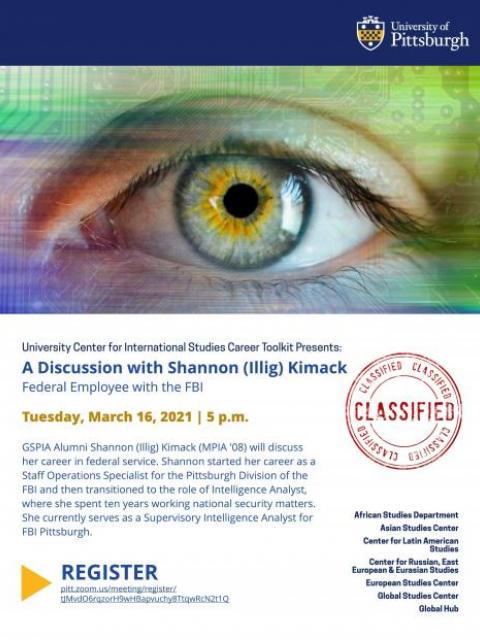
Time:
5:00 pm to 6:00 pm
Presenter:
Shannon Kimack
Location:
Zoom Discussion
Sponsored by:
Center for African Studies, Asian Studies Center, Center for Latin American Studies, Center for Russian East European and Eurasian Studies, European Studies Center, Global Studies Center and Global Hub
Contact:
Angela Illig
Contact Phone:
412-726-7230
Contact Email:
ami17@pitt.edu
A Discussion with Shannon (Illig) Kimack, Federal Employee with the FBI
Tuesday, March 16th, 5pm
Zoom Discussion
GSPIA Alumni Shannon (Illig) Kimack (MPIA '08) will discuss her career in federal service. Shannon started her career as a Staff Operations Specialist for the Pittsburgh Division of the FBI and then transitioned to the role of Intelligence Analyst, where she spent ten years working national security matters. She currently serves as a Supervisory Intelligence Analyst for FBI Pittsburgh.
Register:
https://pitt.zoom.us/meeting/register/tJMvdO6rqzorH9wHBapvuchy8TtqwRcN2t1Q
JMintheUS: European Union-Russia relations

Time:
9:30 am
Presenter:
Dr. Dina Moulioukova
Location:
Zoom
Sponsored by:
European Studies Center along with University of Miami Jean Monnet Chair/EU Center
Dina Moulioukova is a Lecturer of International Studies and Master of International Administration at the University of Miami where she teaches courses on security. Dina has completed her Ph.D. at the University of Miami with focus on innovative approaches to security studies. Prior to her studies at UM, Dina received her Master of Law degree law (LL.M.) at the University of Cambridge with focus on international law and J.D. from Kazan State University on Russian civil law and international law in Russia. Her current research concentrates on different aspects of Russian foreign policy and security, with special emphasis on Russia’s relations with the European Union, Russia’s energy security and geopolitical competition between the West and rising powers in Africa and Latin America. Dina has also widely published on the topics of her research and is currently working on finalizing her book. In addition to her academic interests, she has been engaged in a number of US Agency for International Development and Library of Congress’ projects on post-Soviet space and has served as an expert in roundtable discussions by Council on Foreign Relations and USSOUTHCOM.