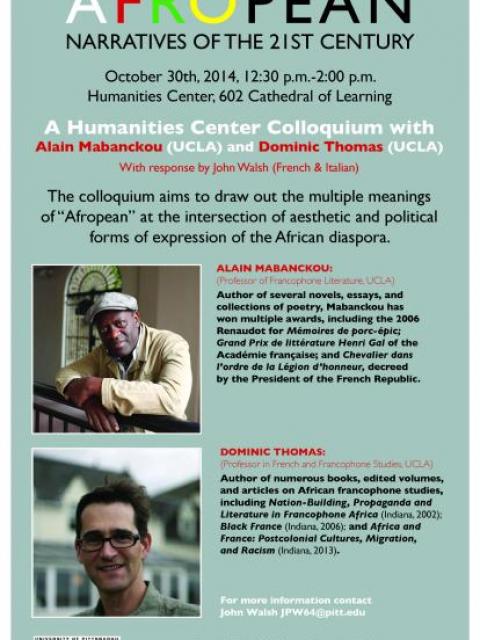
The colloquium aims to draw out the multiple meanings of "Afropean" at the intersection of aesthetic and political forms of expression of the African diaspora. Responses will be given by John Walsh, Department of French and Italian.
Thursday, October 30th, 2014
Afropean: Narratives of the 21st Century
Time:
12:30 pm to 2:00 pm
Presenter:
Alain Mabanckou (UCLA) and Dominic Thomas (UCLA)
Location:
602 Cathedral of Learning
Sponsored by:
Center for African Studies, European Studies Center, European Union Center of Excellence and Global Studies Center along with Humanities Center, Dietrich School of Arts and Sciences and Department of French and Italian
Contact Email:
frit@pitt.edu
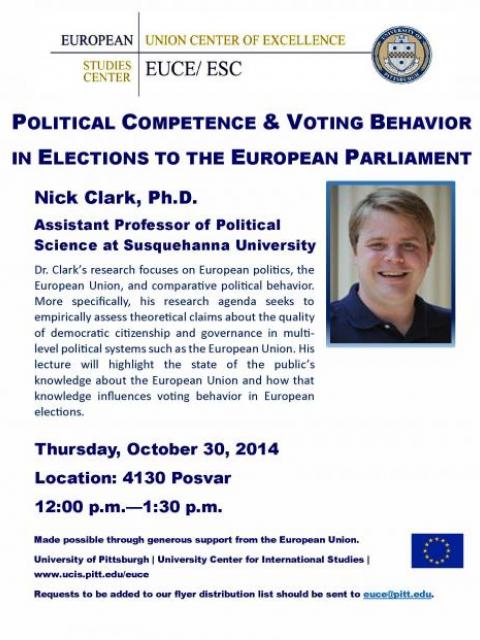
Political Competence & Voting Behavior in Elections to the European Parliament
Time:
12:00 pm to 1:00 pm
Presenter:
Professor Nick Clark, Susquehanna University
Location:
4130 Posvar Hall
Sponsored by:
European Studies Center and European Union Center of Excellence
Dr. Clark’s research focuses on European politics, the European Union, and comparative political behavior. More specifically, his research agenda seeks to empirically assess theoretical claims about the quality of democratic citizenship and governance in multi-level political systems such as the European Union. His lecture will highlight the state of the public’s knowledge about the European Union and how that knowledge influences voting behavior in European elections.
Tuesday, October 28th, 2014
The Triumph of Morality: A Tribute to the Righteous of Greece
Time:
6:30 pm to 8:00 pm
Presenter:
Dr. Yolanda Avram-Willis with special guest, Dr. Michael Naragon
Location:
McConomy Auditorium | University Center, Carnegie Mellon University Campus
Sponsored by:
Center for Russian East European and Eurasian Studies and European Studies Center
Dr. Avram-Willis is a survivor of the Holocaust in Greece.
A light reception and mini-exhibit will follow the lecture.
On October 28, 1940, the cry “OHI” (No!) resounded across all of Greece as the beginning of the Greek people’s bold resistance to the Axis ultimatum to join or be destroyed. The ensuing Nazi occupation of Greece between 1941-1944 ravaged the country and disemboweled entire villages and towns. Even though most of Greece’s Jews were murdered in the Nazi “Final Solution”, Hitler’s savagery was dealt a humiliation as Greek Christians hid, transferred, and otherwise protected as many Greek Jews as possible. From the National Resistance to Archbishop Damaskinos, regional bishops, clergy, civic leaders, and simple families, nowhere else in Nazi-occupied Southern Europe was there so much effort in protecting and saving Jews from the inhumanity of the Nazi regime and its philosophy.
On October 28th, 2014, the Greek-American and Jewish Communities of Western Pennsylvania will come together to remember and to offer a tribute to the Righteous of Greece. The story of Greek Christians protecting and saving Greek Jews remains a largely unexplored aspect of the period’s history and stands in sharp contrast to the darkness of that epoch. It is a story of morality, love, respect, sacrifice, and ultimately an expression of the humanity that binds people together.
For more information, contact info@pahellenicfoundation.org.
Friday, October 24th, 2014
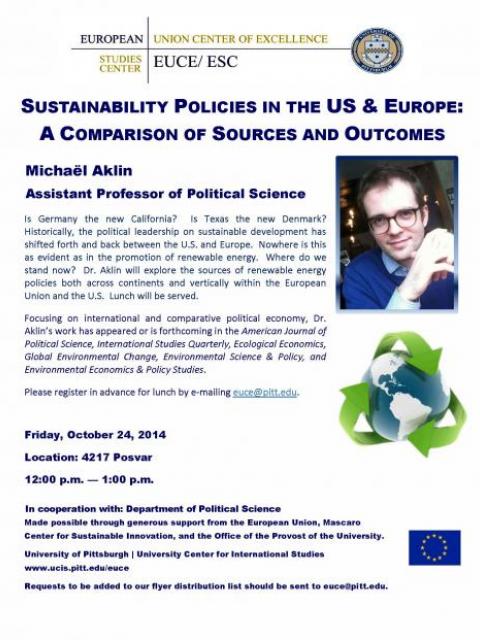
Sustainability Policies in the US and Europe: A Comparison of Sources and Outcomes
Time:
12:00 pm to 1:00 pm
Presenter:
Professor Michaël Aklin, Assistant Professor of Political Science
Location:
4217 Posvar Hall
Sponsored by:
European Studies Center and European Union Studies Association along with Department of Political Science, Mascaro Center for Sustainable Innovation and Office of the Provost
Contact Email:
euce@pitt.edu
Is Germany the new California? Is Texas the new Denmark? Historically, the political leadership on sustainable development has shifted back and forth between the U.S. and Europe. Nowhere is this as evident as in the promotion of renewable energy. Where do we stand now? Dr. Aklin will explore the sources of renewable energy policies both across continents and vertically within the European Union and the U.S.
Tuesday, October 21st, 2014
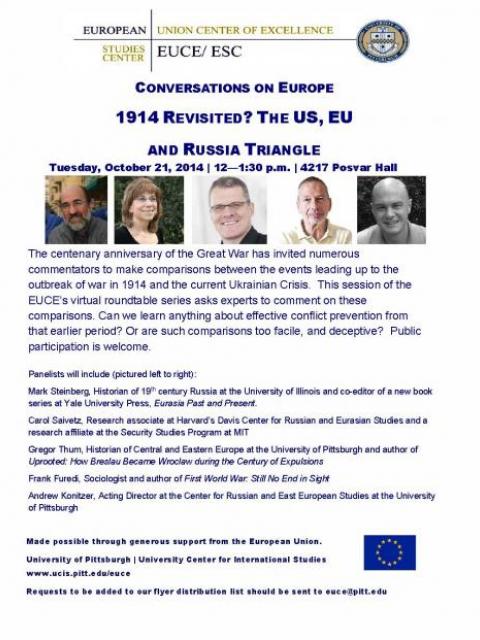
'Conversations On Europe' Videoconference: 1914 Revisited? The EU-US Russian Triangle
Time:
12:00 pm to 1:30 pm
Location:
4217 Posvar Hall
Sponsored by:
Center for Russian East European and Eurasian Studies, European Studies Center and European Union Center of Excellence
Contact Email:
euce@pitt.edu
The centenary anniversary of the Great War has invited numerous commentators to make comparisons between the events leading up to the outbreak of war in 1914 and the current Ukrainian Crisis. This session of the EUCE’s virtual roundtable series asks experts to comment on these comparisons. Can we learn anything about effective conflict prevention from that earlier period? Or are such comparisons too facile, and deceptive? Public participation is welcome.
Panelists will include:
Mark Steinberg, Historian of 19th century Russia at the University of Illinois and co-editor of a new book series at Yale University Press, "Eurasia Past and Present"
Carol Saivetz, Research associate at Harvard’s Davis Center for Russian and Eurasian Studies and a research affiliate at the Security Studies Program at MIT
Gregor Thum, Historian of Central and Eastern Europe at the University of Pittsburgh and author of "Uprooted: How Breslau Became Wrocław during the Century of Expulsions"
Frank Furedi, Sociologist and author of "First World War: Still No End in Sight"
Andrew Konitzer, Acting Director at the Center for Russian and East European Studies at the University of Pittsburgh
Thursday, October 16th, 2014
Barbara
Time:
5:30 pm
Location:
324 Cathedral of Learning
Announced by:
European Studies Center on behalf of Department of German
October 16th
Director: Christian Petzold, 2013
Popcorn and drinks provided
Winner of the Best Director prize at this year's Berlin Film Festival, the latest film from Christian Petzold (Yella, Jerichow) is a simmering, impeccably crafted Cold War thriller, starring the gifted Nina Hoss-in her fifth lead role for the director-as a Berlin doctor banished to a rural East German hospital as punishment for applying for an exit visa. As her lover from the West carefully plots her escape, Barbara waits patiently and avoids friendships with her colleagues-except for Andre (Ronald Zehrfeld) the hospital's head physician, who is warmly attentive to her. But even as she finds herself falling for him, Barbara still cannot be sure that Andre is not a spy. As her defensive wall slowly starts to crumble, she is eventually forced to make a profound decision about her future. A film of glancing moments and dangerous secrets, BARBARA paints a haunting picture of a woman being slowly crushed between the irreconcilable needs of desire and survival. Germany's official Oscar submission for Best Foreign Language Film.
Wednesday, October 15th, 2014
Inside the Brussels Complex: Pizza and Politics
Time:
1:00 pm to 2:00 pm
Presenter:
EU and the World Organization Representatives
Location:
4217 Posvar Hall
Sponsored by:
European Studies Center and European Union Center of Excellence along with The Graduate School of Public and International Affairs and EU and the World
Contact Email:
euce@pitt.edu
In this first 2014 installment of our Pizza and Politics Graduate Lecture Series, GSPIA's EU and the World Organization executive members talk about their experience interviewing policy-makers, EU civil servants, and visiting major institutions in Brussels and Luxembourg as participants in the EU in Brussels Program, co-sponsored by Pitt's EUCE/ESC & Graduate School of Public and International Affairs. Also learn about getting involved in the EU and the World Organization and about other opportunities for EU Studies at Pitt! PIZZA WILL BE SERVED!
Saturday, October 11th, 2014
French Immersion Institute
Time:
9:00 am
Sponsored by:
European Studies Center and European Union Center of Excellence
Thursday, October 9th, 2014 to Friday, October 10th, 2014
(Re)Imagining and (Re)Interpreting Spaces, Symbols and Sites The Baltic Region from the 19th to the 21st Century
Time:
5:30 pm to 6:30 pm
Location:
Thursday night: Alcoa Room, Barco Law Building; Friday day: Humanities Center
Sponsored by:
Center for Russian East European and Eurasian Studies, European Studies Center and European Union Center of Excellence along with World History Center and the Humanities Center and the European Colloquium of the History Department
Contact Email:
euce@pitt.edu
For centuries the area of today’s Estonia, Latvia, and Lithuania has been shaped by different national and ethnic groups. This symposium will examine the (re)imagining and (re)interpreting of spaces, symbols and sites in the of Baltic region from the 19th to the 21st century. Presenters will address historical difficulties with “mapping” this multi-ethnic region as well as current issues connected with the region’s recent history after the dissolution of the Soviet Union.
Thursday, October 9, 2014 (Alcoa Room, Pitt School of Law, 2nd floor)
Introduction: Ron Linden (EUCE/ESC of the University of Pittsburgh)
Keynote 5.30pm Jeffrey Sommers (University of Wisconsin-Milwaukee): Baltic Tiger or Paper Tiger? Unraveling of Europe’s Social Model in Latvia
Friday, October 10, 2014 (Humanities Center, 602 Cathedral of Learning)
Panel 1, 8.45–10.15am
Between the Russian and the German Empire: National Borders and Imaginations
Gregor Thum (University of Pittsburgh): German Culture and Russian Citizenship in Russia’s Baltic Provinces
Jörg Hackmann (University of Szczecin): Mapping the Baltic Region, 1850-1940
Panel 2, 10.30am–12.00pm
The Baltic Region after World War I: the Impact of Nationalism(s)
Adam Brode (University of Pittsburgh): Pride of Place: Symbolic Capital in Riga’s Churches
Andrejs Plakans (Iowa State University): Nationalizing Public Spaces: The WWI Latvian Riflemen in Latvian Memory
Jean-Monnet Symposium
1989 and Beyond: Contested Sites of Memory in Post-Communist Space
Panel 3, 3.00–4.30pm
Daina Stukuls Eglitis (George Washington University): The Baltic Way 1989–2014: Revolution, Remembrance, and Regret in Post-Communist Latvia
Jennie Schulze (Duquesne University): Estonia’s Bronze Soldier Crisis: Kin-state Activism and Minority Policies
Panel 4, 4.45–6.15pm
Neringa Klumbyte (Miami University): Affective Histories in Post-Soviet Lithuania
Katja Wezel (University of Pittsburgh): Riga’s “Corner House” – From a Soviet Place of Terror to a Latvian Site of Remembrance?
The symposium is free and open to the public.
Tuesday, October 7th, 2014
A Conflict of Interests: Croatia and the Balkans after EU Membership
Time:
12:00 pm to 1:30 pm
Presenter:
Andrew Konitzer, Department of Political Science/CREES
Location:
4217 Posvar Hall
Sponsored by:
Center for Russian East European and Eurasian Studies, European Studies Center and European Union Center of Excellence along with Department of Political Science
Croatia’s official government policy towards enlargement into the Western Balkans is shaped by a number of different, sometimes complimentary, sometimes conflicting factors. When it joined the EU as the Union’s 28th member in July 1, 2013, this country of 4.3 million inhabitants ranked 21st in terms of both population size and GDP making it one of the smallest countries in the organization. In foreign policy terms, such small states face the task of either quietly tending to their affairs, oftentimes under the wing of some larger power, or of attempting to capitalize on certain key issues of specific characteristics which would allow them to occupy a niche in the international system. The current Croatian government has opted for the latter strategy, attempting to capitalize on the country’s shared historical, political and cultural legacies with other non-member states in the region to position Croatia as a champion for enlargement. At the same time, Croatia’s legacies with neighboring states and its historical drive to leave the Balkans complicates its role as an advocate for EU expansion into the region. These competing legacies interact with domestic political cleavages in ways that create different pressures on political actors representing various political options. While this project focuses primarily on Croatian foreign policy, it contains many important lessons for other small current and future EU member states.
Friday, October 3rd, 2014
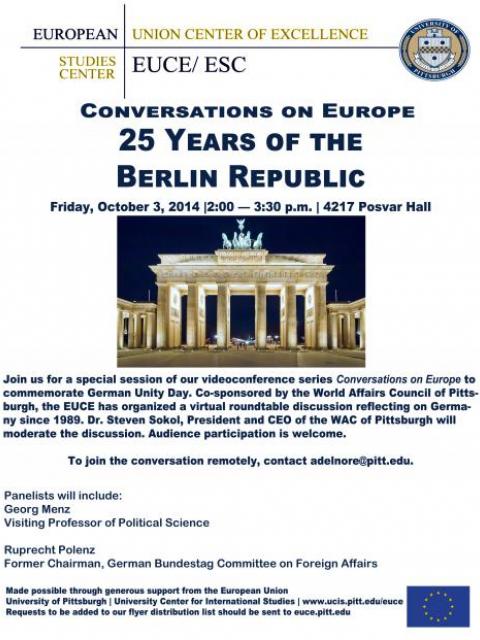
Conversations on Europe: 25 Years of the Berlin Republic
Time:
2:00 pm to 3:30 pm
Presenter:
Georg Menz, University of Pittsburgh Visiting Professor; Ruprecht Polenz, a German politician; Margaret Littler, University of Manchester; Jack Janes, American Institute for Contemporary German Studies
Location:
4217 Posvar Hall
Sponsored by:
European Studies Center and European Union Center of Excellence along with World Affairs Council of Pittsburgh
Contact Email:
euce@pitt.edu
Join us for a special session of Conversations on Europe to commemorate German Unity Day on October 3rd. Co-sponsored by the World Affairs Council of Pittsburgh, the EUCE has organized a virtual roundtable discussion reflecting on Germany since 1989. The expert panel will include Visiting Professor Georg Menz, Department of Political Science; Ruprecht Polenz, a German politician and former Chairman of the German Bundestag’s Committee on Foreign Affairs; Margaret Littler, University of Manchester; and Jack Janes, American Institute for Contemporary German Studies. Steven Sokol, President and CEO of the World Affairs Council of Pittsburgh will moderate the discussion. Audience participation is welcome.
For more information, please visit our webpage on our Conversations on Europe.
Thursday, October 2nd, 2014
Wings of Desire (Himmel über Berlin)
Time:
5:30 pm
Location:
324 Cathedral of Learning
Announced by:
European Studies Center on behalf of Department of German
Wings of Desire (Himmel über Berlin)
October 2nd
Director: Wim Wenders, 1987
Popcorn and drinks provided
“Damiel (Bruno Ganz) and Cassiel (Otto Sander) are angels who watch over the city of Berlin. They don't have harps or wings (well, they usually don't have wings) and they prefer overcoats to gossamer gowns. But they can travel unseen through the city, listening to people's thoughts, watching their actions and studying their lives. … Wim Wenders' Wings of Desire is a remarkable modern fairy tale about the nature of being alive. The angels witness the gamut of human emotions, and they experience the luxury of simple pleasures (even a cup of coffee and a cigarette) as ones who've never known them. From the angels' viewpoint, Berlin is seen in gorgeous black-and-white -- strikingly beautiful but unreal; when they join the humans, the image shifts to rough but natural-looking color, and the waltz-like grace of the angels' drift through the city changes to a harsher rhythm. Peter Falk appears as himself, revealing a secret that we may not have known about the man who played Columbo, and there's also a brief but powerful appearance by Nick Cave & the Bad Seeds. Wings of Desire hinges on the intangible and elusive, and it builds something beautiful from those qualities.
The Diplomat, the Dealer, and the Digger
Writing the History of the Antiquities trade in 19th Century Greece
Time:
4:30 pm
Presenter:
Yannis Galanakis
Location:
125 Frick Fine Arts
Sponsored by:
European Studies Center along with Department of Classics
From tomb robbers to diplomats the lucrative trade in antiquities during the 1800s involved much more than individual treasure hunters and travelers seeking souvenirs. During this period, the field of archaeology was forming as a structured discipline, grand-scale excavations were conceived and undertaken, national and imperial museums were founded, the art market became sophisticated and professional, and private collectors vied to be the owners of precious and impressive artifacts. Out of their competing interests, antiquities became commodities, symbols of power, indicators of wealth, proof of education and taste, and the focus of debates on the rights of ownership, the duties of stewardship, and the role of the archeologist. This lecture will provide a behind-the-scenes look at the antiquities trade in Greece in the 1800s starting from the ground up.
Dr. Galanakis is a lecturer in Greek Prehistory in the Faculty of Classics, and Fellow and Director of Studies in Classics at Sidney Sussex College, Cambridge University. He has participated in excavations, surveys and study seasons in Crete, the Peloponnese and Central Greece. His current publications include The Aegean World, A Guide to the Cycladic, Minoan and Mycenaean Collections in the Ashmolean Museum
This lectured is sponsored by the Department of Classics and the Archaeological Institute of America
How to Prepare for Graduate School
A Workshop of the International Career Toolkit Series
Time:
3:00 pm to 4:00 pm
Presenter:
Jonathan Harris, Anna-Maria Wallis Karnes, Patrick Cornell
Location:
WWPH 4217
Sponsored by:
Center for African Studies, Asian Studies Center, Center for Latin American Studies, Center for Russian East European and Eurasian Studies, European Studies Center, European Union Center of Excellence, Global Studies Center, International Business Center and Global Experiences Office
Cost:
Free
Contact:
Sarah Angel Markwardt
Contact Email:
saa133@pitt.edu
Are you considering graduate school?
Join us at the workshop:
How to Prepare for Graduate School
Thursday, Oct. 2nd / 3pm / WWPH 4217
This workshop will cover the ins and outs of choosing a good program, completing an impressive application, establishing communication with an advisor, as well as advice from Professor Jonathan Harris and current PhD and Master's candidates.
Tuesday, September 30th, 2014
Improvisation and the Orphic Revival in Quattrocento Florence
Time:
5:30 pm
Presenter:
James Coleman
Location:
602 Cathedral of Learning
Announced by:
European Studies Center on behalf of Humanities Center
James Coleman holds a Ph.D. in Italian from Yale University, and a B.A. in
Classics, also from Yale. He has published research on Italian literature from
the Trecento to the Settecento. His published work includes essays on
Giovanni Boccaccio's De Canaria, Angelo Poliziano and Quattrocento
Florentine humanism, Ariosto's Orlando Furioso, and the thought of
Giambattista Vico. He has forthcoming work on the humanist forger Laudivio
Zacchia, the first vernacular commentary on Lucretius's De rerum natura,
and the Renaissance reception of Boccaccio's Genealogia. He is currently
completing a book manuscript entitled Orphic Poetry in Renaissance Italy.
From All Walks of Life: Revisiting the German-Speaking Presence in Yucátan (1865-1914)
Time:
12:00 pm to 1:00 pm
Presenter:
Dr. Alma Durán-Merk, Author and Journalist
Location:
4217 Posvar Hall
Sponsored by:
Center for Latin American Studies, European Studies Center and European Union Studies Association along with University of Augsburg and Germany
Contact Email:
euce@pitt.edu
Dr. Durán-Merk comes to us as a result of Pitt’s long-standing researcher exchange agreement with Universität Augsburg in Germany, where she is a research associate at the Institute for European Ethnology and Folklore. Her primary areas of interest include migration research, visual anthropology, the anthropology of consumption, and media studies, particularly regarding relations between German and Latin American cultures. Before moving to Germany, Dr. Durán-Merk worked for several years as a television producer and writer in Monterrey, Mexico and the U.S.
Monday, September 29th, 2014
Securitizing Energy in Turkey and the EU: Cheap Talk or New Policies?”
Time:
12:00 pm to 1:00 pm
Presenter:
Dr. Basak Alpan, Assistant Professor, Department of Political Science and Public Administration/Centre for European Studies, Middle East Technical University, Turkey
Location:
4217 Posvar Hall
Sponsored by:
Center for Russian East European and Eurasian Studies, European Studies Center and European Union Studies Association
Contact Email:
euce@pitt.edu
Dr. Alpan, a visiting scholar in the Center’s International Research Scholar Exchange Scheme, will discuss how energy emerges as a practical security concept and is represented in policy discourses in Europe and Turkey. Ever since the end of Cold War and since 9/11 in particular, the concept of ‘security’ has experienced a profound conceptual change. This talk will examine the securitization of ‘energy’ within the EU and Turkey and its impact on from a comparative perspective.
Friday, September 26th, 2014
International Business: Alumni and Professionals Panel
International Career Toolkit Series

Time:
3:00 pm to 4:00 pm
Presenter:
David Brand, Melissa Amler, Timothy Kraus
Location:
WWPH 4217
Sponsored by:
Center for African Studies, Asian Studies Center, Center for Latin American Studies, Center for Russian East European and Eurasian Studies, European Studies Center, European Union Center of Excellence, Global Studies Center and International Business Center
Cost:
Free
Contact:
Sarah Angel Markwardt
Contact Phone:
724-562-6466
Contact Email:
saa133@pitt.edu
University of Pittsburgh Alumni and local international business professionals will present about employment options and important skill development for those interested in careers in international business.
Thursday, September 25th, 2014
Berlin Now: The City in the Years since 1989
Time:
1:00 pm to 2:00 pm
Presenter:
Mr. Peter Schneider, Author and Journalist
Location:
3431 Posvar Hall
Sponsored by:
Center for Russian East European and Eurasian Studies, European Studies Center, European Union Center of Excellence and Global Studies Center along with Department of German, Dean of Undergraduate Studies, Dietrich School of Arts & Sciences and Film Studies Program and the World History Center
Contact Email:
euce@pitt.edu
In honor of the 25th anniversary of the Fall of the Berlin Wall, the EUCE/ESC and the Department of German are pleased to present a group of events to commemorate the fall of the Berlin Wall. Author of the book “Berlin Now: The City After the Wall”, Peter Schneider, who moved to Berlin in 1962 and witnessed the tearing down of the Berlin Wall, visits the University of Pittsburgh to share his experiences as keen observer of Berlin. His novel Der Mauerspringer (The Wall Jumper) was first published in 1983, and has become a classic. In it he describes life in the shadow of the Wall. His new book, Berlin Now: The City after the Wall (translated by Sophie Schlondorff) is a collection of perceptive and witty essays about modern Berlin.
Wednesday, September 24th, 2014
The evolution of Albanian foreign policy since the end of Communism and prospects for the future
Time:
12:00 pm to 1:30 pm
Presenter:
Agata Biernat, PhD Student, University of Nicolaus Copernicus, Poland
Location:
4217 Posvar Hall
Sponsored by:
Center for Russian East European and Eurasian Studies, European Studies Center and European Union Center of Excellence
For many decades Albania remained a little known country not only for ordinary people in Europe or in the United States but also for different political analysts. One of the reason was that after World War II, it became a Stalinist state under Enver Hoxha, a communist dictator, and remained staunchly isolationist until its transition to democracy after 1990. With the collapse of communism Albania found itself facing a new security environment, including changing geopolitical situation in the Balkan region, so came with a new idea for international relations and began seeking closer ties and diplomatic relations with the West. That kind of diplomacy, oriented towards western countries, was supposed to be a solution to problems inherited from the past. At the same time this small Balkan country has striven to normalize ties especially with its neighbors. Regional cooperation was defined by Albanian government as an element that will boost and strengthen regional security. During these last two decades the main goal of Albanian foreign policy remains the same, which is the Euro-Atlantic integration, close relations with the United States and full membership in the European Union. However, Albania already reached the goal of the NATO membership on 1 April 2009 and also become an official candidate to join the European Union (June 2014).
The main aim of this lecture is to analyze the Albanian foreign policy since 1991 and show how it has evolved over time. To achieve this, I will focus on both domestic and international factors that influence Albanian foreign policy. The crucial part of the presentation will be an examination of current Albanian diplomacy under new government lead by Prime Minister Edi Rama, the leader of the Socialist Party.
Tuesday, September 23rd, 2014
Conversations on Europe: The Scottish Referendum: Results & Implications

Time:
12:00 pm to 1:30 pm
Presenter:
Ailsa Henderson (University of Edinburgh), Guy Peters (University of Pittsburgh), and André Lecours (University of Ottawa)
Location:
4217 Posvar Hall
Sponsored by:
European Studies Center and European Union Center of Excellence
“Should Scotland be an independent country?” In a referendum scheduled for September 18th, voters in that country will have an opportunity to vote ‘yes’ or ‘no’ on that very question. On Tuesday, Sepetember 23rd, the EUCE at Pitt will devote the first session of its award-winning Conversations on Europe virtual roundtable series to a discussion of the results of the referendum. What is the future of the Scottish National Party? How will this effect UK politics? What are the implications of the results for other nationalist movements in Europe and North America? Are there useful comparisons to be drawn between the 2014 Scottish Referendum and the 1995 Québeqois referendum? Please join us at noon in 4217 Posvar Hall for what promises to be a lively discussion. Ron Linden, Director of the EUCE and Professor of Political Science, will moderate.
Thursday, September 18th, 2014
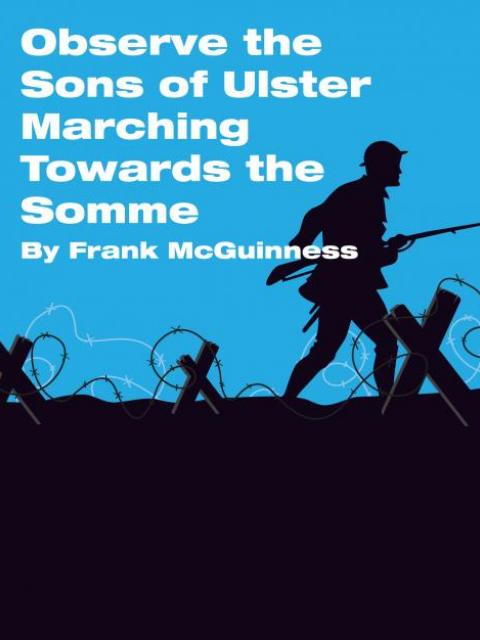
Observe the Sons of Ulster Marching towards Somme
Time:
8:00 pm to 10:00 pm
Presenter:
Written by Mr. Frank McGuinness and directed by Mr. Matt Torney
Location:
Stephen Foster Memorial (4301 Forbes Avenue)
Sponsored by:
European Studies Center along with Pittsburgh Irish & Classical Theatre
Cost:
All adult tickets are $25 ($11 discount off of regular adult ticket), Pitt student tickets are $18.
Contact Phone:
(412) 561-6000
How strong is the bond between men united by the call to arms? Eight young Irishmen, thrown together for army training during the Great War, must move beyond the troubles between Protestant and Catholic as they prepare for the Battle of the Somme. Frank McGuinness' lyrical play captures the fierce friendship and loyalty among men who must face the wickedness and wastefulness of war. The effects of WWI, launched almost 100 years ago to the day, still haunt our headlines. This is a timeless story, appropriate for ages 12+.
The EUCE/ESC is pleased to announce that PICT has a special ticket offer: EUCE night is Thursday, September 18 at 8pm. All adult tickets are $25 ($11 discount off of regular adult ticket). You can make your purchase online and enter code UNION25 to receive your $25 price for September 18, or you can call the PICT Classic Theatre at (412) 561-6000 to secure your seats. Just mention the UNION25 discount when calling. If you are a Pitt student, you always receive the $18 student price for any PICT show.
Tuesday, September 16th, 2014
Covering a Changing Europe: Reflections on the New Journalism
Time:
12:00 pm to 1:00 pm
Presenter:
Laurent Sierro, Journalist with the Swiss National New Agency & Transatlantic Media Fellow at the Center for Strategic and International Studies
Location:
4217 Posvar Hall
Sponsored by:
European Studies Center and European Union Center of Excellence
Contact Email:
euce@pitt.edu
Mr. Laurent Sierro has covered events in East and West Europe and the Middle East for ten years, most recently for the Swiss National News Agency. He will lead a discussion on the how changes in Europe and the nature of reporting have affected modern journalism.
Monday, September 15th, 2014
DAAD Information Session
Time:
4:00 pm
Presenter:
Dr. Katja Wezel, DAAD Visiting Assistant Professor
Location:
4130 Posvar
Sponsored by:
European Studies Center and European Union Center of Excellence
Dr. Katja Wezel, DAAD Visiting Assistant Professor
Students interested in study, research, or an internship experience in Germany will have the opportunity to begin investigating the numerous funding opportunities through the DAAD (German Academic Exchange Service). These grants are available to all US or Canadian citizens or permanent residents AND Foreign nationals if they have been full-time students at an accredited US or Canadian University for more than one year at the time of application. German language prerequisites vary--from none to proficient--depending on the DAAD award, applicant’s field, and plan in Germany. Grants range from Graduate Study Scholarships to Research Grants for Doctoral Candidates, Young Academics, and Scientists; and from Undergraduate Scholarships for research or internships to Science and Engineering-based internships. For more information, please direct questions re: graduate DAAD awards to Stephen Lund, slund@pitt.edu, and re: undergraduate DAAD awards to Shannon Mischler, sjm130@pitt.edu. Additional information can be found on the DAAD WEBSITE.
Sunday, September 14th, 2014
Yiddish Art Songs and Poems
Time:
2:30 pm to 4:00 pm
Presenter:
Alexei Belousov and Ruth Levin
Location:
Bellefield Auditorium
Sponsored by:
Center for Russian East European and Eurasian Studies, European Studies Center and European Union Center of Excellence along with Department of Music, Jewish Studies Program, Department of German and International Research Network City for the Cultures of Peace
Ruth Levin's concert is devoted to Yiddish art songs and poems written by Jewish poets from the Bukowina, Poland, Romania, and Russia. For the past ten years, Levin worked together with Alexei Belousov, a Russian-Jewish classical guitar concert artist in order to create a special program.
Saturday, September 13th, 2014
Neotolia Concert
Time:
6:00 pm to 8:00 pm
Location:
Frick Fine Arts Museum
Sponsored by:
Center for Russian East European and Eurasian Studies, European Studies Center, European Union Center of Excellence and Nationality Rooms and Intercultural Exchange Programs
Cost:
$25 per person, $10 for students
Contact:
Kyle Marc Bishop
Contact Phone:
412-624-6150
Contact Email:
KMB247@pitt.edu
The Turkish Nationality Room Committee is hosting a concert featuring the group NEOTOLIA, which will begin with a meet and greet reception with refreshments at 6 pm, followed by the concert at 6:30 pm. The proceeds of the concert will help fund the Turkish Room Summer Study Abroad Scholarship. Tickets are $25 per person, $10 for students, and additional donations to the scholarship fund will be accepted. To reserve seats, please send a check made payable to the University of Pittsburgh to the following address: Nationality Rooms Program/ ATTN: Turkish Room Committee/ 1209 Cathedral of Learning/ Pittsburgh, PA 15260. There will be seats available the night of the performance, but please consider making your reservations before the concert. For more information, please visit the Turkish Nationality Room facebook page.
Thursday, September 11th, 2014
Der Geteilte Himmel/Divided Heaven
Time:
5:30 pm
Location:
324 Cathedral of Learning
Sponsored by:
European Studies Center and European Union Center of Excellence along with Department of German
In honor of the 25th anniversary of the Fall of the Berlin Wall, the German Department and the EUCE have organized a film and lecture series.
The first film, Der Geteilte Himmel/Divided Heaven (1963), will be held on September 11th at 5:30pm in room 324 of the Cathedral of Learning. The film will be introduced by Prof. Halle
Pizza will be provided at the film events.
The Divided Heaven
(Der geteilte Himmel)
Director: Konrad Wolf, b/w, 113 min., 1963/64
East Germany in 1961, just before the construction of the Berlin Wall. After suffering a nervous breakdown, Rita Seidel returns to her village from the city of Halle to find peace and quiet. She recalls the past years, her love for chemist Manfred Herrfurth, her work in a railway car factory and her studies to become a teacher. There were problems with political opportunists and ideological hardliners in the factory and at university. Rita’s love affair came to an end after Manfred, bitter that uncompromising supervisors had rejected his new chemical process, fled the city for West Berlin without Rita, who chose not to join him. THE DIVIDED HEAVEN, created just a few years after the Wall was constructed, is one of the bravest movies ever to be made in the GDR – not only because of its unusual dramaturgy, but also because it seeks responsibility for conflicts in one’s own country and not with the “class enemy”.
THE EU’S NORMATIVE POWER: HUMAN RIGHTS IN KAZAKHSTAN
Time:
12:00 pm to 1:30 pm
Presenter:
Dr. Işık Kuşçu, Assistant Professor of International Relations, Middle East Technical University, and Visiting Scholar through the International Research Scholar Exchange Scheme
Location:
4217 Posvar Hall
Sponsored by:
Center for Russian East European and Eurasian Studies, European Studies Center, European Union Center of Excellence and Global Studies Center
Contact Email:
euce@pitt.edu
For the last decade there has been wide debate on European Union (EU) as a normative power actor in international politics. Visiting scholar Işık Kuşçu contributes to this debate by analyzing the impact of the EU in Kazakhstan in the field of human rights. As one of the former Soviet republics in Central Asia, Kazakhstan has emerged as an actor with a desire to win the recognition of the West as a modern, progressive power in the region. While the EU`s engagement in Central Asia does not have a long history, it considers Kazakhstan an important partner in the region. EU-Kazakhstan relations evolved around different issue areas, the promotion of human rights in Kazakhstan being one of them. This talk will examine EU policy towards Kazakhstan on human rights, as reflected in official documents, discourse used by representatives of civil society organizations, and Kazakhstani media with a focus on the impact of such policies on the country`s human rights record.
Monday, September 8th, 2014
Career Perspectives: International Risk Management
Time:
4:00 pm to 5:00 pm
Presenter:
Jason Dury, International Security and Crisis Management Leader
Location:
4217 Posvar Hall
Sponsored by:
Center for African Studies, Asian Studies Center, Center for Latin American Studies, Center for Russian East European and Eurasian Studies, European Studies Center, European Union Center of Excellence and Global Studies Center
Jason Dury is an International Security and Crisis Management leader with experience in counterterrorism, counterintelligence, Insider Threat and Corporate Espionage awareness among other areas. With over 20 years of experience, he has served in the US Intelligence Community, worked for Fortune 500® companies, and as a consultant to corporations and individuals around the world. He has successfully developed key security programs for employee travel safety, investigations, and corporate information protection to enable success in the complex international business arena. This includes kidnap and ransom management, anti-abduction and personal protection training, country risk briefs, business intelligence and due diligence, and merger and acquisition support.
Friday, September 5th, 2014
EUCE/ESC Fall Welcome Reception
Time:
3:00 pm
Location:
4130 Posvar Hall
Sponsored by:
European Studies Center and European Union Center of Excellence
Contact Email:
euce@pitt.edu
Mark your calendars! The EUCE/ESC invites students, faculty, and friends of the Center to join us at our opening reception in 4130 Posvar Hall. Learn about this year’s full schedule of events, new courses, faculty and students, and meet this year’s visitors while enjoying some light refreshments.
Friday, May 16th, 2014
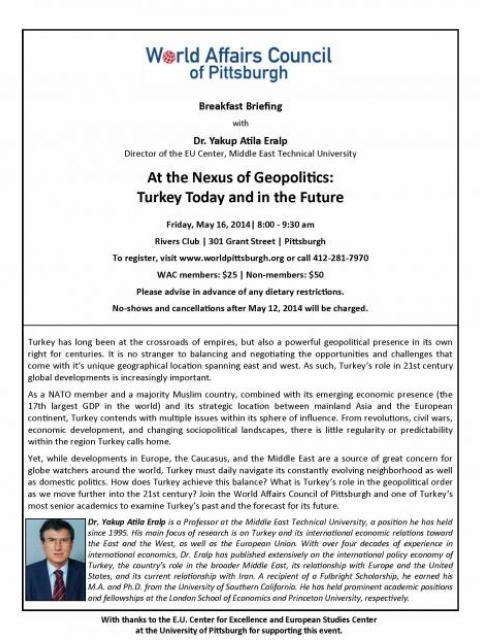
Jean Monnet Symposium. At the Nexus of Geopolitics: Turkey Today and in the Future
Time:
8:00 am to 9:30 am
Presenter:
Dr. Yakup Atila Eralp, Director of the EU Center, Middle East Technical University, Turkey
Location:
Rivers Club | 301 Grant Street | Pittsburgh
Sponsored by:
European Studies Center and European Union Center of Excellence along with World Affairs Council of Pittsburgh
Cost:
WAC members: $25 | Non-members: $50
Contact Phone:
412-281-7970
Dr. Yakup Atila Eralp is the Director of the EU Center, Middle East Technical University, and is visiting the University of Pittsburgh as a part of the International Research Exchange Scheme. This talk is sponsored by the EUCE/ESC as the 2014 Jean Monnet Symposium with thanks to the World Affairs Council for co-sponsorship.
Please advise in advance of any dietary restrictions.
To register, visit www.worldpittsburgh.org or call 412-281-7970. No-shows and cancellations after May 12, 2014 will be charged.
Monday, May 12th, 2014
Europe's Watershed Moment: What the conflict in Ukraine Means for Europe, the U.S., and Relations with Russia
Time:
12:00 pm to 1:45 pm
Presenter:
Constanze Stelzenmüller, Senior Transatlantic Fellow, German Marshall Fund of the U.S.
Location:
Rivers Club, 301 Grant Street
Announced by:
European Studies Center on behalf of World Affairs Council of Pittsburgh and American Council on Germany
Cost:
Free, with EUCE sponsorship (must confirm availability in advance)
Contact:
Kate Bowersox
Contact Email:
kal68@pitt.edu
The EUCE will host a table for faculty interested in learning more about how the conflict in Ukraine impacts European and American relations with Russia. The event should provide information useful for future research and teaching about transatlantic relations. To participate, please contact Kate Bowersox at kal68@pitt.edu.
Monday, April 28th, 2014
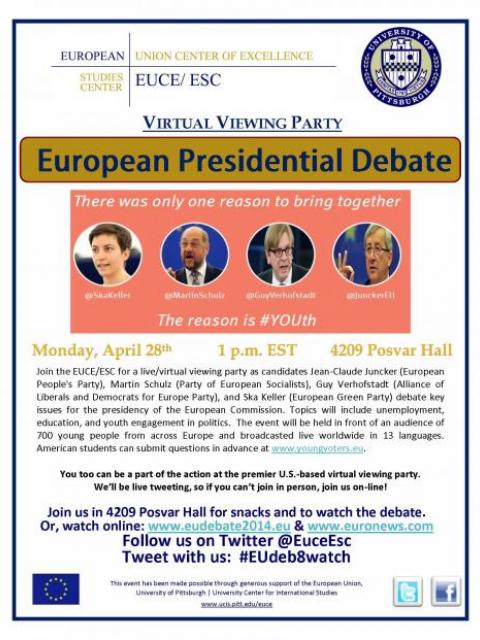
European Presidential Debate
Time:
1:00 pm to 2:00 pm
Presenter:
European Candidates
Location:
4209 Posvar Hall
Sponsored by:
European Studies Center and European Union Center of Excellence
Contact Email:
euce@pitt.eu
Join the EUCE/ESC for a live/virtual viewing party as candidates Jean-Claude Juncker (European People's Party), Martin Schulz (Party of European Socialists), Guy Verhofstadt (Alliance of Liberals and Democrats for Europe Party), and Ska Keller (European Green Party) debate key issues for the presidency of the European Commission. Topics will include unemployment, education, and youth engagement in politics. The event will be held in front of an audience of 700 young people from across Europe and broadcasted live worldwide in 13 languages. American students can submit questions in advance at www.youngvoters.eu.
You too can be a part of the action at the premier U.S.-based virtual viewing party.
We’ll be live tweeting, so if you can’t join in person, join us on-line!
Join us in 4209 Posvar Hall for snacks and to watch the debate.
Or, watch online: www.eudebate2014.eu & www.euronews.com
Follow us on Twitter @EuceEsc
Tweet with us: #EUdeb8watch
Saturday, April 26th, 2014
French Immersion
Time:
(All day)
Sponsored by:
European Studies Center
Thursday, April 17th, 2014
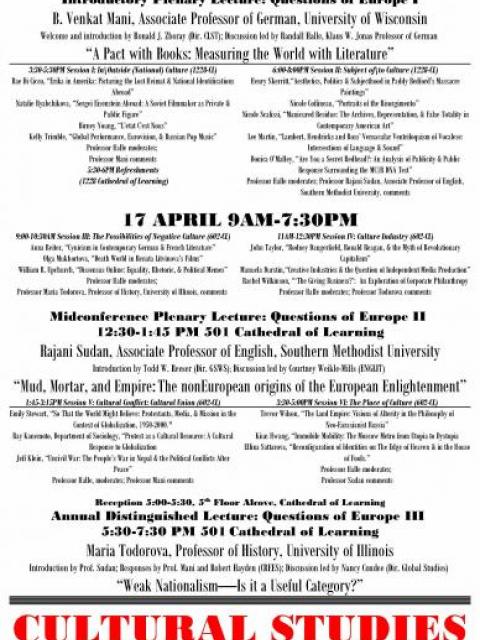
“Weak Nationalism—Is it a Useful Category?”
Time:
5:30 pm to 7:30 pm
Presenter:
Maria Todorova, Professor of History, University of Illinois
Location:
501 Cathedral of Learning
Sponsored by:
European Studies Center and European Union Center of Excellence along with Department of Sociology, Cultural Studies Program; Humanities Center; and the Departments of Communication, English, Department of German, History and Department of Slavic Languages and Literatures
Contact Email:
cultural@pitt.edu
This lecture will close the Cultural Studies Common Seminar Colloquium on “Cultural Dis/Union” and will be presented by Maria Todorova, Professor of History at the University of Illinois. An introduction will be provided by Professor Rajani Sudan, Associate Professor of English, Southern Methodist University; responses will be offered by Professor B. Venkat Mani, Associate Professor of German, University of Wisconsin and Professor Robert Hayden, Professor of Anthropology and Director of the Center for Russian and East European Studies. The discussion will be led by Nancy Condee, Professor of Slavic and Film Studies and Director of the Global Studies Center.
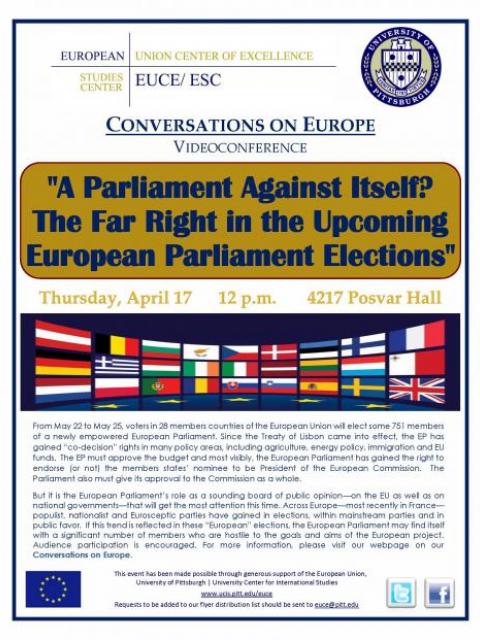
A Parliament Against Itself? The Far Right in the Upcoming European Parliament Elections
Time:
12:00 pm to 1:30 pm
Location:
4217 Posvar Hall
Sponsored by:
European Studies Center and European Union Center of Excellence
Contact Email:
euce@pitt.edu
From May 22 to May 25, voters in 28 members countries of the European Union will elect some 751 members of a newly empowered European Parliament. Since the Treaty of Lisbon came into effect, the EP has gained “co-decision” rights in many policy areas, including agriculture, energy policy, immigration and EU funds. The EP must approve the budget and most visibly, the European Parliament has gained the right to endorse (or not) the members states’ nominee to be President of the European Commission. The Parliament also must give its approval to the Commission as a whole.
But it is the European Parliament’s role as a sounding board of public opinion—on the EU as well as on national governments—that will get the most attention this time. Across Europe—most recently in France—populist, nationalist and Eurosceptic parties have gained in elections, within mainstream parties and in public favor. If this trend is reflected in these “European” elections, the European Parliament may find itself with a significant number of members who are hostile to the goals and aims of the European project.
Audience participation is encouraged. Presenters include Catherine De Vries, University of Oxford; Kostantinos Kourtikakis, University of Illinois, Urbana-Champagne; Will Daniel, Francis Marion University; Borbala Goncz, Corvinus University of Budapest.
Thursday, April 17th, 2014 to Friday, May 16th, 2014
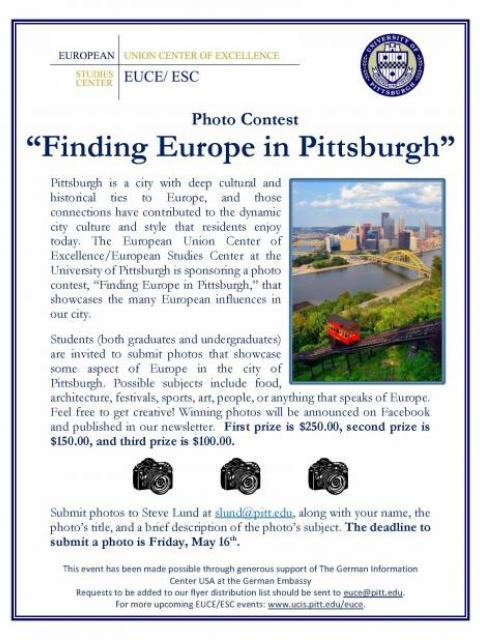
Finding Europe in Pittsburgh
Time:
12:00 pm to 5:00 pm
Sponsored by:
European Studies Center and European Union Center of Excellence
Contact:
Mr. Steve Lund
Contact Email:
slund@pitt.edu
Pittsburgh is a city with deep cultural and historical ties to Europe, and those connections have contributed to the dynamic city culture and style that residents enjoy today. The European Union Center of Excellence/European Studies Center at the University of Pittsburgh is sponsoring a photo contest, “Finding Europe in Pittsburgh,” that showcases the many European influences in our city.
Students (both graduates and undergraduates) are invited to submit photos that showcase some aspect of Europe in the city of Pittsburgh. Possible subjects include food, architecture, festivals, sports, art, people, or anything that speaks of Europe. Feel free to get creative! Winning photos will be announced on Facebook and published in our newsletter. Submit photos to Steve Lund at slund@pitt.edu, along with your name, the photo’s title, and a brief description of the photo’s subject. First prize is $250.00, second prize is $150.00, and third prize is $100.00.
Wednesday, April 16th, 2014
Videoconference about the State and Prospects of the Eurozone
Time:
3:00 pm to 3:45 pm
Presenter:
Mr. Ben Carliner, Senior Economist at the Delegation of the European Union to the USA
Location:
3431 Posvar Hall
Sponsored by:
Asian Studies Center, Center for Latin American Studies, Center for Russian East European and Eurasian Studies, European Studies Center, European Union Center of Excellence, Global Studies Center and International Business Center along with The Graduate School of Public and International Affairs
Mr. Carliner, an American economist working for the EU Delegation in Washington, D.C., will join the Pitt community via videoconference from the EU Delegation in Washington to offer a talk focused on the E.U. and the future of economic regionalism. He will also answer questions about the nature of the Eurozone crisis, its resolution and its implications for the future of the EU.
Monday, April 14th, 2014
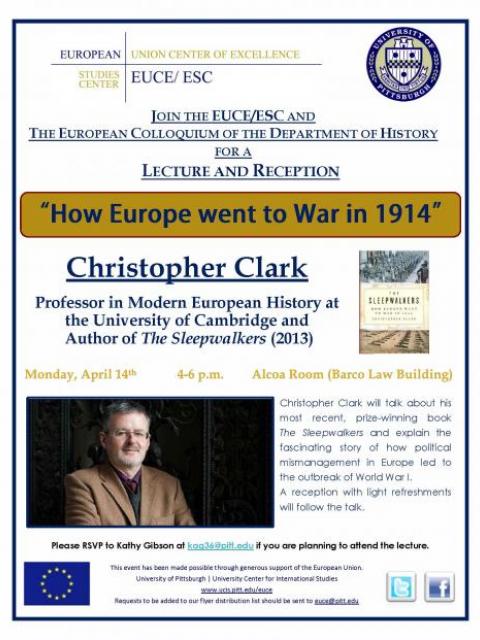
How Europe went to War in 1914
Time:
4:00 pm to 6:00 pm
Presenter:
Christopher Clark, Professor in Modern European History at the University of Cambridge and Author of The Sleepwalkers (2013)
Location:
Alcoa Room, Barco Law Building
Sponsored by:
European Studies Center and European Union Center of Excellence along with European Colloquium of the Department of History
Cost:
Free, but registration appreciated.
Contact:
Kathy Gibson
Contact Email:
kag36@pitt.edu
Christopher Clark will talk about his most recent, prize-winning book The Sleepwalkers and explain the fascinating story of how political mismanagement in Europe led to the outbreak of World War I. A reception with light refreshments will follow the talk. Please RSVP to Kathy Gibson at kag36@pitt.edu if you are planning to attend the lecture.
Saturday, April 12th, 2014
Italian Film Festival - Long Live Freedom (Viva la Libertà)
Time:
7:00 pm
Location:
Frick Fine Arts Auditorium
Announced by:
European Studies Center on behalf of Department of French and Italian
Join the Department of French and Italian and Italian Film Festival USA for the closing night of the Italian Film Festival. Then join us for a complimentary Closing Night reception afterwards in the FFA cloisters! Free and open to the public!
Long Live Freedom (Viva la Libertà), 7 p.m. April 12, Frick Fine Arts Auditorium, 650 Schenley Drive. The leader of the most notorious political opposition party mysteriously disappears. His wife and assistant turn to his identical twin brother, who has recently been released from a psychiatric hospital. Will anyone notice the switch?
Friday, April 11th, 2014
Italian Film Festival - The Venice Syndrome (Teorema Venezia)
Time:
9:00 pm
Location:
Posvar Hall 1700
Announced by:
European Studies Center on behalf of Department of French and Italian
Join the Department of French and Italian and Italian Film Festival USA for a Pittsburgh film premiere!
The Venice Syndrome (Teorema Venezia), 9 p.m. April 11, 1700 Wesley W. Posvar Hall, 230 S. Bouquet St. Venice, the world’s most beautiful city, is invaded every day by 50,000 tourists. There are only 48,000 residents, and there are fewer every year as the city becomes nearly uninhabitable. The film shows what remains of Venetian life in a requiem for a grand city.
Europe: East and West; Undergraduate Research Symposium
Time:
9:00 am to 4:00 pm
Presenter:
Selected undergraduate students
Location:
William Pitt Union, Rooms 548, 527 and 837
Sponsored by:
Center for Russian East European and Eurasian Studies, European Studies Center, European Union Center of Excellence and International Business Center
Contact:
Gina Peirce
Contact Phone:
412-648-2290
Contact Email:
gbpeirce@pitt.edu
The Undergraduate Research Symposium is an annual event since 2002 designed to provide undergraduate students, from the University of Pittsburgh and other colleges and universities, with advanced research experiences and opportunities to develop presentation skills. The event is open to undergraduates from all majors and institutions who have written a research paper from a social science, humanities, or business perspective focusing on the study of Eastern, Western, or Central Europe, the European Union, Russia, or other countries of the former Soviet Union. The Symposium is held on the University of Pittsburgh-Oakland campus.
After the initial submission of papers, selected participants were grouped into panels according to their research topics. At the symposium, participants give a 10- to 15-minute presentations based on their research to a panel of faculty and graduate students. The presentations are open to the public.
Thursday, April 10th, 2014
Italian Film Festival - The Women Workers’ War
Time:
7:00 pm
Location:
Cathedral of Learning G-24
Announced by:
European Studies Center on behalf of Department of French and Italian
Join the Department of French and Italian and Italian Film Festival USA for our exciting next installment of our annual film festival!
The Women Workers’ War, 7 p.m. April 10, Room 24, Ground Floor, Cathedral of Learning, 4200 Fifth Ave. A documentary recounting the story of two women: one who leads the longest factory sit-in by women in Italy and another who operates a factory that encourages cultural growth among the workers. This screening will feature a special appearance by director Massimo Ferrari.
Wednesday, April 9th, 2014
Celtic Interactions with Indigenous People and Slaves in the British Empire: “Critics” or “Agents” of Imperialism?
Time:
4:00 pm to 5:30 pm
Presenter:
Peter Karsten
Location:
Posvar 3703 - History Department Lounge
Announced by:
European Studies Center on behalf of Department of History
The History Department Work-in-Progress Seminar presents Peter Karsten, University of Pittsburgh. Lead discussants Van Beck Hall and Bernie Hagerty.
NOTE: Text will be circulated three weeks before event. All attending are urged to prepare to take full part in discussion.
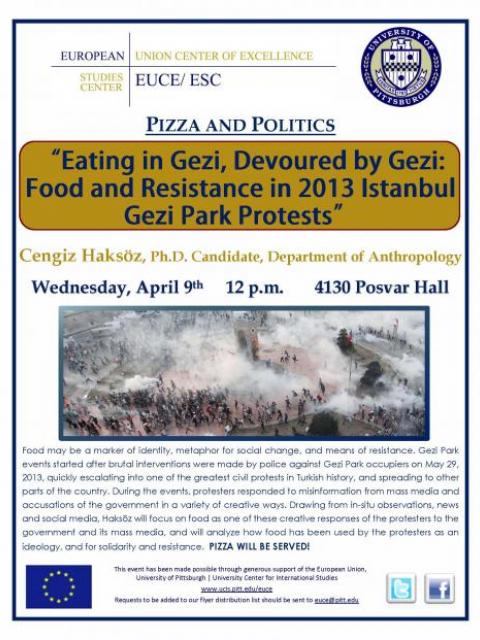
Eating in Gezi, Devoured by Gezi: Food and Resistance in 2013 Istanbul Gezi Park Protests
Time:
12:00 pm to 1:15 pm
Presenter:
Cengiz Haksöz, Ph.D. Candidate, Department of Anthropology
Location:
4130 Posvar Hall
Sponsored by:
European Studies Center, European Union Studies Association and Global Studies Center
Cost:
Free.
Contact Email:
euce@pitt.edu
Food may be a marker of identity, metaphor for social change, and means of resistance. Gezi Park events started after brutal interventions were made by police against Gezi Park occupiers on May 29, 2013, quickly escalating into one of the greatest civil protests in Turkish history, and spreading to other parts of the country. During the events, protesters responded to misinformation from mass media and accusations of the government in a variety of creative ways. Drawing from in-situ observations, news and social media, Haksöz will focus on food as one of these creative responses of the protesters to the government and its mass media, and will analyze how food has been used by the protesters as an ideology, and for solidarity and resistance. PIZZA WILL BE SERVED!
Sunday, April 6th, 2014
From Central Europe to the U.S.: A Slovak Family in the Building of its Proud Nation
Time:
2:00 pm
Presenter:
John Palka, Author, My Slovakia My Family
Location:
1700 Posvar Hall
Sponsored by:
Center for Russian East European and Eurasian Studies, European Studies Center and European Union Center of Excellence along with Department of Slavic Languages and Literatures, Pitt Student Slovak Club and Slovak Studies Program
Prof. John Palka's lecture will be based on his book that, while historical in essence, is refreshingly contemporary in its account of the past that his ancestors helped to shape. It contains vivid portraits of courage and love of freedom and country that will resonate with modern Slovak-Americans, it will connect them with the boarder story of their ancestors.
Saturday, April 5th, 2014
Italian Film Festival - The Best Offer (La Migliore Offerta)
Time:
7:00 pm
Location:
Carnegie Museum of Art Theatre
Announced by:
European Studies Center on behalf of Department of French and Italian
Join the Department of French and Italian and Italian Film Festival USA as we show our fourth Pittsburgh premiere film! La migliore offerta tells the story of a genius art expert - come enjoy it at the Carnegie Museum of Art's theater!
The Best Offer (La Migliore Offerta), 7 p.m. April 5, Carnegie Museum of Art Theatre, 4400 Forbes Ave. A world-renowned antiques auctioneer, who leads a solitary life, is appointed to oversee the sale of a beautiful heiress’ art collection and is soon engulfed by a passion that rocks his bland existence.
Friday, April 4th, 2014
Italian Film Festival - Balancing Act (Gli Equilibristi)
Time:
7:00 pm
Location:
Frick Fine Arts Building Auditorium
Announced by:
European Studies Center on behalf of Department of French and Italian
Join the Department of French and Italian and Italian Film Festival USA for the third film in the annual film festival!
Balancing Act (Gli Equilibristi), 7 p.m. April 4, Frick Fine Arts Auditorium, 650 Schenley Drive. Giulio leads a seemingly idyllic life with his wife and two children, but after making a critical error that unravels everything, he is forced to discover the thin line between well-being and poverty.
Triumphs and Frustrations: Hungarian dissidents & their Western friends, 1973-2004
Time:
3:30 pm to 5:30 pm
Presenter:
Victoria Harms
Location:
Posvar 3703 - History Department Lounge
Announced by:
European Studies Center on behalf of Department of History
University of Pittsburgh and Carnegie Mellon University Graduate Student Symposium
Presents:
Victoria Harms
University of Pittsburgh
Triumphs and Frustrations: Hungarian dissidents & their Western friends, 1973-2004
Populism & Democracy in Contemporary Italy: North League to 5 Stars Movement
Time:
1:00 pm to 2:30 pm
Presenter:
Professor Aide Esu, Distinguished Italian Fulbright Professor, Department of French and Italian
Location:
4217 Posvar Hall
Sponsored by:
European Studies Center and European Union Center of Excellence along with Department of French and Italian
Contact Email:
euce@pitt.edu
Over twenty years of political transformation, Italian populism reflects the full European panorama, moving from a local-xenophobic movement (Lega Nord) to one-man party (Berlusconi), and even to an anti-politics grass-root movement (5 Stars Movement). Professor Esu will analyze the issues, mobilization, leadership, and popular discourse characterizing these movements in order to highlight some of the key questions related to what appears to be fertile ground in Europe for popular mobilization. A reception with light refreshments will follow.
Wednesday, April 2nd, 2014
Political Decentralization in Ukraine: If done right, decentralization can be a great solution for Ukraine
Time:
2:30 pm to 4:00 pm
Presenter:
Tymofiy Mylovanov, Assistant Professor of Economics, University of Pittsburgh
Location:
4217 Posvar Hall
Sponsored by:
Center for Russian East European and Eurasian Studies, European Studies Center and European Union Center of Excellence along with Department of Economics
Contact:
Anna Talone
Contact Email:
crees@pitt.edu
Political and economic decentralization is the immediate systemic change needed for Ukraine to become a stable and healthy democracy. Democratic regional decentralization would have three important and distinct benefits for Ukraine's nascent democratic institutions.
1. It would be an effective guarantee that important local economic and social decisions are made by the people most affected by these decisions, rather than being dictated by whichever party comes to power in Kiev.
2. It would reduce the stakes in the conflict in national politics and help focus attention not on whether one region will impose its will on another, but on the urgent economic and political problems facing Ukraine.
3. A vibrant local democracy would do much to strengthen Ukraine's national political institutions and provide a forum where new local politicians can prove themselves, gain the trust of the people and get executive experience.
The lecture will discuss the advantages and the costs of decentralization in Ukraine, the challenges with implementing it politically, and will delineate the difference between decentralization and federalization proposed by Russia.
The Four Waves of Modern Terror: An Essay on Generations
Time:
12:00 pm to 1:30 pm
Presenter:
Dr. David C. Rapoport
Location:
3911 Posvar Hall
Announced by:
European Studies Center on behalf of Matthew B. Ridgway Center for International Security Studies
Contact Email:
beb38@pitt.edu
Modern terror began in the late 1870s; its distinctive features are its global character, use of explosives, and emergence and recession in the form of waves. We have experienced four waves, the “Anarchist”, “Anti-Colonial”, “New Left” and “Religious”. Each wave contains a large number of independent groups, special purposes, distinctive tactics, and a distinctive geography and has a different impact on the international state system. The overwhelming number of groups in a wave has much shorter lives than a wave does, but if a group does survive the wave it was originally associated with, it absorbs some of the features in the next wave. The first three waves lasted around 40 years or a generation by Biblical standards. If the “Religious Wave” which began in 1979 follows the course of its predecessors it should basically disappear by the 2020’s decade. If history repeats itself, a fifth one will emerge. Lunch will be provided – please RSVP to beb38@pitt.edu
Tuesday, April 1st, 2014
German Business Panel
Time:
12:15 pm to 2:30 pm
Presenter:
Jeffrey T. Deane, BKD, LLP; Robert Dehm, Embassy of the Federal Republic of Germany; Joe Peilert, VEKA Holdings; Suzi Pegg, Pittsburgh Regional Alliance
Location:
4130 Posvar Hall
Sponsored by:
European Studies Center, European Union Center of Excellence and International Business Center along with Department of German
Contact Email:
euce@pitt.edu
Given the German economy’s central role in the Euro Area, and Germany’s place as a strong business partner with the US and Pennsylvania, many people are interested in the characteristics of the German business model. Our panelists will discuss their experiences attracting German companies to the Pittsburgh region, partnering with them in transatlantic relationships, and tips for successful relationships with German companies and colleagues.
Panelists include: Jeffrey T. Deane, Managing Partner of BKD, LLP; Robert Dehm, of the Economic Department at the Embassy of the Federal Republic of Germany; Joe Peilert, President & CEO of VEKA Holdings; and Suzi Pegg, Vice President, Global Marketing, Pittsburgh Regional Alliance. Q & A will follow the presentations.
All are welcome! Lunch begins at 12:15pm, with the panel discussion to follow at 1pm.
Monday, March 31st, 2014
McLean Lecture: National Security and Intelligence in the 21st Century
Time:
6:00 pm
Presenter:
Corin R. Stone
Location:
Barco Law Building: Room 109
Announced by:
European Studies Center on behalf of School of Law
Corin R. Stone is the assistant director of national intelligence for policy and strategy in the Office of the Director of National Intelligence (ODNI). In this role, she oversees the formulation and implementation of intelligence community (IC)-wide policy and strategy on the full range of intelligence issues. She also is the ODNI lead for the closure and disposition of detainees at the Guantanamo Bay naval base and provides leadership for ODNI and IC information sharing initiatives. Before joining ODNI, Stone was an attorney adviser in the Office of the Legal Adviser at the U.S. Department of State. She served in Iraq, first as an associate general counsel in the Coalition Provisional Authority and then as the first legal adviser to U.S. Ambassador John Negroponte and the new U.S. embassy in Baghdad. While at the State Department, she also worked as an attorney adviser for the Bureau of Oceans and International Environmental and Scientific Affairs, as the special assistant to Legal Adviser William H. Taft IV, and in the state department’s legal office, where she handled international claims and investment disputes and represented the U.S. government before the Iran-United States Claims Tribunal and the Hague.
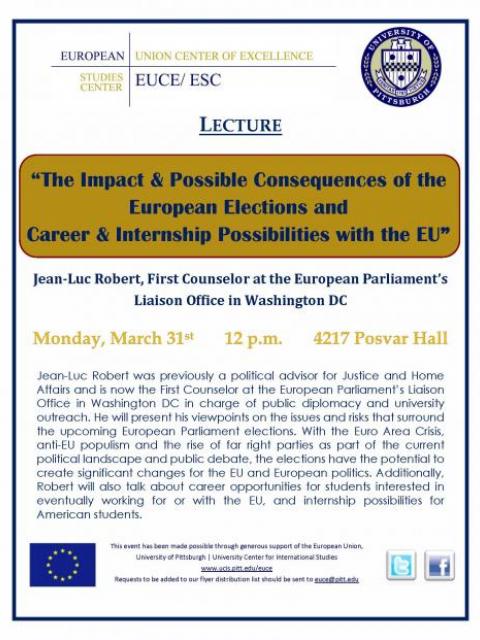
The Impact & Possible Consequences of the European Elections & Career and Internship Possibilities with the EU
Time:
12:00 pm to 1:00 pm
Presenter:
Jean-Luc Robert, First Counselor at the European Parliament’s Liaison Office in Washington DC
Location:
4217 Posvar Hall
Sponsored by:
European Studies Center, European Union Center of Excellence and Global Studies Center
Contact:
Steve Lund
Contact Email:
slund@pitt.edu
Jean-Luc Robert was previously a political advisor for Justice and Home Affairs and is now the First Counselor at the European Parliament’s Liaison Office in Washington DC in charge of public diplomacy and university outreach. He will present his viewpoints on the issues and risks that surround the upcoming European Parliament elections. With the Euro Area Crisis, anti-EU populism and the rise of far right parties as part of the current political landscape and public debate, the elections have the potential to create significant changes for the EU and European politics. Additionally, Robert will also talk about career opportunities for students interested in eventually working for or with the EU, and internship possibilities for American students.
Saturday, March 29th, 2014
Italian Film Festival - First Snowfall (La Prima Neve)
Time:
7:00 pm to 9:00 pm
Location:
Frick Fine Arts Building Auditorium
Announced by:
European Studies Center on behalf of Department of French and Italian
Join us for the second film of the Italian Film Festival! Hosted in conjunction with the Department of French and Italian and Italian Film Festival USA, we are pleased to show this Pittsburgh premiere on Pitt's campus!
First Snowfall (La Prima Neve), 7 p.m. March 29, Frick Fine Arts Auditorium, 650 Schenley Drive. Set in the beautiful Italian Alps, a fatherless 10 year old and an immigrant who just lost his wife prepare for the upcoming winter and learn to listen to each other while healing.
Status of Human Rights in Northern Ireland: State Collusion – Time for Truth
Time:
2:00 pm to 5:00 pm
Presenter:
Niall Murphy and Kevin R Winters, Members Human Rights Attorneys from Belfast, Northern Ireland
Location:
Cathedral of Learning, Room G-8
Sponsored by:
European Studies Center and European Union Center of Excellence along with Irish American Unity Conference
Cost:
Free.
Contact:
Sarah McAuliffe-Bellin
Contact Phone:
412.512.9388
Contact Email:
sarahm1916@comcast.net
Offering a presentation on long-standing human rights violations and governmental stonewalling of inquiries and reforms in Northern Ireland, human rights attorneys will discuss their experiences as well as proposals for human rights reform. Case profiles that will be discussed include the representation of victims and the reopening of inquests in the Claudy atrocity, Kingsmill, Loughlinisland massacres, and the Dublin/Monaghan Bombing, as well as investigations of sanctioned involvement of the security services in these and other high profile cases from the past 40 years. Dr. Tony Novosel, Professor of History, will provide an introduction and background on the history of collusion in Northern Ireland and its effects on both communities. An opportunity for Q & A will follow the presentation.
Thursday, March 27th, 2014
Italian Film Festival - Reality
Time:
7:00 pm to 9:00 pm
Location:
Frick Fine Arts Building Auditorium
Announced by:
European Studies Center on behalf of Department of French and Italian
Join the Department of French and Italian for the launch of their annual film festival! Held in conjunction with Italian Film Festival USA, we are pleased to showcase new premiere Italian movies in Pittsburgh! This evening we will hold a free Opening Night reception in the Frick Fine Art cloisters. Free and open to the public!
Reality, 7 p.m. March 27, Frick Fine Arts Auditorium, 650 Schenley Drive. Luciano never misses the chance to perform for his customers in the fish market. At the urging of his family, he auditions for the reality show Big Brother, forever changing his perception of reality.
Sketching Imperial Contours: Mapping Habsburg Borders in the Eighteenth Century
Time:
4:00 pm to 6:00 pm
Presenter:
Madalina Veres, University of Pittsburgh
Location:
History Department Lounge Room 3703, Posvar Hall
Sponsored by:
Center for Russian East European and Eurasian Studies and European Studies Center along with Department of History European Colloquium
The History Department Work-in-Progress Seminar presents Madalina Veres, University of Pittsburgh. Lead discussants Elspeth Martini and Katja Wezel.
NOTE: Text will be circulated three weeks before event. All attending are urged to prepare to take full part in discussion.
The Dining Gaul (And His Phrygian Dishes)
Time:
4:00 pm
Presenter:
Dr. Shannon Stewart
Location:
125 Frick Fine Arts Building
Announced by:
European Studies Center on behalf of AIA Pittsburgh Society
Contact Email:
aiapghsociety@gmail.com
Although ancient authors had little interest in recording the details of daily life of the Gauls, excavation and research has generated a large corpus of relevant data especially from Hellenistic houses (333 – 189 BCE) at Gordion, an archaeological site in central Turkey. When considered together, the evidence reveals much about food in its original quotidian context and even more about the residents themselves: what they ate and drank, how it was prepared and served, and how and why these culinary customs changed over time.
Shannon Stewart has excavated in Israel, Cyprus, Turkey and Albania. Her areas of specialization are Hellenistic pottery, the archaeology of domestic life, ”Hellenization,” and Anatolia in the First Millenium BCE.
The View from Ukraine: A Digital Video Conference with the U.S. Embassy in Kyiv
Time:
9:00 am to 10:00 am
Presenter:
Members of the Political, Economic, Defense and Public Affairs divisions of the U.S. Embassy in Kyiv
Location:
4217 Posvar Hall
Sponsored by:
Center for Russian East European and Eurasian Studies, European Studies Center and European Union Center of Excellence along with Graduate School of Public and International Affairs (GSPIA)
Contact:
Anna Talone
Contact Email:
crees@pitt.edu
Pitt students and faculty are invited to join a group of key staff members from the Political, Economic, Defense, and Public Affairs divisions of the U.S. Embassy in Kyiv for an “off-the-record” question and answer session about the ongoing crisis in Ukraine:
- Press Attaché - Embassy uses of social media tools and the role of social media throughout Ukraine’s political crisis
- Economic Officer – Economic overview
- Politico-Military Affairs Officer – Political overview
- Energy Attaché – Energy issues effecting Ukrainian sovereignty
- DTRO Attaché – 20 years of Cooperative Threat Reduction assistance in Ukraine
Wednesday, March 26th, 2014
Croatian Folk Culture in Modern Museums: from Economic to Ethnographic
Time:
12:00 pm to 1:30 pm
Presenter:
Heidi Cook, PhD candidate, History of Art and Architecture
Location:
4217 Posvar Hall
Sponsored by:
Center for Russian East European and Eurasian Studies, European Studies Center and European Union Center of Excellence along with History of Art and Architecture
Contact:
Anna Talone
Contact Email:
crees@pitt.edu
Throughout the 19th and 20th centuries, Croatian folk culture has been and continues to be used as cultural legitimization for both a Croatian nation and the integration of that nation into empires. Using documentation of historical displays of Croatian folk art in Vienna and Zagreb, this research explores the early-20th century transition of these objects from Habsburg museums of applied art to newly founded ethnographic museums after World War I. With this change of location the purpose of these collections changed from promoting the economic products of cottage industry and a unified imperial identity to scientific classification for nationalist projects. However, in the underindustrialized Croatian lands, a Habsburg-influenced economic interest in folk art lingered late into the interwar period.
Pizza and Politics: European Elections for National Parties: Electoral Goals and Candidate Selection in the Parties of Europe
Time:
12:00 pm to 1:00 pm
Presenter:
Andrea Aldrich, Ph.D. Candidate, Department of Political Science
Location:
4209 Posvar Hall
Sponsored by:
European Studies Center and European Union Center of Excellence
Cost:
Free.
Contact Email:
euce@pitt.edu
Join the European Union Center of Excellence and European Studies Center for a lunchtime discussion as Andrea Aldrich, Ph.D. Candidate in the Department of Political Science, presents her research on the national European parties and their relationships with European Elections and Members of the European Parliament. Assuming that political parties have office, vote, and policy seeking goals in any electoral contest, she will argue these goals in European elections are defined by their ability to seize opportunities in national politics and their preferences for European integration. These goals then dictate the choice made for candidate selection for the European Parliament and are able to explain why variation exists among MEPs with respect to their past political experience, party service, European institutional leadership experience, and substantive expertise. In doing so, it highlights the variation in the quality of representation among member states and the impact this has on the quality of representative democracy in the EU. PIZZA WILL BE SERVED.
Tuesday, March 25th, 2014
EuroChallenge
Time:
(All day)
Sponsored by:
European Studies Center and European Union Center of Excellence
Friday, March 21st, 2014 to Saturday, March 22nd, 2014
Environment and Energy: Comparison of U.S. and EU Policies
Time:
8:00 am to 4:30 pm
Location:
Pittsburgh Athletic Association
Sponsored by:
Center for Russian East European and Eurasian Studies, European Studies Center, European Union Center of Excellence, Global Studies Center and International Business Center along with Graduate School of Public and International Affairs (GSPIA)
Cost:
Free, but registration required.
Contact:
Kate Lewis Bowersox
Contact Email:
kal68@pitt.edu
The conference promotes evidence-based policy-making on environment and energy, drawing on policy experiences and research knowledge from the US and the EU. Specifically, the focus will be on the challenge of securing energy for economic growth while ensuring the protection of human health and the environment. The broader conference agenda examines the choice of the energy portfolio of various countries, and how trade-offs should be struck on the benefits and risks of various energy resources. The narrower agenda examines the development of shale gas, its benefits and potential risks, and strategies to mitigate these risks.
The conference is free and open to the public, but registration is required: http://tinyurl.com/lu2rujr.
Thursday, March 20th, 2014 to Saturday, April 5th, 2014
Carnegie Mellon’s 2014 International Film Festival: "Faces of Work"
Time:
(All day)
Location:
Carnegie Mellon University
Sponsored by:
Center for African Studies, Asian Studies Center, Center for Latin American Studies, Center for Russian East European and Eurasian Studies, European Studies Center, European Union Center of Excellence and Global Studies Center
Contact:
Jolanta Lion
Contact Email:
jola@cmu.edu
The eighth edition of the Carnegie Mellon International Film Festival is dedicated to the legacy of world-renowned filmmaker, psychologist, and Carnegie Mellon professor, Paul Goodman, and to his professional focus on the human challenges and achievements of diverse groups of workers worldwide. Audiences will have the opportunity to explore "Faces of Work" through Paul's compelling short films along with the Pittsburgh premiere screenings of new, distinctive, and award-winning international films and documentaries from Brazil, Mexico, Peru, Sweden, Romania, Turkey, Poland, Bulgaria, Croatia, Germany, France, Egypt, Chad, Iran, India, Japan, Vietnam, China, Canada, and the USA.
The Faces Festival is an annual celebration of international film and its potential to shine a light on the human faces involved in shaping our contemporary social landscape. Audiences are encouraged to explore the numerous complex themes of these films beyond the screenings themselves by participating in audience Q&A sessions with directors, artists, academics, and professionals; by engaging with interactive performances by student artists; and by sampling exotic foods and international cuisine from local eateries.
Wednesday, March 19th, 2014
Iberian Perspectives in the Global Pacific
Time:
4:00 pm
Presenter:
Rainer F. Buschmann
Location:
3703 Posvar
Announced by:
European Studies Center on behalf of Department of History; World History Center
The global history of the Pacific made good progress over the last few years.
David Armitage, Alison Bashford, David Igler, and Matt Matsuda have written important
books bridging events occurring both in the island and littoral Pacific. The attempt to
link the island worlds of Oceania with the continental landmasses of Asia and the
Americas has also been at the center of my research.
The “Spanish Lake” refers to a convenient historical shorthand signaling a period,
during the sixteenth and seventeenth centuries, of increasing European expansion into the
Pacific. Historical investigations have long focused on the economic implications of the
Manila Galleon exchange as the onset of true globalization. However, the Manila
Galleon route linking colonial Latin America with East and Southeast Asia had limited
impact on the island world of Oceania. In my talk, I will argue for an expanded notion of
the “Spanish Lake” that moves well beyond the Manila-Acapulco link.
My seminar will be divided into two interrelated parts. Firstly, I will outline the
Pacific’s comparative framework by reading this ocean against the Atlantic and Indian
worlds. The second part of the presentation will situate my Iberian research into the
emerging global conceptualization of the Pacific.
Roundtable Talk: Ukraine in Crisis
Time:
2:00 pm to 3:00 pm
Location:
3911 Posvar Hall
Sponsored by:
Center for Russian East European and Eurasian Studies, European Studies Center and European Union Center of Excellence along with International Security Organization and Matthew B. Ridgway Center for International Security Studies
Contact Email:
ejm76@pitt.edu
The Cold War “ended” with the dissolution of the Soviet Union in 1991. Almost 23 years later, the division between Russia and the West has returned to the forefront of U.S. national security concerns. Ukraine, a former Soviet Socialist Republic, is now a flashpoint for conflict. Russia threatens to invade Ukraine to protect the Russian population living there after pro-Western protestors overthrew the pro-Russian Yanukovych regime. Russia’s interests are driving Russian forces to take control of the Crimean peninsula where a Russian Navy base is located. Fearing escalation of the conflict, the West is attempting to find a diplomatic solution.
Please join the International Security Organization and the Matthew B. Ridgway Center for International Security Studies for presentations on the crisis in Ukraine by Dr. Phil Williams, Director of the Matthew B. Ridgway Center for International Security Studies, Wesley W. Posvar Chair in International Security Studies and Professor, Graduate School of Public and International Affairs, Dr. Ryan Grauer, Assistant Professor of International Affairs, Graduate School of Public and International Affairs, Dr. Ronald Linden, Director of the EU Center of Excellence and the European Studies Center and Professor of Political Science, University of Pittsburgh, and Dr. Tymofiy Mylovanov, Assistant Professor of Economics, University of Pittsburgh.
Pizza and refreshments will be provided -- Please RSVP to EJM76@pitt.edu
The Cost of Euro Adoption in Poland
Time:
12:00 pm to 1:30 pm
Presenter:
Svitlana Maksymenko, Lecturer, Department of Economics
Location:
4217 Posvar Hall
Sponsored by:
Center for Russian East European and Eurasian Studies, European Studies Center and European Union Center of Excellence along with Department of Economics
Contact:
Anna Talone
Contact Email:
crees@pitt.edu
The paper investigates the potential effects of euro adoption on the Polish economy. It analyses how a replacement of the national currency -zloty, and therefore an elimination of a real exchange rate, affects output fluctuations. In the paper, we develop a utility-based theoretical framework to provide a metric for judgment of alternative monetary policies; identify and estimate the sources of aggregate fluctuations; and calibrate the model's structural parameters to Polish economy. Our results show that the real exchange rate did in fact serve as an external shock absorber in Poland in 1990-2012. Its elimination should be interpreted as a cost of euro adoption to the national economy.
Tuesday, March 18th, 2014
Same-sex Marriage: From Europe to the Global Arena
Time:
4:00 pm to 5:30 pm
Presenter:
David Paternotte
Location:
4500 Posvar Hall
Sponsored by:
European Studies Center and European Union Center of Excellence along with Gender, Sexuality, and Women's Studies Program and Department of French and Italian
Contact Email:
euce@pitt.edu
This talk examines this process of global diffusion, highlighting the specific role played by European activists. Given the diversity of countries where same-sex marriage is currently under discussion, structural causes once put forward to explain the emergence of same-sex marriage in Western societies must now be challenged. This talk thus argues that more complex explanations are now necessary, and suggests two new factors that must be taken into account: first, the insertion of same-sex marriage within global politics (which also explains Putin’s resistance to LGBT rights), and, second, the increasingly legal nature of marriage claims compared to earlier claims to civil or domestic partnership. Although debates on same-sex marriage are now global, this talk also discusses Europe’s specific role in the globalization of this debate, as the continent remains the main region where same-sex couples are allowed to marry.
Responses to the lecture will be given by Dr. Helma de Vries-Jordan, Assistant Professor, Department of Political Science, University of Pittsburgh at Bradford, and Anthony C. Infanti, Associate Dean for Academic Affairs and Professor of Law, University of Pittsburgh.
The Thorn and The Thistle in Europe's Side? English and Scottish Nationalism and the Future of the EU
Time:
12:00 pm to 1:30 pm
Location:
4217 Posvar Hall
Sponsored by:
European Studies Center and European Union Center of Excellence
Contact Email:
euce@pitt.edu
In this month’s installment of our Conversations on Europe virtual roundtable series, a panel of experts and audiences from European Union Centers across the U.S. will engage in a discussion of the upcoming Scottish referendum on independence from Britain scheduled for September of this year and the possibility of a UK referendum on EU membership that could occur as early as 2016. How likely is Scottish independence? What would be the prospects of an independent Scotland in the European Union? How might the story be complicated by the specter of a British exit (aka “Brexit”) from the EU? How likely is a British yes vote on exit and how might such a vote impact the EU going forward? Presenters include John Curtice, Deputy-Director of Center for Research into Elections and Social Trends and Professor of Politics at the University of Strathclyde; Neill Nugent, Emeritus Professor of Politics and Jean Monnet Professor of European Integration at Manchester Metropolitan University; and the University of Pittsburgh's Andrew Strathern, Andrew W. Mellon Professor of Anthropology and Pamela Stewart, Senior Research Associate and Co-Director of the Cromie Burn Research Unit, Department of Anthropology. Audience participation is welcomed in what promises to be a spirited discussion!
Sunday, March 9th, 2014
Taras Shevchenko 200th Anniversary Concert
Time:
3:00 pm
Location:
Frick Fine Arts Building Auditorium
Announced by:
European Studies Center on behalf of Ukrainian Room Committee
The Ukrainian Room Committee and the Nationality Rooms Program proudly present the
Taras Shevchenko 200th Anniversary Concert this Sunday, March 9th at 3 PM in the
Frick Fine Arts Auditorium.
Taras Shevchenko, born in 1814, was a Ukrainian poet, writer, artist, folklorist,
and ethnographer. Known for many masterpieces of painting and illustration, his
literary heritage is also regarded to be the foundation of modern Ukrainian
literature and language.
This event, featuring readings of Shevchenko's poetry, displays of his artwork, and
an opera performance, is free and open to the public. Donations are greatly
appreciated.
Thursday, March 6th, 2014
Endogenous Form. Goethe's Theory of Art and its Idealist Unfolding
Time:
12:30 pm to 2:30 pm
Presenter:
David Wellbery
Location:
Cathedral of Learning: 602
Announced by:
European Studies Center on behalf of Department of German
Wednesday, March 5th, 2014
Hands-On Social Media Workshop: Understanding and Using Virtual Communities in the Classroom and Beyond
Time:
5:30 pm to 7:30 pm
Location:
4130 Posvar Hall, University of Pittsburgh
Sponsored by:
Center for African Studies, Asian Studies Center, Center for Latin American Studies, Center for Russian East European and Eurasian Studies, European Studies Center, Global Studies Center and International Business Center along with National Consortium for Teaching about Asia
Cost:
Free
Contact:
Jennifer Murawski
Contact Email:
jennm@pitt.edu
Do you consider yourself a very basic user of Facebook? Do you know the difference between Twitter and Tumblr? Have you tried to create a wiki for a class project, or does the very idea keep you up at night? Pitt’s international studies outreach program will host an interactive workshop to help teachers improve their use of social media websites and tools for education and personal use, including:
· Collaborative projects (for example, Wikispaces)
· Blogs and microblogs (for example, Twitter)
· Social news networking sites (for example, Reddit)
· Content communities (for example, YouTube)
· Social networking sites (for example, Facebook)
Participants are highly encouraged (but not required) to bring a laptop, tablet, or smartphone to this workshop in order to gain full hands-on experience in setting up user accounts, understanding how these sites can help or hinder educational projects, and explore what other educators have done to successfully add a social media dimension to school or personal projects.
Dinner and parking provided with registration.
Tuesday, March 4th, 2014
Kafka and the Art of Interpretation
Time:
5:00 pm to 6:30 pm
Presenter:
David Wellbery
Location:
Cathedral of Learning: 602
Announced by:
European Studies Center on behalf of Department of German