As a part of Europe Day celebrations, EUCE connected with Sunnyside Elementary. We presented information on the EU to two 6th grade classes.
Wednesday, May 15th, 2013
Europe Day Visit to Sunnyside Pre-K - 8
Time:
(All day)
Presenter:
Kate Lewis & Rebecca Young
Sponsored by:
European Studies Center and European Union Center of Excellence
Tuesday, May 7th, 2013
Europe Day Classroom Visit to Carlow Campus School Montessori PK3-K
Time:
8:30 am to 9:30 am
Presenter:
Allyson Delnore
Location:
Campus School of Carlow University
Sponsored by:
European Studies Center and European Union Center of Excellence
Presentation to a Montessori mixed age classroom of 3-year-olds, 4-year-olds, and kindergarteners about the European Union - an introduction. The students were given individual "passports" and then pretended to visit Europe. They learned that they would only get one stamp when they got to Europe, no matter how many different countries they visited. The students are given regular instruction in the continents and could all name countries in Europe. They learned that some of those countries were member states, some were not. And then they learned about the euro and the different designs that appear on euro coins were compared to the different state's designs on U.S. quarters. They were able to hold and play with euro notes and coins.
Sunday, May 5th, 2013
Good Neighbors, Bad Neighbors: How War and Conflict Change Us
Time:
3:00 pm to 5:00 pm
Presenter:
Dan Simpson (Pittsburgh Post-Gazette), Jan Gross (Princeton), Anthony Novosel (University of Pittsburgh), Edward Orehek (Univeristy of Pittsburgh), Robert Szymczak (Penn State), Gregor Thum (University of Pittsburgh)
Location:
Frick Fine Arts Auditorium
Sponsored by:
Center for Russian East European and Eurasian Studies, European Studies Center and Global Studies Center along with Jewish Studies Program, Pittsburgh Irish & Classical Theatre, Polish Cultural Council of Pittsburgh and Classrooms Without Borders
Cost:
Free
Contact:
Michelle Belan
Contact Email:
mbelan@picttheatre.org
A continuation of the conversation begun by PICT Theatre's production of Tadeusz Slobodzianek's play Our Class,/i>, and featuring noted Princeton historian Dr. Jan T. Gross, whose book Neighbors inspired the play. Join us for a compelling discussion.
Haven't seen the play? Our Class runs through May 4th. Use code PANEL55 for Buy-One-Get-One-Free tickets at picttheatre.org or call 412-561-6000.
RSVP requested: https://picttheatre.secure.force.com/ticket/
Friday, May 3rd, 2013
Faculty Seminar: Science, Culture, and the Human after World War II
Time:
11:00 am to 1:00 pm
Presenter:
Priscilla Wald (Duke)
Location:
Cathedral of Learning, Room 602
Announced by:
European Studies Center on behalf of Humanities Center
Contact:
Ms. Tory Konecny
Contact Email:
vad16@pitt.edu
Science, Culture, and the Human after World War II
The definition of the human is always in flux. Science offers no absolute account of “human nature”; even the species definition can be contested. The idea of human rights has faltered not only on what counts as rights and who can enforce them, but also on who is entitled to them: on who counts as “human.” Despite the instability of its definition, the human has long been a foundational term for theories of social justice. What happens, then, when scientific innovations and geopolitical transformations conspicuously challenge the definition of the human? These seminars will focus on the scientific and technological innovations and the geopolitical transformations in the decades following the World War II.
Political theorists as diverse as Hannah Arendt and Frantz Fanon decried the failure of the concept of human rights and called for new formulations of the human. At the same time, the biologist Rachel Carson cautioned of the contamination and exhaustion of natural resources endangering life on a planetary scale. The genre of science fiction proliferated in this period as it engaged with the scientific innovations and geopolitical transformations that placed the idea of the human in question. The narratives emerging from these works, philosophical and fictional, offer insight into a politics and poetics of life that continue to structure twenty-first debates about science and politics; they will be the subject of this seminar.
In these seminars, we will consider a broad range of works, across genres, media, and cultures. We will explore connections among concepts such as “human rights” and the changing idea of “human being” as it emerged through scientific research especially in fields renovated (or generated) by the war, such as genetics, cybernetics, and psychoanalysis. We will consider how the effort to come to terms with the unthinkable in a variety of arenas gave rise not only to new anxieties about the future (and accompanying recasting of the past), but also to new ways of thinking about the connections among artistic expression, cultural criticism, freedom, and human possibility.
Readings may include works by such authors as Paul Celan, Theodor Adorno, Walter Benjamin, Aimé Césaire, Frantz Fanon, Hannah Arendt, Antonin Artaud, Erwin Schrödinger, Norbert Wiener, John Hersey, Rachel Carson, Johan Galtung, Stokely Carmichael, Martin Luther King, Octavia Butler and such films as Invasion of the Body Snatchers, Manchurian Candidate, and Blade Runner.
*Please register by e-mailing: Ms. Tory Konecny vad16@pitt.edu.*
**followed by lunch for participants**
Thursday, May 2nd, 2013
Faculty Seminar: Science, Culture, and the Human after World War II
Time:
11:00 am to 1:00 pm
Presenter:
Priscilla Wald (Duke)
Location:
Cathedral of Learning, Room 602
Announced by:
European Studies Center on behalf of Humanities Center
Contact:
Ms. Tory Konecny
Contact Email:
vad16@pitt.edu
Science, Culture, and the Human after World War II
The definition of the human is always in flux. Science offers no absolute account of “human nature”; even the species definition can be contested. The idea of human rights has faltered not only on what counts as rights and who can enforce them, but also on who is entitled to them: on who counts as “human.” Despite the instability of its definition, the human has long been a foundational term for theories of social justice. What happens, then, when scientific innovations and geopolitical transformations conspicuously challenge the definition of the human? These seminars will focus on the scientific and technological innovations and the geopolitical transformations in the decades following the World War II.
Political theorists as diverse as Hannah Arendt and Frantz Fanon decried the failure of the concept of human rights and called for new formulations of the human. At the same time, the biologist Rachel Carson cautioned of the contamination and exhaustion of natural resources endangering life on a planetary scale. The genre of science fiction proliferated in this period as it engaged with the scientific innovations and geopolitical transformations that placed the idea of the human in question. The narratives emerging from these works, philosophical and fictional, offer insight into a politics and poetics of life that continue to structure twenty-first debates about science and politics; they will be the subject of this seminar.
In these seminars, we will consider a broad range of works, across genres, media, and cultures. We will explore connections among concepts such as “human rights” and the changing idea of “human being” as it emerged through scientific research especially in fields renovated (or generated) by the war, such as genetics, cybernetics, and psychoanalysis. We will consider how the effort to come to terms with the unthinkable in a variety of arenas gave rise not only to new anxieties about the future (and accompanying recasting of the past), but also to new ways of thinking about the connections among artistic expression, cultural criticism, freedom, and human possibility.
Readings may include works by such authors as Paul Celan, Theodor Adorno, Walter Benjamin, Aimé Césaire, Frantz Fanon, Hannah Arendt, Antonin Artaud, Erwin Schrödinger, Norbert Wiener, John Hersey, Rachel Carson, Johan Galtung, Stokely Carmichael, Martin Luther King, Octavia Butler and such films as Invasion of the Body Snatchers, Manchurian Candidate, and Blade Runner.
*Please register by e-mailing: Ms. Tory Konecny vad16@pitt.edu.*
**followed by lunch for participants**
Thursday, May 2nd, 2013 to Friday, May 3rd, 2013
The Changing Security Environment of the Black Sea
Policy Conference
Time:
9:00 am to 4:00 pm
Location:
Pittsburgh Athletic Association
Sponsored by:
Center for Russian East European and Eurasian Studies, European Studies Center and European Union Center of Excellence along with Harvard Ukrainian Research Institute and Harvard University Davis Center for Russian and Eurasian Studies
Contact:
Eleni Valliant
Contact Email:
env1@pitt.edu
In recent years, the area of the Black Sea region has seen several momentous changes, including: the emergence of several new states—some as a result of violent conflict; the appearance of a variety of governing systems, nominally based on democratic models but varying widely in terms of the practices of democracy; the end of the long-standing status quo of the Cold War with a resulting change of alliance patterns; and increasing prominence of a European, and Russian, energy highway. This conference will draw together experts from the United States and Europe to assess both the nature and impact of global changes on the Black Sea region and the responses of powerful international actors. A series of workshops sessions will cover, among other topics, the military, economic, ethnic-religious and energy dynamics of the Black Sea region and the strategic responses of the United States, European Union, Russia, Turkey and Ukraine. For more information, please email the EUCE/ESC at euce@pitt.edu or call 412-648-7405. More information, including a draft of the program, can be found on the EUCE/ESC website.
Wednesday, May 1st, 2013
Faculty Seminar: Science, Culture, and the Human after World War II
Time:
11:00 am to 1:00 pm
Presenter:
Priscilla Wald (Duke)
Location:
Cathedral of Learning, Room 602
Announced by:
European Studies Center on behalf of Humanities Center
Contact:
Ms. Tory Konecny
Contact Email:
vad16@pitt.edu
Science, Culture, and the Human after World War II
The definition of the human is always in flux. Science offers no absolute account of “human nature”; even the species definition can be contested. The idea of human rights has faltered not only on what counts as rights and who can enforce them, but also on who is entitled to them: on who counts as “human.” Despite the instability of its definition, the human has long been a foundational term for theories of social justice. What happens, then, when scientific innovations and geopolitical transformations conspicuously challenge the definition of the human? These seminars will focus on the scientific and technological innovations and the geopolitical transformations in the decades following the World War II.
Political theorists as diverse as Hannah Arendt and Frantz Fanon decried the failure of the concept of human rights and called for new formulations of the human. At the same time, the biologist Rachel Carson cautioned of the contamination and exhaustion of natural resources endangering life on a planetary scale. The genre of science fiction proliferated in this period as it engaged with the scientific innovations and geopolitical transformations that placed the idea of the human in question. The narratives emerging from these works, philosophical and fictional, offer insight into a politics and poetics of life that continue to structure twenty-first debates about science and politics; they will be the subject of this seminar.
In these seminars, we will consider a broad range of works, across genres, media, and cultures. We will explore connections among concepts such as “human rights” and the changing idea of “human being” as it emerged through scientific research especially in fields renovated (or generated) by the war, such as genetics, cybernetics, and psychoanalysis. We will consider how the effort to come to terms with the unthinkable in a variety of arenas gave rise not only to new anxieties about the future (and accompanying recasting of the past), but also to new ways of thinking about the connections among artistic expression, cultural criticism, freedom, and human possibility.
Readings may include works by such authors as Paul Celan, Theodor Adorno, Walter Benjamin, Aimé Césaire, Frantz Fanon, Hannah Arendt, Antonin Artaud, Erwin Schrödinger, Norbert Wiener, John Hersey, Rachel Carson, Johan Galtung, Stokely Carmichael, Martin Luther King, Octavia Butler and such films as Invasion of the Body Snatchers, Manchurian Candidate, and Blade Runner.
*Please register by e-mailing: Ms. Tory Konecny vad16@pitt.edu.*
**followed by lunch for participants**
Tuesday, April 30th, 2013
Faculty Seminar: Science, Culture, and the Human after World War II
Time:
11:00 am to 1:00 pm
Presenter:
Priscilla Wald (Duke)
Location:
Cathedral of Learning, Room 602
Announced by:
European Studies Center on behalf of Humanities Center
Contact:
Ms. Tory Konecny
Contact Email:
vad16@pitt.edu
Science, Culture, and the Human after World War II
The definition of the human is always in flux. Science offers no absolute account of “human nature”; even the species definition can be contested. The idea of human rights has faltered not only on what counts as rights and who can enforce them, but also on who is entitled to them: on who counts as “human.” Despite the instability of its definition, the human has long been a foundational term for theories of social justice. What happens, then, when scientific innovations and geopolitical transformations conspicuously challenge the definition of the human? These seminars will focus on the scientific and technological innovations and the geopolitical transformations in the decades following the World War II.
Political theorists as diverse as Hannah Arendt and Frantz Fanon decried the failure of the concept of human rights and called for new formulations of the human. At the same time, the biologist Rachel Carson cautioned of the contamination and exhaustion of natural resources endangering life on a planetary scale. The genre of science fiction proliferated in this period as it engaged with the scientific innovations and geopolitical transformations that placed the idea of the human in question. The narratives emerging from these works, philosophical and fictional, offer insight into a politics and poetics of life that continue to structure twenty-first debates about science and politics; they will be the subject of this seminar.
In these seminars, we will consider a broad range of works, across genres, media, and cultures. We will explore connections among concepts such as “human rights” and the changing idea of “human being” as it emerged through scientific research especially in fields renovated (or generated) by the war, such as genetics, cybernetics, and psychoanalysis. We will consider how the effort to come to terms with the unthinkable in a variety of arenas gave rise not only to new anxieties about the future (and accompanying recasting of the past), but also to new ways of thinking about the connections among artistic expression, cultural criticism, freedom, and human possibility.
Readings may include works by such authors as Paul Celan, Theodor Adorno, Walter Benjamin, Aimé Césaire, Frantz Fanon, Hannah Arendt, Antonin Artaud, Erwin Schrödinger, Norbert Wiener, John Hersey, Rachel Carson, Johan Galtung, Stokely Carmichael, Martin Luther King, Octavia Butler and such films as Invasion of the Body Snatchers, Manchurian Candidate, and Blade Runner.
*Please register by e-mailing: Ms. Tory Konecny vad16@pitt.edu.*
**followed by lunch for participants**
Monday, April 29th, 2013
Faculty Seminar: Science, Culture, and the Human after World War II
Time:
11:00 am to 1:00 pm
Presenter:
Priscilla Wald (Duke)
Location:
Cathedral of Learning, Room 602
Announced by:
European Studies Center on behalf of Humanities Center
Contact:
Ms. Tory Konecny
Contact Email:
vad16@pitt.edu
Science, Culture, and the Human after World War II
The definition of the human is always in flux. Science offers no absolute account of “human nature”; even the species definition can be contested. The idea of human rights has faltered not only on what counts as rights and who can enforce them, but also on who is entitled to them: on who counts as “human.” Despite the instability of its definition, the human has long been a foundational term for theories of social justice. What happens, then, when scientific innovations and geopolitical transformations conspicuously challenge the definition of the human? These seminars will focus on the scientific and technological innovations and the geopolitical transformations in the decades following the World War II.
Political theorists as diverse as Hannah Arendt and Frantz Fanon decried the failure of the concept of human rights and called for new formulations of the human. At the same time, the biologist Rachel Carson cautioned of the contamination and exhaustion of natural resources endangering life on a planetary scale. The genre of science fiction proliferated in this period as it engaged with the scientific innovations and geopolitical transformations that placed the idea of the human in question. The narratives emerging from these works, philosophical and fictional, offer insight into a politics and poetics of life that continue to structure twenty-first debates about science and politics; they will be the subject of this seminar.
In these seminars, we will consider a broad range of works, across genres, media, and cultures. We will explore connections among concepts such as “human rights” and the changing idea of “human being” as it emerged through scientific research especially in fields renovated (or generated) by the war, such as genetics, cybernetics, and psychoanalysis. We will consider how the effort to come to terms with the unthinkable in a variety of arenas gave rise not only to new anxieties about the future (and accompanying recasting of the past), but also to new ways of thinking about the connections among artistic expression, cultural criticism, freedom, and human possibility.
Readings may include works by such authors as Paul Celan, Theodor Adorno, Walter Benjamin, Aimé Césaire, Frantz Fanon, Hannah Arendt, Antonin Artaud, Erwin Schrödinger, Norbert Wiener, John Hersey, Rachel Carson, Johan Galtung, Stokely Carmichael, Martin Luther King, Octavia Butler and such films as Invasion of the Body Snatchers, Manchurian Candidate, and Blade Runner.
*Please register by e-mailing: Ms. Tory Konecny vad16@pitt.edu.*
**followed by lunch for participants**
Friday, April 26th, 2013
European Union Center of Excellence/ West European Studies Certificate Graduation Ceremony
Time:
4:00 pm to 5:00 pm
Presenter:
Ronald Linden (EUCE/ESC Director)
Location:
Pittsburgh Athletic Association
Sponsored by:
European Studies Center and European Union Center of Excellence
Cost:
free
The EUCE/ESC will hold a ceremony during graduation weekend to recognize its undergraduate and graduate recipients of the European Union or West European Studies Certificate Program. A reception will follow for family and friends of the Center in the Pittsburgh Athletic Association.
Linguistics Undergraduate Research Poster Session
Time:
3:00 pm
Presenter:
Ranem Atia, Felicia Grasso, Mara Katz, Anisa Mughal, Jessica Packer, Spencer Onuffer
Location:
Cathedral of Learning, Room 208B
Announced by:
European Studies Center on behalf of Department of Linguistics
Contact:
Sally Kim
Contact Email:
sjk70@pitt.edu
*Undergraduate Directed Research*
Felicia Grasso (with Jody Garcia):
Jody's work centers on language contact and historical language change. My work with
Jody’s research included translating a number of texts in different dialects of German
to English. I took a look at translation theory, the issues that have arisen over the years
in translation. I gave a sample of specific issues I ran into when translating dialects and
outdated German texts into English, and show how I chose to face these issues. I show
my work was heavily influenced by Nida's concept of equivalence through the translation
of poetry. Nida argues that “one of the most essential, and yet often neglected, elements
is the expressive factor, for people must also feel as well as understand what is said.” In
my translation of works from Heine and others, I have experienced the same struggle in
expressing emotion of the original author, felt when read in the source text.
Mara Katz:
My research involves historical analysis of Somali Bantu Kizigua, an underdocumented language from the Bantu family spoken by members of the Somali refugee community in Pittsburgh. I am documenting the morphosyntactic structures of the language, with the goal of creating a teachable grammar, as well as performing comparative historical analysis to determine how much the language differs from related languages as well
as earlier forms of itself.
Anisa Mughal (with Nausica Marcos):
Syntactic awareness (SA) is the knowledge of a word category without necessarily knowing what the word itself means (Kieffer & Lesaux, 2012). SA is an attribute of derivational morphology that reflects a second language learner’s knowledge of how affixes of words change the meaning of a word (Kieffer & Lesaux). Testing for SA was conducted with 225 English-speaking L2 learners of Spanish at different proficiency levels. These learners completed an SA task that tested knowledge of Spanish nouns, adjectives and verbs. Preliminary results support the hypothesis that SA increases with proficiency.
"Not All Clauses are Created Equal: Classifying Complexity in ESL Speech"
Jessica Packer (with Mary Lou Vercellotti):
“Complex language” has been defined as language which utilizes a diverse range of
structures. This conceptualization presents complexity as one means of gauging language
proficiency over time. In the past, SLA researchers have combined finite and non-finite clauses when reporting on structural complexity. Within such coding systems, finite clauses and non- finite clauses with a complement or adjunct were considered equal as “clauses,” where complexity could then be gauged in global terms (words per sentence), by subordination (clauses per sentence), and subphrasally (words per clause). This classification schema has presented with weaknesses in its ability to gauge proficiency level in language learns. Thus, it has been proposed that it is likely obscuring the multi-faceted nature of structural complexity. On this basis, this research proposes a new classification scheme which recognizes the following: independent clauses, conjunctive verb phrase clauses, subordinate clauses, complementizer clauses, and relative clauses. These new classifications are derived from theoretical literature on clause acquisition and also from English language instruction curriculum material. The classification scheme is applied to production data taken from L2 instructed English learners over real time and the frequencies of learners’ production of these clauses over time are considered in order to characterize the development of complexity.
"An Analysis of Minimum Pause Durations"
Spencer Onuffer (with Mary Lou Vercellotti):
This study hopes to determine the most efficient and accurate measures of fluency and pause. It uses thirteen minimum pause lengths one data set to create a comparison of the same results using different measures. This data may be able to determine if there is a specific pause length at which a pause is no longer the same type of pause: for example if there is a notable difference between a short and long pause it will determine at what length a pause becomes long. The data will also be used to determine what measures are most affected by the different minimum pause lengths. The data will also be used to display the results in terms of trade-off effects using mean length of fluent run and mean length of utterance to display if the data can display a relation between complexity accuracy and fluency. "
Friday, April 19th, 2013
Student Symposium: The Living and the Dead
Time:
2:00 pm to 5:00 pm
Location:
Visual Media Workshop, 116 Frick Fine Arts Building
Announced by:
European Studies Center on behalf of Department of History of Art and Architecture
Contact:
Natalie Swabb
Contact Email:
njs21@pitt.edu
This is an interdisciplinary seminar, drawing students from art history, films studies, anthropology, and creative writing, which has investigated the role of death and mortality in the formation and transformation of culture. The course is organized around the new constellation structure of HAA, focusing on the conceptual frameworks of agency, identity, and mobility/exchange.
Twelve students will be presenting their research on topics spanning the ancient world to the present, Asia to Europe to the U.S. The atmosphere will be informal and students will be available concurrently, four at any given time, to discuss their research. Each of them will have the chance to give a short "TED talk" of 8 to 10 minutes at least twice during their round, leaving ample time for discussion with those who drop by.
Thursday, April 18th, 2013
Sharing the Wealth: And EU-US Free Trade Agreement
Time:
12:00 pm to 1:30 pm
Location:
4217 WWPH
Sponsored by:
European Studies Center, European Union Center of Excellence and Global Studies Center along with In collaboration with the American Council on Germany and the World Affairs Council of Pittsburgh, University of Illinois Urbana-Champaign European Union Center of Excellence and University of North Carolina - Chapel Hill European Union Center of Excellence
Contact Email:
euce@pitt.edu
In February President Obama announced the beginning of negotiations designed to produce a US-EU Free Trade Agreement. Mutual tariffs are already low and trade high; business and labor constituents seem supportive, and officials are eager to conclude this agreement “on one tank of gas,” i.e., quickly. But significant issues will be in play, including: opening markets for agriculture products, trade in services, and access to public contracts. Regulation and non-tariff barriers-including, for example, “cultural exceptions” favored by some European countries and American restrictions on European airlines may constitute substantial obstacles. More broadly, supporters of more global approaches to trade fear the impact of such an exclusive bilateral deal on the emerging and less developed markets. Our Conversation on Europe will cover these and other related issues, with participants from several venues and input from university and community people.
Ambassador (ret.) J.D. Bindenagel is a special Advisor to the President at DePaul University in Chicago.
Martin Staniland is a Professor in the Graduate School of Public and International Affairs at the University of Pittsburgh.
David Cleeton is a Professor of Economics at Illinois State University.
Zaki Laïdi is a Professor and the Director of Research at Sciences Po in Paris, France.
Ben Beachy is Research Director with Public Citizen's Global Trade Watch.
Wednesday, April 17th, 2013
A Window into the Making of Architectural History in Great Britain (1800-1850)
Time:
12:00 pm
Presenter:
Courtney Skipton Long (HAA)
Location:
Room 203 Frick Fine Arts
Announced by:
European Studies Center on behalf of Department of History of Art and Architecture
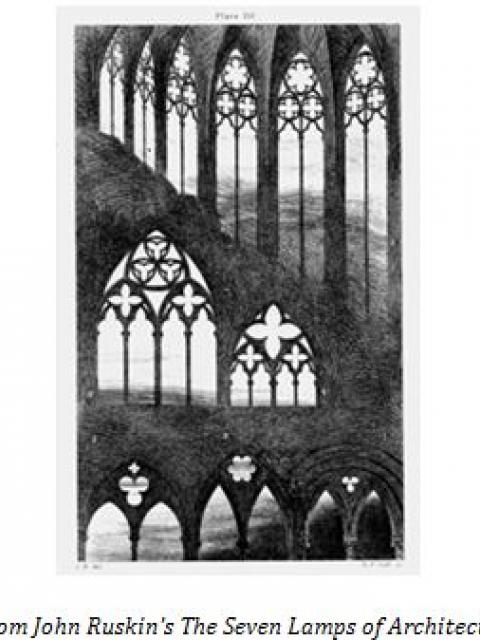
This presentation is offered as an introduction to Courtney Long’s dissertation, “Re-Categorizing Great Britain's Medieval Architecture: A Lesson in Nineteenth-Century Visual Taxonomy.” Courtney’s project seeks to investigate the ways in which architectural historians and natural scientists conveyed the process of change over time in textual and graphic observations published between 1800 and 1850. In her talk, Courtney will focus on the numerous attempts made by nineteenth-century British architects, historians, and theorists to systematically describe and illustrate the history of medieval ecclesiastical architecture in Great Britain. Examining pictures and diagrams found in a select work of published books by Thomas Rickman, John Britton, Edmund Sharpe, and John Ruskin, this presentation seeks to analyze the nineteenth-century attempts to codify British Architectural History and to structure knowledge graphically.
Saturday, April 13th, 2013
French Immersion
Time:
8:30 am to 1:30 pm
Sponsored by:
European Studies Center
Cost:
$20
French Immersion Workshop for primary and secondary school teachers.
Friday, April 12th, 2013
The External Dimension of the EU's Immigration Policy: The Case Study of Turkey
Time:
3:30 pm to 4:30 pm
Presenter:
Dr. Ayselin Goze Yildiz
Location:
4625 Posvar Hall
Sponsored by:
European Studies Center and European Union Center of Excellence
Contact Email:
euce@pitt.edu
The presentation aims to analyse the external dimension of the EU’s immigration policy and its implications for Turkey as a transit country. It tries to demonstrate the development and institutionalization of the EU’s externalization of its immigration policy within a theoretical context. Applying the theoretical debate
concerning “Europeanization beyond EU borders”, it investigates to what extent the EU has successfully externalised its immigration policy to Turkey, and what kind of intended and unintended impacts this has had on Turkey's migration management. It tries to explore both the successes and limits of the Europeanization of Turkey’s domestic immigration policy by benchmarking progress in the harmonization of legal contexts, border management, visa policies, readmission agreements and asylum policies.
"Europe: East and West" Undergraduate Research Symposium 2013
Time:
(All day)
Sponsored by:
Center for Russian East European and Eurasian Studies, European Studies Center, European Union Center of Excellence and International Business Center
Contact:
Gina Peirce
Contact Email:
gbpeirce@pitt.edu
The Undergraduate Research Symposium is an annual event designed to provide undergraduate students from the University of Pittsburgh and other colleges and universities in the region with advanced research experiences and opportunities to develop presentation skills. The event is open to undergraduates from all majors and institutions who have written a research paper from a social science, humanities, or business perspective focusing on the study of Eastern, Western, or Central Europe, the European Union, Russia, or other countries of the former Soviet Union. The Symposium is held on the University of Pittsburgh-Oakland campus.
Collage
After the initial submission of papers, selected participants are grouped into panels according to their research topics. The participants then give 10- to 15-minute presentations based on their research to a panel of faculty and graduate students. The presentations are open to the public.
2013 Dates:
Students submit a 250-300 word abstract and their entire paper, postmarked by January 28, 2013, using the downloadable application form on this site.
Selected students notified by mid-February 2013.
Final revised papers due by March 20, 2013.
Presentations made at the Symposium on April 12, 2013.
Thursday, April 11th, 2013
Peoples' Poetry/Peoples' History
Time:
7:30 pm
Presenter:
Martin Espada, Marcus Rediker (History)
Location:
TBA
Announced by:
European Studies Center on behalf of Humanities Center and Department of History
Contact:
Marcus Rediker
Contact Email:
red1@pitt.edu
*A conversation with poet Martin Espada and historian Marcus Rediker
How movements from below create and use poetry and history.
A Tale of Three Hagia Sophias: Conversion, Museumification, Contestation
Time:
4:00 pm to 6:00 pm
Presenter:
Tuğba Tanyeri-Erdemir, Lecturer at the Graduate Program of Middle Eastern & Eurasian Studies, Middle East Technical University
Location:
4217 Posvar Hall
Sponsored by:
Center for Russian East European and Eurasian Studies and European Studies Center along with Department of Anthropology
Cost:
Free
Contact:
Anna Talone
Contact Email:
crees@pitt.edu
The Hagia Sophias of Istanbul, Iznik, and Trabzon shared similar conversion histories. All three were built as Byzantine churches, converted into mosques under the rule of the Ottoman Empire, and functioned as museums in the 20th century. Transforming such emotionally charged spaces, either into buildings reserved for the practices of another religion or into public museums open for visitation, requires major physical and conceptual changes, which are closely related to the political, historical and social contexts in which they take place, and are deeply embedded in long-term contestation over these sites. In this talk, Professor Tanyeri-Erdemir focuses on the debates around the museumification and de-museumification of these emotionally charged buildings, analyzing the historical, political, social, religious, and institutional factors in the manifestation of major structural and conceptual changes related to the museumification and de-museumification practices.
Colloquium: On Being Wrong About Children
Time:
12:30 pm to 2:00 pm
Presenter:
Marah Gubar (English)
Location:
Cathedral of Learning, Room 602
Sponsored by:
European Studies Center
On British children's literature.
With responses by Karl Schafer (Philosophy) and Stuart Hammond (Psychology).
Faculty and graduate students in Pitt Humanities departments can access readings for colloquia by logging in to , clicking on the tab “My Resources,” clicking on “Humanities Center,” and then clicking on “Colloquium Series” where there is a link to the pdf files. Anyone else wishing to access the readings may request the reading at humctr@pitt.edu.
PIZZA & POLITICS: Home in Europe: Transgressing Borders and Genres in Current German Road Films
Time:
12:00 pm to 1:00 pm
Presenter:
Yvonne Franke
Location:
4217 WWPH
Sponsored by:
European Studies Center and European Union Center of Excellence
Contact Email:
euce@pitt.edu
Historically, we have understood home and travel as antitheses: to travel is to be away from home. What happens when home becomes travel, when the difference between home and travel is sublated? Franke's paper explores the contemporary tropes of home and travel in German film as they transform under the influences of Europeanization and globalization. Images of home, offering a sense of belonging have always been crucial to representations of identity. In the wake of well-analyzed displacements brought about by globalization, one can observe the transformations of images of home and a concomitant increased search for identity as a central motif of significant German films in the past 20 years. With respect to the European idea, it has simply become more complicated to draw rigid borderlines on the European map, and accordingly, between genres in European national cinema as well. Awarded an EU Dissertation Fellowship by the European Union Center of Excellence in the Summer of 2012, Franke's paper discusses selected German road films that visualize socio-political transformations in Europe from a German or cross-cultural perspective.
PIZZA WILL BE SERVED.
Wednesday, April 10th, 2013
Chary Opportunists: Money, Values, and Change in Postsocial Romania
Time:
11:30 am to 1:00 pm
Presenter:
Narcis Tulbure, Doctoral Candidate, Department of Anthropology
Location:
3106 Posvar Hall
Sponsored by:
Center for Russian East European and Eurasian Studies and European Union Center of Excellence along with Department of Anthropology
Cost:
Free
The Genres of Europeanization – Moving Towards the New Heimatfilm
Time:
10:00 am
Presenter:
Yvonne Franke (German)
Location:
Cathedral of Learning, Room 1218
Announced by:
European Studies Center on behalf of Department of German
Contact:
Alana Dunn
Contact Email:
alanad@pitt.edu
Dissertation Defense, open to the public
Tuesday, April 9th, 2013
The Economic Impact Of Social Ties: Evidence From German Reunification
Time:
3:00 pm
Presenter:
Tarek Hassan (Chicago)
Location:
4716 Posvar Hall
Announced by:
European Studies Center on behalf of Department of Economics
Contact:
Debra Ann Ziolkowski
Contact Email:
daz1@pitt.edu
Abstract
We use the fall of the Berlin Wall in 1989 to show that personal relationships which
individuals maintain for non-economic reasons can be an important determinant of regional
economic growth. We show that West German households who have social ties to East
Germany in 1989 experience a persistent rise in their personal incomes after the fall of
the Berlin Wall. Moreover, the presence of these households significantly affects economic
performance at the regional level: it increases the returns to entrepreneurial activity, the
share of households who become entrepreneurs, and the likelihood that firms based within
a given West German region invest in East Germany. As a result, West German regions
which (for idiosyncratic reasons) have a high concentration of households with social ties
to the East exhibit substantially higher growth in income per capita in the early 1990s. A
one standard deviation rise in the share of households with social ties to East Germany in
1989 is associated with a 4.7 percentage point rise in income per capita over six years. We
interpret our findings as evidence of a causal link between social ties and regional economic
development.
Friday, April 5th, 2013
Conference on Global Humanities and World History
Time:
10:00 am to 2:15 pm
Presenter:
April 5, 2013 Friday 10:00 am – 2:15 pm.
Announced by:
European Studies Center on behalf of Department of Music, World History Center, Humanities Center and Department of History of Art and Architecture
Contact:
Katie Jones
Contact Email:
joneskh@pitt.edu
Wednesday, April 3rd, 2013
Applied Modernism: Living in the Now
Time:
1:30 pm to 5:00 pm
Location:
Carnegie Museum of Art Theater, 4400 Forbes Avenue
Announced by:
European Studies Center on behalf of Department of History of Art and Architecture
Contact:
Natalie Swabb
Contact Email:
njs21@pitt.edu
*See the file below for abstracts*
**RSVP requested**
PROGRAM
First Session | 1:30 – 3:00
Welcome and Introduction
Drew Armstrong + Mrinalini Rajagopalan
Architectural Studies Program
University of Pittsburgh
Diego Rivera and the ‘Building’ of Mexican Identity
Patricia Morgado
North Carolina State University
Generalizing Away Uniqueness: James Stirling's Interrogation of the Oxbridge Courtyard
Amanda Reeser Lawrence
Northeastern University
Coffee Break
Second Session | 3:30-5:00
Pittsburgh’s Chatham Village: The Enduring Relevance of a Housing Revolution that Wasn’t
Angelique Bamberg
University of Pittsburgh
Housing for Spatial Justice: The Women's Development Corporation of Providence, Rhode Island
Ipek Türeli
McGill University
Discussion and Closing Remarks
Discussion and Closing Remarks
Colloquium: Surrealism in Romania and France Before, During and After World War II
Time:
12:30 pm to 2:00 pm
Presenter:
Irina Livezeanu (History)
Location:
Cathedral of Learning, Room 602
Announced by:
European Studies Center on behalf of Humanities Center
With responses by Barbara McCloskey (History of Art and Architecture) and David Pettersen (French).
Faculty and graduate students in Pitt Humanities departments can access readings for colloquia by logging in to , clicking on the tab “My Resources,” clicking on “Humanities Center,” and then clicking on “Colloquium Series” where there is a link to the pdf files. Anyone else wishing to access the readings may request the reading at humctr@pitt.edu.
Tuesday, April 2nd, 2013
Print, Piety, and the Rise of Early Modern Vernacular
Time:
12:30 pm to 2:00 pm
Presenter:
John King (Ohio State University)
Location:
Cathedral of Learning, Room 602
Announced by:
European Studies Center on behalf of Humanities Center and Medieval and Renaissance Studies Program
Contact:
Jennifer Waldron (English)
Contact Email:
jwaldron@pitt.edu
Our work on this topic seeks to bridge the divide between medieval and early modern studies by taking a long view of three questions surrounding particular uses of vernacular languages and broader processes of vernacularization in this period: How did changes in technologies of communication, such as the rise of letterpress printing, intersect with the uses of vernacular languages? How were the structures of "vernacular theology" transfigured during the period leading up to and following the Protestant Reformation and Catholic Counter-Reformation? And how does a focus on vernacularization help us to reevaluate theories and practices of translation-whether from one language to another, from one medium to another, or from one cultural sphere to another?
John King is Distinguished University Professor Emeritus at the Ohio State University. He is the author of numerous books, including the following:
English Reformation Literature: The Tudor Origins of the Protestant Tradition; Tudor Royal Iconography: Literature and Art in an Age of Religious Crisis; Spenser's Poetry and the Reformation Tradition; Milton and Religious Controversy: Satire and Polemic in Paradise Lost; Foxe's Book of Martyr's and Early Modern Print Culture. He is the recipient of fellowships from the American Council of Learned Societies, the John Simon Guggenheim Memorial Foundation, and the National Endowment for the Humanities, among many others.
This event is part of a yearlong series, “Speaking in Tongues,” organized by the Medieval and Renaissance Studies Program at the University of Pittsburgh and supported by a collaborative research grant from the University of Pittsburgh’s Humanities Center.
Monday, April 1st, 2013
The Reformation of the Book: Vernacular and Vernacularization
Time:
4:30 pm
Presenter:
John King (Ohio State University)
Location:
Cathedral of Learning, Room 602
Announced by:
European Studies Center on behalf of Humanities Center and Medieval and Renaissance Studies Program
Contact:
Jennifer Waldron (English)
Contact Email:
jwaldron@pitt.edu
Our work on this topic seeks to bridge the divide between medieval and early modern studies by taking a long view of three questions surrounding particular uses of vernacular languages and broader processes of vernacularization in this period: How did changes in technologies of communication, such as the rise of letterpress printing, intersect with the uses of vernacular languages? How were the structures of "vernacular theology" transfigured during the period leading up to and following the Protestant Reformation and Catholic Counter-Reformation? And how does a focus on vernacularization help us to reevaluate theories and practices of translation-whether from one language to another, from one medium to another, or from one cultural sphere to another?
John King is Distinguished University Professor Emeritus at the Ohio State University. He is the author of numerous books, including the following:
English Reformation Literature: The Tudor Origins of the Protestant Tradition; Tudor Royal Iconography: Literature and Art in an Age of Religious Crisis; Spenser's Poetry and the Reformation Tradition; Milton and Religious Controversy: Satire and Polemic in Paradise Lost; Foxe's Book of Martyr's and Early Modern Print Culture. He is the recipient of fellowships from the American Council of Learned Societies, the John Simon Guggenheim Memorial Foundation, and the National Endowment for the Humanities, among many others.
This event is part of a yearlong series, “Speaking in Tongues,” organized by the Medieval and Renaissance Studies Program at the University of Pittsburgh and supported by a collaborative research grant from the University of Pittsburgh’s Humanities Center.
Thursday, March 28th, 2013
Le Mépris (Jean-Luc Godard 1963) and its story of cinema: a ‘fabric of quotations’
Time:
5:00 pm
Presenter:
Laura Mulvey (Uni of London)
Location:
Cathedral of Learning, Room 324
Announced by:
European Studies Center on behalf of Humanities Center, Film Studies Program, Cultural Studies Program and Gender, Sexuality, and Women's Studies Program
Contact:
Jamie Hamilton
Contact Email:
jlh231@pitt.edu
Laura Mulvey is Professor of Film and Media Studies at Birkbeck College, University of London. She has written extensively on film and film theory. Her books include Fetishism and Curiosity (1996), Death Twenty-four Times a Second: Stillness and the Moving Image (2006), Experimental British Television (edited with Jamie Sexton, 2007), and Visual and Other Pleasures (2nd edition, 2009). She has co-directed films, including Riddles of the Sphinx (1978) and Frida Kahlo and Tina Malatti (1980), as well as the documentary Disgraced Monuments (1996).
*Reception to follow*
Passions and Portraits: Thoughts on Rembrandt, Van Dyck, and the History of Taste
Time:
4:00 pm to 5:30 pm
Presenter:
STEPHANIE DICKEY (Queen's University)
Location:
Frick Fine Arts Building, Room 202
Announced by:
European Studies Center on behalf of Department of History of Art and Architecture and Medieval and Renaissance Studies Program
Contact:
Jennifer Waldron (English)
Contact Email:
jwaldron@pitt.edu
Among the Baroque paintings held in the Royal Collection in London are two works from the early modern Netherlands: the Dutch artist Rembrandt van Rijn's Portrait of the Shipbuilder Jan Rijcksen and his Wife Griet Jans, 1633, and the Flemish artist Anthony van Dyck's Cupid and Psyche, 1640. At first glance, these paintings could not look more different, yet they have more in common than at first appears. Close analysis reveals how these paintings encapsulate the competitive relationship between two gifted artists, the tensions between tradition and modernity that characterized their age, and the essential significance of emotion in the visual language of the Baroque.
*Dr. Stephanie S. Dickey is the Bader Chair in Northern Baroque Art at Queen's University
Supplementing Lenin: Toward a Communism of Other-determination
Time:
4:00 pm to 6:00 pm
Presenter:
Nergis Ertürk, Associate Professor of Comparative Literature, Penn State University
Location:
501 Cathedral of Learning
Sponsored by:
Center for Russian East European and Eurasian Studies, European Studies Center and Global Studies Center along with Department of Film Studies and boundary 2
Cost:
Free
Nergis Ertürk is the author of Grammatology and Literary Modernity in Turkey (Oxford University Press, 2011), the recipient of the 2012 MLA Prize for a First Book. In 2008, she won the William Riley Parker Prize for her essay, "Modernity and Its Fallen Languages: Tanpınar's Hasret, Benjamin's Melancholy," which appeared in PMLA. Her article, “Phonocentrism and Literary Modernity in Turkey,” appeared in boundary 2, and her research has also appeared in a wide-ranging collection of prominent literary works.
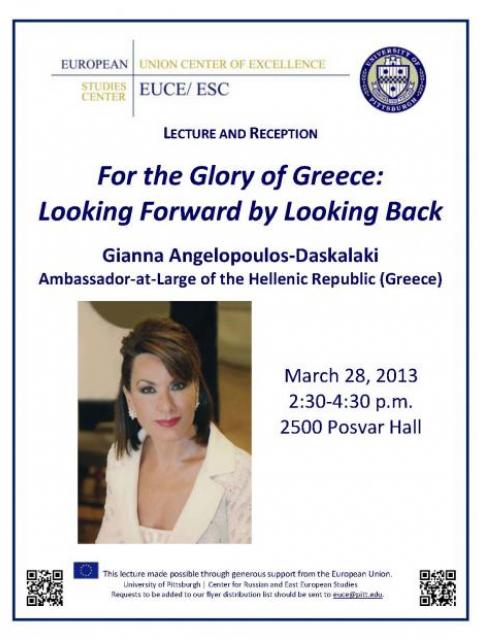
For the Glory of Greece: Looking Forward by Looking Back
Time:
2:30 pm to 4:30 pm
Presenter:
Her Excellency Mrs. Gianna Angelopoulos-Daskalaki
Location:
2500 WWPH
Sponsored by:
Center for Russian East European and Eurasian Studies, European Studies Center, European Union Center of Excellence and Nationality Rooms and Intercultural Exchange Programs along with American-Hellenic Foundation of Western Pennsylvania
Contact:
Eleni Valliant
Contact Email:
env1@pitt.edu
Mrs. Gianna Angelopoulos-Daskalaki was elected Member of Parliament of the Greek Republic in 1989 and was re-elected the following year. In 1998, the Republic of Greece appointed her Ambassador-at-Large for her service leading Greece’s successful bid to host the 2004 Olympic Games. Two years later, she was asked to assume the presidency of the ATHENS 2004 Organizing Committee for the Olympic Games, which was at the time behind schedule and over-budget. Under her leadership, Athens gave the world what IOC President Jacques Rogge called: "an unforgettable, dream Games." Today, Ambassador Angelopoulos-Daskalaki is an active member of the Clinton Global Initiative and Vice-Chairman of the Dean's Council for Harvard's Kennedy School of Government. Her book, My Greek Drama: Life, Love and One Woman's Olympic Effort to Bring Glory to her Country, will be published in May. A reception in honor of Her Excellency Ambassador Angelopoulos-Daskalaki will be held immediately following the talk. REFRESHMENTS WILL BE SERVED. PUBLIC IS WELCOME.
Cross-Border Networks as a Source of Regulatory Change in the EU's Eastern Neighborhood
Time:
12:00 pm to 1:30 pm
Presenter:
Evgeny Postnikov
Location:
4217 Posvar Hall
Sponsored by:
Center for Russian East European and Eurasian Studies, European Studies Center and European Union Center of Excellence
Cost:
Free
Contact:
Anna Talone
Contact Email:
crees@pitt.edu
Wednesday, March 27th, 2013
Making Prussia Polish. Changing Land and People in Poland’s New Territories, 1945–1960
Time:
4:00 pm to 6:00 pm
Presenter:
Katharina Matro, PhD Candidate, Stanford University
Location:
3702 Posvar Hall
Sponsored by:
Center for Russian East European and Eurasian Studies and European Studies Center along with Department of History
Cost:
Free
Katharina Matro’s dissertation and talk focuses on the transformation of the vast estates of Prussia’s nobility into Polish state farms and smaller family farmsteads post-1945 and the defeat of Nazi Germany. Her research forms the argument that the continual assault on both land and property rights during the time determined the fragile postwar economy and society in the region.
Colloquium: Gervase, Edmer, and the Gestalt of Canterbury Cathedral
Time:
12:00 pm
Presenter:
Karen Webb (HAA)
Location:
Room 203 Frick Fine Arts
Announced by:
European Studies Center on behalf of Department of History of Art and Architecture
Contact:
Natalie Swabb
Contact Email:
njs21@pitt.edu
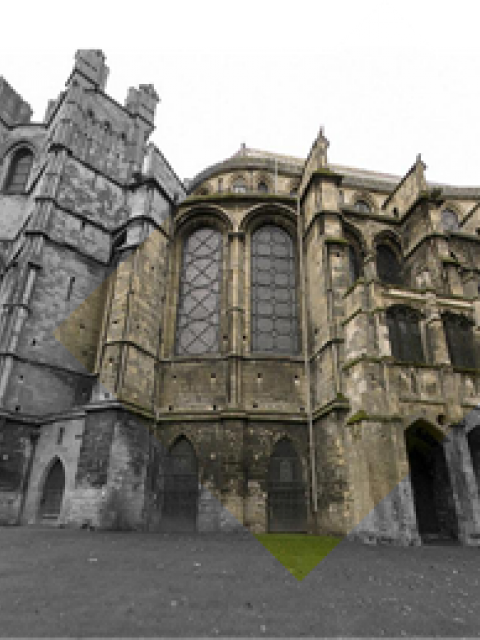
Few architectural tracts remain from the medieval period in the west. Two tracts on architecture that this paper utilizes from this period—one by Gervase in 1185, and one by Edmer in 1116—both discuss subjects that collectively include the fire, building, and arrangement of different architectural campaigns at Canterbury Cathedral. Here, these texts are used to trace the written knowledge of the succession of churches—those of Lanfranc, Anselm, William of Sens, and William the Englishman, the last of whose termination of the cathedral remains intact today. Viewing these buildings as a united set of statements, this paper proposes that they interlink in purpose and in conception. While scholars like Richard Krautheimer and Günter Bandmann have suggested there is a possible link between architectural form and conceptual or philosophical meaning, there has been much doubt about this connection by scholars like Paul Crossley. In the course of this paper, the idea of an iconography of architecture and even an iconography of architectural tools are explored in a direct challenge to Crossley’s work by using Gervase and Edmer to establish a line of intention in planning and meaning. While Crossley states that “Even if style can . . . be derived from thought, the character of the gothic cathedral, the sources of its totality, cannot be traced back to some single ‘intention.’” This paper maintains that the complete set of buildings from at least that of Anselm (1090 – 1130) that come-and-go on the site of Canterbury Cathedral form a Gestalt, or a planned intentional set of parts that create a whole originary vision. This vision reproduces a set of parallel architectural types comparable to the styles of the visual figurative arts like idealism, naturalism, stylization, abstraction, and non-representation and paralleled in the text of Isidore of Seville’s Etymologies. In this presentation, the explication of idealism in architecture is the primary objective and its theological relationship to what this study relates to Christian representation and Jewish representation.
Tuesday, March 26th, 2013
International Toolkit Series: National Scholarships: Fulbright
Time:
3:00 pm to 4:00 pm
Location:
4217 Posvar Hall
Sponsored by:
Center for African Studies, Asian Studies Center, Center for Latin American Studies, Center for Russian East European and Eurasian Studies, European Studies Center and Global Studies Center along with Career Development and Placement Assistance Office
Cost:
Free
Contact:
Susan Hicks
Contact Email:
smhicks@pitt.edu
Hear about opportunities to teach English or conduct research abroad through the Fulbright U.S. Student Program. Fulbright alumni and current Fulbright participants will join representatives from the university’s National Scholarships advising office to provide information on the Fulbright experience and how to best prepare for it.
Friday, March 22nd, 2013
Medieval Song from Head to Tail
Time:
4:00 pm
Presenter:
ANNA ZAYARUZNAYA (Princeton)
Location:
Music Building Room 132
Announced by:
European Studies Center on behalf of Department of Music, Cultural Studies Program, Medieval and Renaissance Studies Program and Department of French and Italian
Contact:
Jennifer Waldron
Contact Email:
jwaldron@pitt.edu
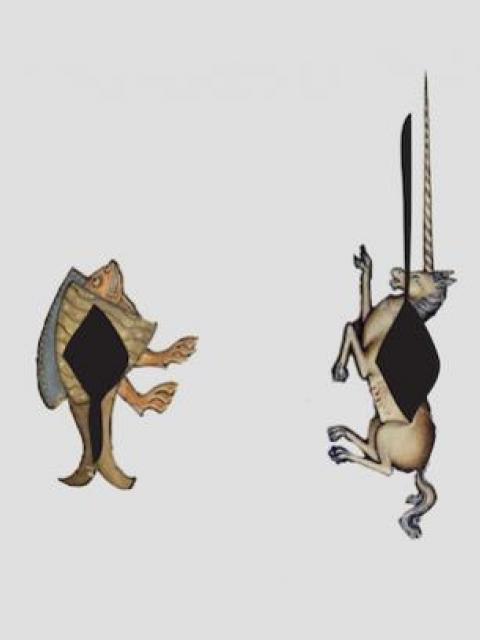
From the heads and tails of individual notes to the foreheads and feet of song stanzas, medieval musical writings are replete with body parts. Sometimes the terms are used by convention, or in the service of simple mnemonics. But in other cases, the reasons for acts of musical anthropomorphization are less clear. Tracing the rhetoric of musical animation from the treatises into the realm of musica practica can give us fresh insight into some of the best-known songs of the later middle ages. Beyond this, the rhetoric of songs alive offers a useful alternative to the “work concept”—a musical ontology whose applicability before the Renaissance has been repeatedly called into question. The “creature concept” of song can serve as a powerful (if whimsical) tool for describing and analyzing musical things that are perishable but autonomous, subject to change and growth, and capable of doing work in the world.
Anna Zayaruznaya, an Assistant Professor of Music at Princeton University, is interested in the relationship between music and its texts in the fourteenth and fifteenth centuries. Her research brings the history of musical form and notation into dialogue with medieval literary theory, the history of ideas, and iconographic and codicological trends. Recent papers and publications have focused on the motets of Guillaume de Machaut and Philippe de Vitry, Milanese chant, Isorhythm, and musical resonances in the poetry of John Gower and Jean Molinet. Currently she is working on a book that explores the roles played by the monstrous and hybrid in fourteenth-century musical aesthetics.
Thursday, March 21st, 2013
Why Wagner?: Some Thoughts on the Occasion of his Bicentennial
Time:
5:00 pm
Presenter:
Nicholas Vazsonyi (South Carolina)
Location:
Cathedral of Learning, Room 602
Announced by:
European Studies Center on behalf of Humanities Center, Cultural Studies Program, Department of German and Carnegie Mellon University Department of Modern Languages
Contact Email:
vad16@pitt.edu
Nicholas Vazsonyi is Professor of German and Comparative Literature at the University of South Carolina and the editor of the Cambridge Wagner Encyclopedia (forthcoming 2013), an international effort involving some 80 scholars from 11 academic disciplines and residing in 9 countries. He teaches and researches on German literature and culture, including music and film, covering the 18th through the 21st centuries. He has published monographs on Wagner and on Goethe, and edited volumes on Wagner’s Meistersinger and on German national identity from 1750 to 1871.
Comparing the European Parliament with the US Congress: Theoretical and Methodological Challenges
Time:
12:00 pm to 1:00 pm
Presenter:
Selma Bendjaballah, Sciences Po
Location:
4217 Posvar Hall
Sponsored by:
European Studies Center and European Union Center of Excellence
Cost:
Free
Contact:
Allyson Delnore
Contact Phone:
624-5404
Contact Email:
adelnore@pitt.edu
Comparing Legislatures implies numerous challenges to capture the complexity of democratic logics playing in these institutions, especially when these legislative bodies are embedded in institutional settings and present features that are seen as unique or exceptional. This talk aims at presenting a specific reading of comparative legislative research on two exceptional Legislatures, namely the European Parliament and the US Congress. Dr. Bendjaballah will retrace what has been done in this field, the research questions that have been raised, and the epistemological and methodological challenges that have emerged as well.
Selma Bendjaballah is a research manager at the Centre for European Studies at Sciences Po in Paris, from where she also received her Ph.D. in Political Science. Dr. Bendjaballah specializes in comparative politics with an emphasis on legislatures (standing committees) and party systems of the European Union, individual countries within Europe, and the American Congress. She has published numerous articles in such journals as Politique européenne and a special issue, forthcoming, of the International Review of Comparative Politics. Her book, Introduction to Legislative Studies, co-authored with Olivier Rozenberg and Anne-Laure Beaussier, will appear in print this year.
Thursday, March 21st, 2013 to Saturday, April 13th, 2013
Carnegie Mellon University's International Film Festival 2013: Faces of Media
Time:
(All day)
Sponsored by:
Center for African Studies, Asian Studies Center, Center for Russian East European and Eurasian Studies, European Studies Center and Global Studies Center
Contact:
Jolanta Lion
Contact Email:
jola@cmu.edu
"Whoever controls the media, controls the mind." - Jim Morrison
The Carnegie Mellon International Film Festival, sponsored by the Humanities Center, is proud to present its 2013 theme, Faces of Media. From March 21st - April 13th, audiences will have the opportunity to enjoy Pittsburgh premiere screenings of over a dozen brand new and award-winning films from Germany, the United Kingdom, Italy, France, Denmark, Norway, Romania, Austria, Finland, Spain, Poland, the Ukraine, the Congo, Egypt, Iran, Israel, Japan, China, Australia, Canada, and the United States. All films are presented in English or with English subtitles.
From the young protestors in Egypt who utilized social media apps like Facebook to mobilize a revolution to an American community in the near future that maintains social contact through constant live video feeds on individual home computers, the compelling real-life and fictional faces introduced by these films will provoke thoughtful questions about how our global media impacts society and vice versa. Contemporary issues concerning the societal effects of rapid globalized media development, such as violence, (in)justice, identity transformation, voyeurism, obsession, networking, and alienation, will be highlighted in the films through the unique constructs of language, imagery, and narrative.
We are thrilled to introduce you to powerful films from around the globe that we believe are extraordinarily unique and relevant to our time. Even in the digital age where we can access almost anything with the click of a mouse, these rare new releases are not yet available to stream online. Beyond the screenings themselves, audiences may continue to explore the complex and multifarious themes of these films at our events by participating in Q&A sessions with international directors, viewing interactive performances by student artists, and tasting delicious global cuisine from local eateries.
Whether you are fluent in all things related to new media or prefer to observe the constantly changing technology trends from a distance, the 2013 Carnegie Mellon International Film Festival: Faces of Media will provide you with the perfect chance to learn more about our evolving world of globalized communication through a cinematic lens. We look forward to seeing your faces in the audience!
Wednesday, March 20th, 2013
Patterns of Vernacular Affectivity in Late Medieval and Protestant England
Time:
3:00 pm
Presenter:
Barbara Rosenwein (Loyola)
Location:
Cathedral of Learning, Room 602
Announced by:
European Studies Center on behalf of Humanities Center and Medieval and Renaissance Studies Program
Contact:
Jennifer Waldron (English)
Contact Email:
jwaldron@pitt.edu
If the purpose of "Speaking in Tongues" is to bridge the divide between medieval and early modern studies, then one issue that must be faced is whether there was a great change in emotions or affectivity from one period to the other. Certainly the prevailing thesis, hanging on the coattails of Norbert Elias's Civilizing Process, is that there was a great change--and it can be summed up as the transition from medieval emotionality to modern restraint.
In this paper, I take issue with that thesis by looking specifically at one form of emotionality, "affective piety." I argue that affective piety, as exemplified by Margery Kempe, continued to some degree, at least among some groups, even in the Protestant world. My focus is on the testimonials of the members of a mid-17th century "gathered church""-that is, a Puritan church-near London. Both Margery and the Puritans wrote in the vernacular, though of course that vernacular changed over time. Thus my exploration is indeed about "speaking in tongues. " I shall conclude with the thought that there are more continuities between medieval and early modern religious emotions than most historians have admitted.
Barbara H. Rosenwein is Professor of History at Loyola University Chicago. She has been at the forefront of research on the history of emotions, editing Anger's Past: The Social Uses of an Emotion in the Middle Ages (Cornell, 1998), and authoring Emotional Communities in the Early Middle Ages (Cornell, 2006). This talk is from a current project on the history of emotions from late antiquity to about 1700.
This event is part of a yearlong series, “Speaking in Tongues,” organized by the Medieval and Renaissance Studies Program at the University of Pittsburgh and supported by a collaborative research grant from the University of Pittsburgh’s Humanities Center. Our work on this topic seeks to bridge the divide between medieval and early modern studies by taking a long view of three questions surrounding particular uses of vernacular languages and broader processes of vernacularization in this period:
How did changes in technologies of communication, such as the rise of letterpress printing, intersect with the uses of vernacular languages?
How were the structures of "vernacular theology" transfigured during the period leading up to and following the Protestant Reformation and Catholic Counter-Reformation?
And how does a focus on vernacularization help us to reevaluate theories and practices of translation-whether from one language to another, from one medium to another, or from one cultural sphere to another?
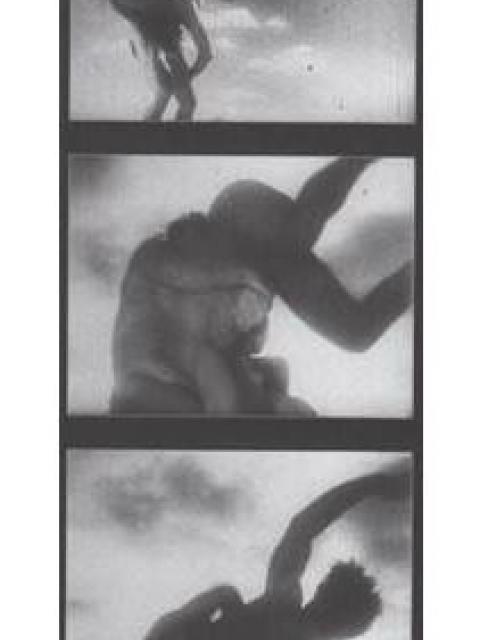
Silencing Machine: Peter Roehr’s Film Montages as Queer Disavowal
Time:
12:00 pm
Presenter:
Meredith North (HAA)
Location:
Room 203 Frick Fine Arts
Announced by:
European Studies Center on behalf of Department of History of Art and Architecture
This paper analyzes the 1965 Film Montages of the West German artist Peter Roehr. Roehr’s untitled Film Montages of American and European commercial advertisements utilized an explicitly mechanical aesthetic to remove removed any personal identification, political impetus, or artistic qualities from the montages. Such an extreme disavowal of subjectivity through the cold objective logic of mechanical precision indicated that these montages could, and should, be understood in two other ways: as Roehr’s purposeful self-silencing, and as critiques of commodity fetishization. As my paper proposes, Roehr’s silencing machine aesthetic arises from a particularly queer perspective that gives access to alternative modes of social critique and political purpose.
Tuesday, March 19th, 2013
Northern Ireland's Lost Opportunity
Time:
4:00 pm to 6:00 pm
Presenter:
Tony Novosel (History)
Location:
3703 WWPH - History Lounge
Sponsored by:
European Studies Center and European Union Center of Excellence along with Department of History
*Part of the History Department's Book Symposia Series*
Featuring commentary by:
Billy Hutchinson (Progressive Unionist Party, Northern Ireland)
David Miller (CMU)
Peter Shirlow (Queen's University-Belfast)
Saturday, March 16th, 2013
French Immersion
Time:
(All day)
Sponsored by:
European Studies Center and European Union Center of Excellence
Tuesday, March 12th, 2013
EuroChallenge
Time:
(All day)
Location:
PAA
Sponsored by:
European Union Center of Excellence and European Union Studies Association
What is the Euro Challenge?
The Euro Challenge is an exciting educational opportunity for high school students to learn about the European Union (EU) and the euro. Student teams of three to five students are asked to make presentations answering specific questions about the European economy and the single currency, the euro. They are also asked to pick one member country of the “euro area” (the 17 EU member countries that have adopted the euro so far), to examine an economic problem at the country level, and to identify policies for responding to that problem.
In 2013, its eighth year, the Euro Challenge will continue to expand nationally, with more than 100 teams from various regions in the United States expected to compete for monetary awards generously provided by The Moody’s Foundation.
The Euro Challenge is a program launched by the Delegation of the European Union to the United States in partnership with The Moody’s Foundation and with the Federal Reserve Bank of New York serving as program advisor. The program is supported by Credit Suisse, the University of North Carolina, Florida International University, the University of Pittsburgh, the University of Illinois, the University of Texas at Austin, Rutgers University, George Washington University, Indiana University, the University of Wisconsin, the World Affairs Council of Pittsburgh, the DC World Affairs Council, the Federal Reserve Bank of Cleveland (Pittsburgh Branch), the Federal Reserve Bank of Boston, and the Federal Reserve Bank of Chicago and Detroit Branch.
Thursday, March 7th, 2013
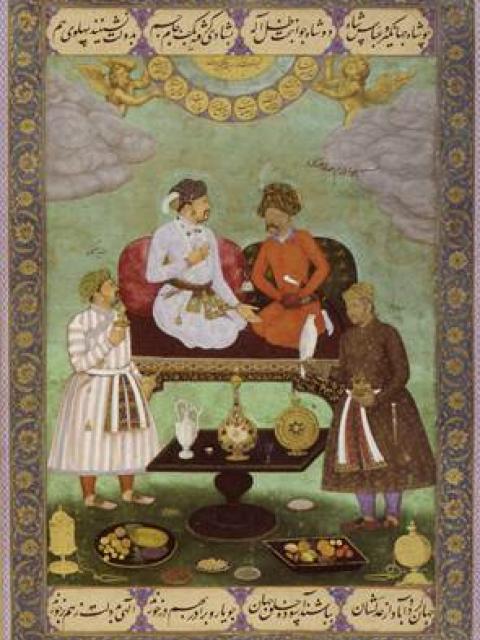
Metamorphosis at the Mughal Court: The Case of the Diana Automaton
Time:
4:00 pm to 5:30 pm
Presenter:
Jessica Keating (Southern California)
Location:
Room 202 Frick Fine Art
Announced by:
European Studies Center on behalf of Department of History of Art and Architecture
Contact:
Natalie Swabb
Contact Email:
njs21@pitt.edu
This paper considers how a seventeenth-century German Automaton featuring the Roman Goddess Diana atop a stag made its way to the court of the Mughal Emperor Jahangir (1569-1627), and it explores this object's social life outside of its putative home of the Holy Roman Empire.
Colloquium: Figuring out Europe: Nation, State and the European Union in the German Public Sphere
Time:
12:30 pm to 2:00 pm
Presenter:
Russell Berman (Stanford)
Location:
Cathedral of Learning, Room 602
Sponsored by:
European Studies Center and European Union Center of Excellence along with Humanities Center, Cultural Studies Program and Department of German
Contact:
Alana Dunn
Contact Phone:
412-624-5909
Contact Email:
alanad@pitt.edu
With responses by Nancy Condee (Global Studies), Alberta Sbragia (Political Science) and Gregor Thum (History).
Russell Berman is Director of German Studies at Stanford, Senior Fellow at the Hoover Institution, Editor of TELOS,
and recent President of the Modern Language Association. He is an expert on German literature and culture and
on cultural relations between Europe and the United States, and is a pioneer in German Cultural Studies.
In more than 80 articles and five books, he has written widely on modern German and European literature and politics,
as well as on issues in contemporary cultural theory
Wednesday, March 6th, 2013
Graduate Seminar
Time:
(All day)
Presenter:
Russell Berman (Stanford)
Announced by:
European Studies Center on behalf of Department of German
Contact:
John Lyon
Contact Email:
jblyon@pitt.edu
Graduate Seminar building on Prof. Berman's talk "Figuring out Europe: Nation, State and the European Union in the German Public Sphere"
Tuesday, March 5th, 2013
Is the Ivory Tower an Iron Cage? Why We Need to Reform Humanities Education
Time:
5:00 pm
Presenter:
Russell Berman (Stanford University)
Location:
Cathedral of Learning, Room 602
Sponsored by:
European Studies Center along with Humanities Center, Cultural Studies Program, Department of German and Dietrich School of Arts & Sciences
Contact:
Alana Dunn
Contact Phone:
412-624-5909
Contact Email:
alanad@pitt.edu
Russell Berman is Director of German Studies at Stanford, Senior Fellow at the Hoover Institution, Editor of TELOS,
and recent President of the Modern Language Association. He is an expert on German literature and culture and
on cultural relations between Europe and the United States, and is a pioneer in German Cultural Studies.
In more than 80 articles and five books, he has written widely on modern German and European literature and politics,
as well as on issues in contemporary cultural theory.
Graduate Seminar
Time:
(All day)
Presenter:
Russell Berman (Stanford)
Announced by:
European Studies Center on behalf of Department of German
Contact:
John Lyon
Contact Email:
jblyon@pitt.edu
Graduate Seminar building on Prof. Berman's talk Is the Ivory Tower an Iron Cage? Why We Need to Reform Humanities Education
Monday, March 4th, 2013
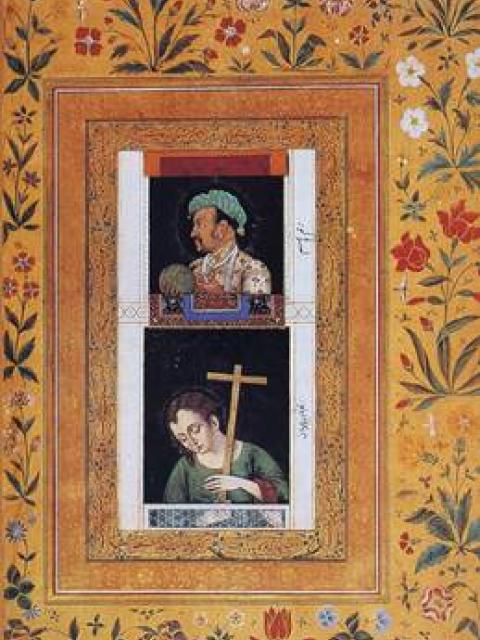
Mughal Occidentalism: Rethinking Artistic Encounters Between Europe and Asia at the Mughal Courts of India
Time:
4:30 pm to 6:00 pm
Presenter:
Mika Natif (Harvard)
Location:
Room 202 Frick Fine Art
Announced by:
European Studies Center on behalf of Department of History of Art and Architecture
Contact:
Natalie Swabb
Contact Email:
njs21@pitt.edu
Since the reign of Emperor Akbar the Great (d. 1605), paintings produced in Mughal India began to evince responses from Mughal artists to European art. This lecture centers on the phenomenon of what I term “Mughal Occidentalism,” namely the trans-global style and visual expression that Mughal artists and patrons developed following the meeting of Indian painting with Renaissance art; the use of European pictorial techniques by Muslim and Hindu artists; and the transformation of Christian visual culture into an Indian idiom. By analyzing visual and textual evidence, I examine these works of art from the perspective of the Mughals, and observe how Mughal artists were recontextualizing Western motifs and creating their own vernacular/cosmopolitan aesthetics. This synthesis of European and Indo-Persian pictorial traditions became the hallmark of the Mughal painting style.
Friday, March 1st, 2013
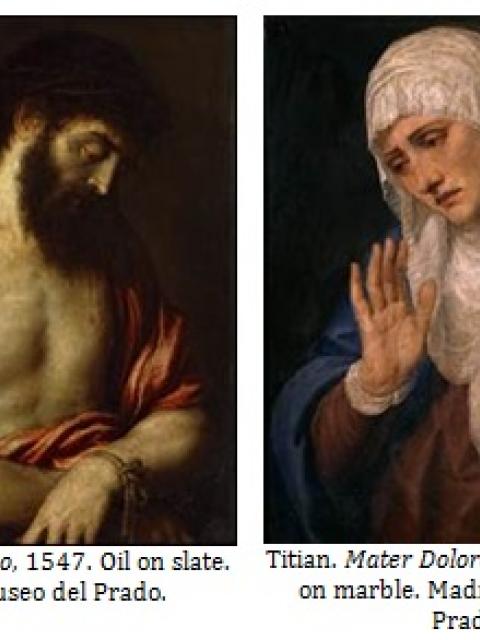
Titian's Painted Stones: Slate, Oil and the Transubstantiation of Painting
Time:
4:00 pm to 5:30 pm
Presenter:
Christopher J. Nygren (Penn)
Location:
Room 202 Frick Fine Art
Announced by:
European Studies Center on behalf of Department of History of Art and Architecture
Contact:
Natalie Swabb
Contact Email:
njs21@pitt.edu
Titian’s Ecce Homo and Mater Dolorosa with Open Hand (both Madrid, Museo del Prado) stand out for a number of reasons. Firstly, they were not commissioned but were done as gifts, so they reflect Titian’s artistic volition rather than the will of a patron. Secondly, the materials that Titian chose to use demand attention: the Ecce Homo is painted on slate while the Mater dolorosa is painted on a slab of marble. Depending on how scholars account for problems of attribution, workshop participation, and works that have not survived, estimates of Titian’s artistic production range from about 400 works on the conservative side to more than 600. Despite these large numbers (not matched by other masters of his period like Raphael and Michelangelo), the Ecce Homo and Mater Dolorosa are the only paintings that Titian ever painted on non-traditional supports. Their outlier status, then, is clear and should make them of interest to scholars. Yet modern scholarship has essentially ignored Titian’s selection of artistic materials. This paper will examine Titian’s redeployment of the novel technique of stone painting by focusing on how the painter sought to heighten the affective immediacy of Christian devotion by drawing on the complex associations between the spiritual content of his images and the physical characteristics of their material substrates.
*Christopher J. Nygren is a Mellon Post-Doctoral Teaching Fellow at the University of Pennsylvania
Friday, March 1st, 2013 to Saturday, March 2nd, 2013
8th Annual Graduate Student Conference on the EU
"A Nobel Price? The Consequences of the European Union in Europe and in the World"
Time:
9:00 am
Presenter:
various
Sponsored by:
European Studies Center and European Union Center of Excellence along with EUSA
Contact:
Allyson Delnore
Contact Phone:
412-624-5404
Contact Email:
adelnore@pitt.edu
The University of Pittsburgh hosts the Eighth Annual Graduate Student Conference on the European Union, featuring Alexandre Stutzmann, Diplomatic Adviser to the President of European Parliament, as the keynote speaker. All panel sessions, including the keynote address, are open to the public and will be held in the Patrician Crown Mural Room of the Pittsburgh Athletic Association. For a full listing of panels and a schedule of public events, please visit the EUCE/ESC web page featuring the schedule of the program.
Thursday, February 28th, 2013
Provost's Inaugural Lecture - Civil War in the British Empire: America’s Violent Birth
Time:
4:00 pm
Presenter:
Holger Hoock (History)
Location:
2500 and 2501 Posvar Hall
Announced by:
European Studies Center on behalf of Office of the Provost, Department of History and Eighteenth Century Studies Program
*As part of the Provost's Inaugural Lecture Series, Holger Hoock will deliver an Inaugural Lecture as J. Carroll Amundson Professor of British History.
Pitt hosts the oldest chair in British History in the United States, endowed half a century ago this academic year.
In this talk, as a part of the Provost’s Inaugural Lecture series, Holger Hoock will discuss work in progress on
violence in the American Revolutionary War as a civil war in the British Empire and in America. Most modern
histories focus on the Revolution’s ideals and tend to marginalize the physical and psychological ordeals it
entailed for so many participants. Reflecting on the geopolitical and cultural contexts of that historiographical
marginalization of violence since the late nineteenth century, Hoock will consider how we might write violence
back into the story, and to what effect. British History has long lost the special status it once enjoyed in the
American academy. Its continuing relevance will depend on how it positions itself in relation to European,
Atlantic, and wider transnational contexts. All faculty and students are most welcome. The lecture will be
followed by a reception.
Colloquium: The Origin of Rhyme
Time:
12:30 pm to 2:00 pm
Presenter:
Roberto Dainotto (Duke)
Location:
Cathedral of Learning, Room 602
Announced by:
European Studies Center on behalf of Humanities Center
Contact Email:
vad16@pitt.edu
A focus on Europe with responses by Neil Doshi (French), Randall Halle (German) and Ronald Judy (English).
Faculty and graduate students in Pitt Humanities departments can access readings for colloquia by logging in to , clicking on the tab “My Resources,” clicking on “Humanities Center,” and then clicking on “Colloquium Series” where there is a link to the pdf files. Anyone else wishing to access the readings may request the reading at humctr@pitt.edu.
Wednesday, February 27th, 2013
WHO ARE THESE GERMANS?
Time:
5:00 pm
Presenter:
Susanne Ortner-Roberts (German), Fritz Ottenheimer
Location:
Cathedral of Learning, Room 208B
Announced by:
European Studies Center on behalf of Department of German
Contact:
Alana Dunn
Contact Email:
alanad@pitt.edu
In music and words, two Germans from different generations reflect on the Holocaust, German history, and what it means to be German in the 21st century.
*A discussion/question and answer period will follow the talk*
ABOUT THE PERFORMERS
FRITZ OTTENHEIMER, as a Jewish boy growing up in Nazi Germany, escaped Nazi persecution by immigrating to the U.S. in 1939, and eventually fighting against Germany with the U.S. Army at the end of WWII. A retired engineer, Mr. Ottenheimer has documented his experiences surrounding the Holocaust and Post-War Germany in a memoir, “Escape and Return.” He resides in Pittsburgh, PA.
SUSANNE ORTNER-ROBERTS is a world-renowned clarinetist from Augsburg, Germany, who specializes in Jewish (Klezmer) music. As a representative of a new generation of Germans, she is committed to using words and music to promote cross-cultural understanding, and to educate others about how young Germans today deal with the atrocities of war and the Holocaust committed by their grandparents’ generation. She is the subject of the recent book “Living the Dream – Für die Musik nach Amerika” written by German Television journalist Helge Fuhst. Susanne also teaches German at the University of Pittsburgh.
Tuesday, February 26th, 2013
History and the Novel
Time:
5:00 pm
Presenter:
Roberto Dainotto (Duke)
Location:
Cathedral of Learning, Room 602
Announced by:
European Studies Center on behalf of Humanities Center
Contact Email:
vad16@pitt.edu
Friday, February 22nd, 2013
Engendering Italy: Gaps, Contradictions, & Paradoxes of Gender on the EU Background
Lecture and Reception
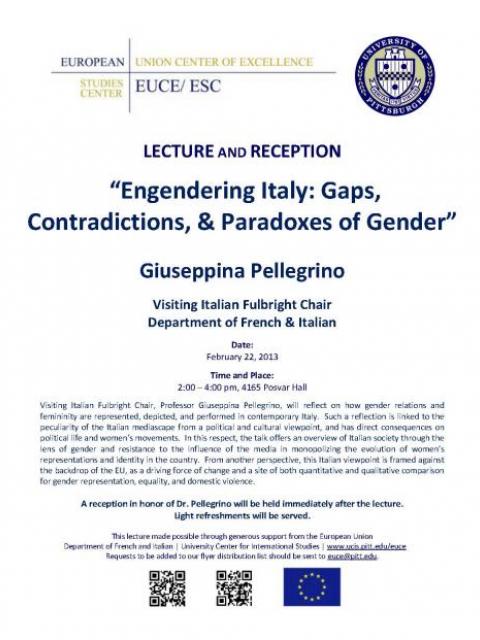
Time:
2:00 pm to 4:00 pm
Presenter:
Giuseppina Pellegrino, Visiting Italian Fulbright Scholar
Location:
4165 WWPH
Sponsored by:
European Studies Center and European Union Center of Excellence
Contact Email:
env1@pitt.edu
The lecture aims to reflect on how gender relationships and femininity are represented, depicted, and performed in contemporary Italy. Such a reflection is linked to the peculiarity of the Italian mediascape from a political and cultural viewpoint, and has direct consequences on political life and women’s movements. In this respect, the talk offers an overview of Italian society through the lens of gender and resistance to the influence of the media in monopolizing the evolution of women’s representations and identity in the country. From another perspective, this Italian viewpoint is framed and contextualized against the backdrop of the EU, as a driving force of change and a site of both quantitative and qualitative comparison for gender representation, equality, and domestic violence. A reception in honor of Visiting Italian Fulbright will be held immediately after the lecture. Light refreshments will be served.
Thursday, February 21st, 2013
Karl Marx and Abraham Lincoln: An Unexpected Convergence
Time:
7:30 pm
Presenter:
Robin Blackburn (University of Essex)
Location:
Frick Fine Arts Auditorium
Announced by:
European Studies Center on behalf of Humanities Center, Department of History and World History Center
Contact:
Marcus Rediker
Contact Phone:
(412) 648-7477
Contact Email:
marcusrediker@yahoo.com
The XIXth Annual E.P. Thompson Memorial Lecture
Robin Blackburn is Professor of Sociology at the University of Essex. He was educated at Oxford University and the London School of Economics and served as editor of New Left Review. He is author of many important books, including an influential trilogy on origins and history of Atlantic slavery: The Overthrow of Colonial Slavery, 1776-1848 (1988), The Making of New World Slavery: From the Baroque to the Modern, 1492-1800 (1997), and The American Crucible: Slavery, Emancipation and Human Rights (2011).
New Security Concerns in the Eastern Mediterranean and the Role of the EU
Time:
12:00 pm to 1:30 pm
Presenter:
Marina Skordeli, Director of the Jean Monnet Center of Excellence at the University of Athens
Location:
4217 WWPH
Sponsored by:
European Studies Center and European Union Center of Excellence
Contact Email:
env1@pitt.edu
The Eastern Mediterranean has long suffered from a complex security setting, which is made up of both traditional security challenges as well as asymmetric threats. More recently, we started to witness the additional effect of a couple of new challenges, which have set in motion a rebalancing of powers in the region and may threaten its stability even further: the Arab Spring and the recent offshore energy findings. These developments can affect US and European interests in multiple ways and, therefore, the EU, in coordination with Washington, should take on a pivotal role in addressing them. Dr. Skordeli previously held the role of Senior Political Advisor to the former Prime Minister of Greece, Kostas Karamanlis.
Wednesday, February 20th, 2013
The Subaltern, Again and Again
Time:
5:00 pm
Presenter:
Gayatri Spivak (Columbia)
Location:
Cathedral of Learning, Room 602
Announced by:
European Studies Center on behalf of Humanities Center
Contact:
Arjuna Parakrama
Contact Email:
arjuna@pitt.edu
Professor Spivak’s talk (and Q&A) will engage with some of the key issues confronting the western historical and intellectual tradition, especially as they relate to post-colonialism and gender.
Coffee with a Visiting Scholar
Time:
2:30 pm
Presenter:
Marina Skordeli (University of Athens)
Location:
Panera, Oakland
Sponsored by:
European Studies Center and European Union Center of Excellence
Marina Skordeli is the Director of the Jean Monnet Center at the University of Athens). Come for an informal discussion about her work and your interests.
Tuesday, February 19th, 2013
Conversations on Europe Videoconference: "NATO: A Hammer in Search of a Nail"
Time:
12:00 pm to 1:30 pm
Location:
4217 WWPH
Sponsored by:
European Studies Center and European Union Center of Excellence
Contact Email:
env1@pitt.edu
With its post-Cold War role in Europe behind it, an end to its role in Afghanistan planned for 2014, and new challenges in the Arab world, NATO is at yet another turning point in searching for a new role. This conversation will focus on what that role might be and how it relates to the security perspectives (broadly conceived) of the United States and its European allies. Faculty participants include Marina Skordeli, Director of the Jean Monnet Center at The University of Athens; Taylor Seybolt, Assistant Professor of International Affairs at the Graduate School of Public and International Affairs, The University of Pittsburgh; Ryan Hendrickson, Professor of Political Science, Eastern Illinois University; and Gulnur Aybet, Senior Lecturer in International Relations, University of Kent.
Monday, February 18th, 2013
European Crisis?
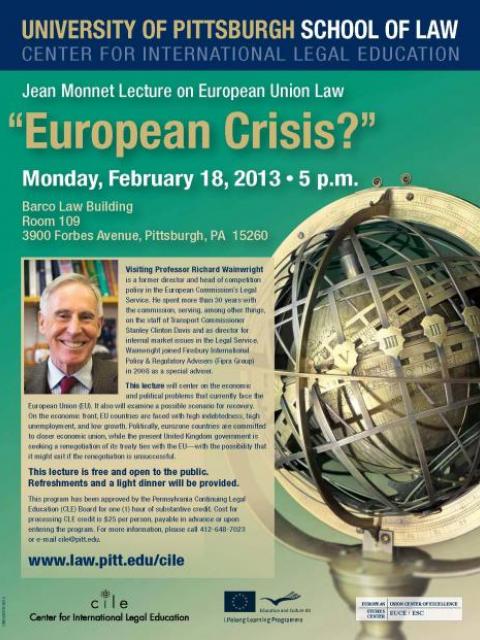
Time:
5:00 pm
Presenter:
Richard Wainwright, Visiting Professor, University of Pittsburgh School of Law
Announced by:
European Studies Center on behalf of Center for International Legal Education
Cost:
Free unless attending for PA CLE Board Credit.
Contact Phone:
412-648-7023
Contact Email:
cile@pitt.edu
As a part of the Jean Monnet Lecture on European Union Law, Professor Wainwright’s lecture will center on the economic and political problems that currently face the European Union, and will examine a possible scenario for recovery. On the economic front, EU countries are faced with high indebtedness, high unemployment, and low growth. Politically, Eurozone countries are committed to closer economic union, while the present United Kingdom government is seeding a renegotiation of its treaty ties with the EU—with the possibility that it might exit if the renegotiation is unsuccessful. Professor Wainwright has worked for more than 30 years with the European Commission’s Legal Service, including serving as the former director and head of competition policy. He has also served on the staff of Transport Commissioner Stanley Clinton Davis and as director for internal market issues in the Legal Service. Refreshments and a light dinner will be provided. This program has also been approved by the PA Continuing Legal Education Board for 1 hour of substantive credit. For more information, please call 412-648-7023 or email cile@pitt.edu.
‘We Carried Your Secrets:’ One Man’s Experience of Reconciliation in Northern Ireland
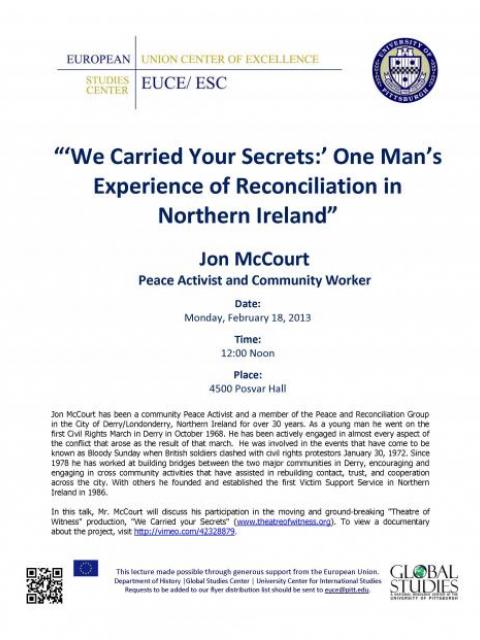
Time:
12:00 pm to 1:00 pm
Presenter:
Jon McCourt, Peace Activist and Community Organizer
Location:
4500 Posvar Hall
Sponsored by:
European Studies Center, European Union Center of Excellence and Global Studies Center along with Department of History
Cost:
Free
Contact:
Allyson Delnore
Contact Phone:
412-624-5404
Contact Email:
adelnore@pitt.edu
Jon McCourt has been a community Peace Activist and a member of the Peace and Reconciliation Group in the City of Derry/Londonderry, Northern Ireland for over 30 years. As a young man he went on the first Civil Rights March in Derry in October 1968. He has been actively engaged in almost every aspect of the conflict that arose as the result of that march. He was involved in the events that have come to be known as Bloody Sunday when British soldiers clashed with civil rights protestors January 30, 1972. Since 1978 he has worked at building bridges between the two major communities in Derry, encouraging and engaging in cross community activities that have assisted in rebuilding contact, trust, and cooperation across the city. With others he founded and established the first Victim Support Service in Northern Ireland in 1986.
In this talk, Mr. McCourt will discuss his participation in the moving and ground-breaking "Theatre of Witness" production, "We Carried your Secrets" (www.theatreofwitness.org). To view a documentary about the project, visit http://vimeo.com/42328879.
Shakespeare's Two Antonios: Language, Stage History, and the History of Sexuality
Time:
12:00 pm
Presenter:
MARIANNE NOVY (English)
Location:
Cathedral of Learning, Room 501G
Announced by:
European Studies Center on behalf of Medieval and Renaissance Studies Program and Dietrich School of Arts and Sciences
Contact:
Jennifer Waldron
Contact Email:
jwaldron@pitt.edu
Shakespeare's plays Merchant of Venice and Twelfth Night both contain men named Antonio who speak of their love for another male character. Both Antonios remain single at the ends of their plays while both of the men they love marry women. Recent critics often see homosexual desire in the Antonios, and productions today often emphasize their exclusion from the comic community. Some have argued, however, that these views lack historical awareness, whether because the Antonios exemplify the conventions of ideal friendship, or because the early modern period might have accepted their forms of same-sex desire. However, one Antonio could also be considered an outsider because he is a melancholy character in a comedy, and the other because he is arrested and called a pirate. This paper considers the possible outsider or insider status of these characters in relation to the characters' language and stage history and the history of sexuality.
This talk is derived from Professor Novy's book Shakespeare and Outsiders, forthcoming from Oxford University Press in June. The talk will introduce a few of the issues to be discussed in her new fall graduate course, Shakespeare, Gender, and Sexuality.
Friday, February 15th, 2013
Making Waves: Democratic Contention in Europe & Latin America Since 1848
Time:
2:30 pm
Presenter:
Kurt Weyland (UT Austin)
Location:
WWPH 4500
Announced by:
European Studies Center on behalf of Department of Political Science
Contact:
Scott Morgenstern
Contact Email:
smorgens@pitt.edu
Kurt has written widely about democratization and methodological themes. He also has had a recent article in PS about the tenure process.
The EU's Response to the Eurozone Crisis: Deeper Integration & Closer Transatlantic Ties
Time:
11:00 am to 12:30 pm
Presenter:
Klaus Welle, Secretary General of the European Parliament
Location:
4217 WWPH
Sponsored by:
European Studies Center, European Union Center of Excellence and Global Studies Center along with Johns Hopkins University Center for Transatlantic Relations
Contact Email:
env1@pitt.edu
The Center for Transatlantic Relations at Johns Hopkins University will be hosting the Secretary General of the European Parliament, Klaus Welle, and will be videoconferencing with numerous schools throughout the United States for a discussion on the Eurozone Crisis, and its effects on Europe and Europe’s international relationships.
Friday, February 15th, 2013 to Saturday, February 16th, 2013
Model EU Undergraduate
Time:
(All day)
Sponsored by:
European Studies Center and European Union Center of Excellence
Thursday, February 14th, 2013
Colloquium: What were Jewish Books in the Fifteenth and Sixteenth Centuries?
Time:
12:30 pm to 2:00 pm
Presenter:
Adam Shear (Humanities Center)
Location:
Cathedral of Learning, Room 602
Announced by:
European Studies Center on behalf of Humanities Center
Reflections about Johannes Reuchlin, Some Notaries, and Some Learned Jews. With responses by Ryan McDermott (English) and Ron Zboray (Communication).
Faculty and graduate students in Pitt Humanities departments can access readings for colloquia by logging in to , clicking on the tab “My Resources,” clicking on “Humanities Center,” and then clicking on “Colloquium Series” where there is a link to the pdf files. Anyone else wishing to access the readings may request the reading at humctr@pitt.edu.
U.S. And European Relations in the Second Obama Administration
Time:
10:30 am
Presenter:
Ron Linden (Poli Sci)
Location:
Levy Hall, Rodef Shalom Congregation, 4905 Fifth Avenue, Pittsburgh, PA 15213
Announced by:
European Studies Center on behalf of Rodef Shalom Brotherhood
Wednesday, February 13th, 2013
Translation Seminar
Time:
2:30 pm
Presenter:
Lawrence Venuti (Temple)
Location:
Cathedral of Learning, Room 602
Announced by:
European Studies Center on behalf of Humanities Center
Contact Phone:
cbove@pitt.edu
Dr. Venuti will give a seminar focusing on different ways of thinking about translation, using theory and examples of translations between English and other languages. He will focus on particular texts and ways to teach them, again, to students without strong second language skills. Amani Attia (Arabic Coordinator), Lina Insana (Associate Professor of Italian), and Gina Peirce (Assistant Director of Russian and East European Studies) will also speak at this workshop.
For seminar materials, contact: Carol M. Bové.
Tuesday, February 12th, 2013
Translation, Intertextuality, Interpretation
Time:
4:00 pm
Presenter:
Lawrence Venuti (Temple)
Location:
Cathedral of Learning, Room 602
Announced by:
European Studies Center on behalf of Humanities Center
Contact:
Carol Bove (English)
Contact Phone:
(412) 624-6506
Contact Email:
cbove@pitt.edu
Prof. Venuti will give an overview of literary translation including the ways in which a translated text offers a set of relations, a form of intertextuality, analogous to the set offered by the source text. He will discuss particular strategies one might use with undergraduates and beginning graduate students who often lack advanced knowledge of a second language, for instance two English versions of the same source text. There will be ample opportunity for discussion.
Saturday, February 9th, 2013
Workshop: Non-Traditional Approaches to International Affairs
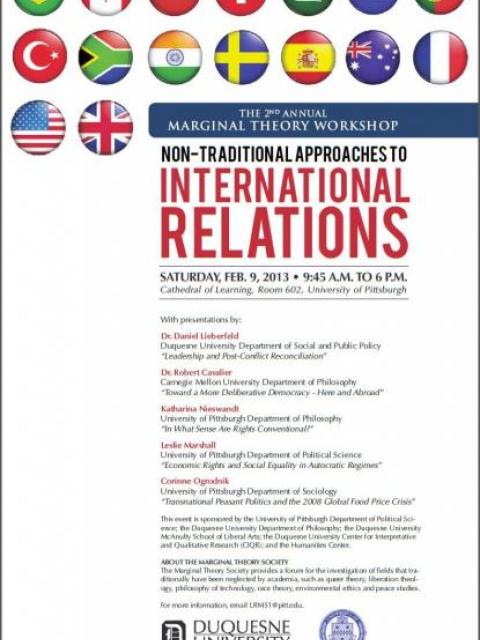
Time:
9:30 am to 5:00 pm
Location:
Cathedral of Learning, Room 602
Announced by:
European Studies Center on behalf of Humanities Center, Department of Political Science, Philosophy Department (Duquesne), Duquesne University McAnulty School of Liberal Arts and Center for Interpretative and Qualitative Research (Duquesne)
Contact:
Leslie Marshall (Political Science), Nathan Eckstrand
Contact Email:
leslie.marshall21@gmail.com, eckstrand@duq.edu
Organizer: The Marginal Theory Society
*Anyone is welcome to attend any of the presentations.*
Marginal Theory Workshop: "Non-Traditional Approaches to International
Relations"
Schedule of events:
Saturday, February 9th
9:45-10:00 - Introduction
10:00-10:30 - First Speaker - Dr. Daniel Lieberfeld - (Duquesne - Social
and Public Policy) - "Leadership and Post-conflict Reconciliation"
10:30-11:00 - Q and A
11:00-11:15 - mini-break
11:15-11:45 - Second Speaker - Dr. Robert Cavalier (CMU - Philosophy) -
"Toward a More Deliberative Democracy - Here and Abroad"
11:45-12:15 - Q and A
12:15-1:30 - long break
1:30-2:00 - Third Speaker - Katharina Nieswandt (Pitt - Philosophy) - "In
What Sense are Rights Conventional?"
2:00-2:30 - Q and A
2:30-2:45 - mini break
2:45-3:15 - Fourth Speaker - Leslie Marshall (Pitt - Political Science) -
"Economic Rights and Social Equality in Autocratic Regimes"
3:15-3:45 - Q and A
3:45-4:00 - mini break
4:00-4:30 - Fifth Speaker - Corinne Ogrodnik (Pitt - Sociology) -
"Transnational Peasant Politics and the 2008 Global Food Price Crisis"
4:30-5:00 - Q and A
5:00-6:00 - Reception