Tuesday, October 16th, 2012
Weimar Cinema Screenings (German Cinema 1919-1933)
Location: Lawrence Hall, Room 209
Announced by:
on behalf of
All films will have subtitles accessible to non-German speaking audiences. All film screenings are open to the public. All films will be DVD projection. Many of these films are rare and hard to find. I would encourage you to bring friends so they can take advantage of the experience.
Tuesday September 11
Nerven [Nerves] (Robert Reiner 1919)
Die Austernprinzessin [The Oyster Princess] (Ernst Lubitsch 1919)
Tuesday September 18
Schloß Vogeloed [Castle Vogeloed] (F.W. Murnau 1921)
Nosferatu (F,W. Murnau 1922)
Tuesday September 25
Die freudlose Gasse [Joyless Streets] (Georg Wilhelm Pabst 1925)
Asphalt (Joe May 1929)
Tuesday October 2
Die Elf Teufel [The Eleven Devils] (Zoltan Korda 1927)
König der Mittelstürmer [The Champion of the Stadium] (Fritz Freisler 1927)
Tuesday October 9
Metropolis (Fritz Lang 1927)
Algol (Hans Werckmeister 1920)
Wunder der Schöpfung [Our Heavenly Bodies] (Hanns Walter Kornblum 1925)
Tuesday October 16
Berlin, die Sinfonie der Großstadt [Berlin the Symphony of the Great City] (Walter Ruttmann 1927)
Die Abenteuer des Prinzen Achmed [The Adventures of Prince Achmed] (Lotte Reiniger, 1923-26)
Tuesday October 23
Büchse der Pandora [Pandora’s Box] (Georg Wilhelm Pabst 1929)
Der Letzte Mann [Last Laugh] (F. W. Murnau 1924)
Tuesday October 30
Der Blaue Engel [The Blue Angel] (Josef Von Sternberg 1930)
Tuesday November 6
Anders als die Andern [Different from the Others] (Richard Oswald 1919)
Mädchen in Uniform [Girls in Uniform] (Leontine Sagan 1931)
Tuesday November 13
Menschen am Sonntag [People on Sunday] (Robert Siodmak 1930)
Tuesday November 20
Die Dreigroschenoper [Three Penny Opera] (Georg Wlhelm Pabst 1931)
Tuesday November 27
Kuhle Wampe [To Whom Does the World Belong?] (Slatan Dudow 1932)
Tuesday December 4
Die Drei von der Tankstelle [Three Men and Lilian] (Wilhelm Thiele 1930)
Der Kongress Tanzt [The Congress Dances] (Erik Charell 1931)
Censorship and Cultural Change: Vernacular Theology, the Oxford Translation Debate, and Arundel's Constitutions of 1409
Presenter: Jen Waldron (English) & Ryan McDermott (English)
Location: Cathedral of Learning, Room 602
Announced by:
on behalf of
Jen Waldron and Ryan McDermott will lead an informal seminar on Nicholas Watson’s "Censorship and Cultural Change: Vernacular Theology, the Oxford Translation Debate, and Arundel's Constitutions of 1409" (1995).
*Part of the yearlong series, “Speaking in Tongues”
Friday, October 12th, 2012
PIZZA & POLITICS: “Inside the Brussels Complex”
Presenter: Andrew Stark, MPIA ’13, GSPIA & Marina Duane, MID ’13, GSPIA
Location: 3610 Posvar Hall
Join GSPIA’s EU and the World Organization President Marina Duane and Vice-President Andrew Stark as they talk about their experience interviewing policy-makers, EU civil servants , and visiting major institutions in Brussels & Luxembourg as participants in the EU in Brussels Program, co-sponsored by Pitt’s EUCE/ESC & GSPIA. Marina and Andrew’s presentation will emphasize how the experience shaped their individual research projects and goals.
Pizza will be served.
Faculty Development Workshop for Nine University and College International Studies Consortium of Georgia
Global Economy and Governance
Location: 4130 Posvar Hall and Southern Polytechnic University
UCIS affiliated faculty and staff presented a professional development workshop via videoconferencing for faculty from the Nine University and College International Studies Consortium of Georgia.
Thursday, October 11th, 2012
Europe Day
A Series of Events Promoting European Studies and Related Resources on the Pitt Campus
Time: 11:00 am to 7:30 pm
Location: William Pitt Union, Wesley W. Posvar Hall
THURSDAY, OCTOBER 11: EUROPE DAY!
Are you interested in studying and eventually working in Europe? Then join us for this series of events that will give you information and resources to successfully include Europe in your plans.
Europe Day Fair
11:00am – 2:00pm, Lower Lounge – William Pitt Union
The Europe Day Fair has been designed to promote Europe related programs and resources on campus, and help undergraduate students understand the ways they can Europeanize their studies and post graduate plans while at Pitt. Come meet with representatives from Europe related centers, academic programs, clubs and organizations on campus, and learn about Europe related resources at the office of Career Development & Placement Assistance. Also learn about European study abroad options and the many ways study abroad can be paid for with scholarships and financial aid.
Panel: “Your Interests in Europe and International Relations: Where Can They Lead?”
3:00 – 4:30, 4130 WWPH
Interested in learning how to match your interests in (Europe related) International Relations and Political Science with academic options and choices for graduate programs and professional fields? Join us for tips & suggestions and to brainstorm about your own interests and plans.
Panelists include: Ron Linden, Director, EUCE/ESC; Bob Hayden, Director, REES; Gemma Marolda, Faculty, EUCE and Political Science Dept; Kristian McCloud – Career Development and Placement Assistance Office
“Passport Career” Orientation
6:00 – 8:30, Lower Lounge – WPU
Passport Career is a useful tool for Pitt students and alumni who may be considering a job or internship search abroad and allows users to search for information by city and country of interest. Susan Musich, the founder Executive Director of Passport Career, will introduce this new resource to students interested in exploring possibilities of working abroad.
Wednesday, October 10th, 2012
Video Conference: Conversations on Europe: "The End of Soft Power? The EU and the Middle East."
Time: 12:00 pm to 1:30 pm
Location: 4217 Posvar Hall
As this second installment in our series of interactive videoconferences this year, Conversations in Europe, the EUCE/ESC will bring experts together via remote connection to discuss the range and level of European influence in the Middle East. Europe has, until recently, been an attractive model for countries in democratization, because of the non-threatening, non-military way Europe—and the EU in particular—attracted adherents. Almost two years after the Arab Spring, does Europe retain any influence, any ability to influence events? Panelists will include: Mohammed Bamyeh (University of Pittsburgh); Tal Sadeh (Tel Aviv University); Urfan Khaliq (Cardiff University); Beverly Crawford (University of California, Berkeley); and Eva-Maria Maggi (Helmut-Schmidt-University/University of Washington). Ronald Linden, Professor of Political Science, will moderate. Audience participation is invited.
Wednesday, October 10th, 2012 to Friday, October 12th, 2012
2012 International Workshop on Higher Education Reform
Reforming the Policy and Practice of Community Engagement of Higher Education
Location: University of Pittsburgh Campus
Reforming the Policy and Practice of Community Engagement of Higher Education featuring keynote addresses by:
Mark A. Nordenberg, Chancellor, University of Pittsburgh
David P. Baker, Penn State
Kassie Freeman, President, Southern University System
Alex Johnson, President, CCAC
Anne Kaplan, Vice President, Northern Illinois University
Josef W. Konvitz, Chair, PASCAL International Observatory
Tuesday, October 9th, 2012
Weimar Cinema Screenings (German Cinema 1919-1933)
Location: Lawrence Hall, Room 209
Announced by:
on behalf of
All films will have subtitles accessible to non-German speaking audiences. All film screenings are open to the public. All films will be DVD projection. Many of these films are rare and hard to find. I would encourage you to bring friends so they can take advantage of the experience.
Tuesday September 11
Nerven [Nerves] (Robert Reiner 1919)
Die Austernprinzessin [The Oyster Princess] (Ernst Lubitsch 1919)
Tuesday September 18
Schloß Vogeloed [Castle Vogeloed] (F.W. Murnau 1921)
Nosferatu (F,W. Murnau 1922)
Tuesday September 25
Die freudlose Gasse [Joyless Streets] (Georg Wilhelm Pabst 1925)
Asphalt (Joe May 1929)
Tuesday October 2
Die Elf Teufel [The Eleven Devils] (Zoltan Korda 1927)
König der Mittelstürmer [The Champion of the Stadium] (Fritz Freisler 1927)
Tuesday October 9
Metropolis (Fritz Lang 1927)
Algol (Hans Werckmeister 1920)
Wunder der Schöpfung [Our Heavenly Bodies] (Hanns Walter Kornblum 1925)
Tuesday October 16
Berlin, die Sinfonie der Großstadt [Berlin the Symphony of the Great City] (Walter Ruttmann 1927)
Die Abenteuer des Prinzen Achmed [The Adventures of Prince Achmed] (Lotte Reiniger, 1923-26)
Tuesday October 23
Büchse der Pandora [Pandora’s Box] (Georg Wilhelm Pabst 1929)
Der Letzte Mann [Last Laugh] (F. W. Murnau 1924)
Tuesday October 30
Der Blaue Engel [The Blue Angel] (Josef Von Sternberg 1930)
Tuesday November 6
Anders als die Andern [Different from the Others] (Richard Oswald 1919)
Mädchen in Uniform [Girls in Uniform] (Leontine Sagan 1931)
Tuesday November 13
Menschen am Sonntag [People on Sunday] (Robert Siodmak 1930)
Tuesday November 20
Die Dreigroschenoper [Three Penny Opera] (Georg Wlhelm Pabst 1931)
Tuesday November 27
Kuhle Wampe [To Whom Does the World Belong?] (Slatan Dudow 1932)
Tuesday December 4
Die Drei von der Tankstelle [Three Men and Lilian] (Wilhelm Thiele 1930)
Der Kongress Tanzt [The Congress Dances] (Erik Charell 1931)
Did European Monetary Union (EMU) Promote a European Identity?
Time: 12:00 pm to 1:30 pm
Presenter: Tal Sadeh, Tel Aviv University
Location: 4217 Posvar Hall
Professor Tal Sadeh, Head of the Hartog School of Government and Policy at Tel Aviv University, will discuss the effects of monetary union on supranational identity in Europe.
Brazil and Turkey: Emerging Nations in the New Global Order
Presenter: Lílian Duarte (Cultural Attaché, Brazilian Embassy in Turkey)
Location: 4130 Wesley W. Posvar Hall, University of Pittsburgh
Friday, October 5th, 2012
Poor People, Poor Places, and Poor Health: the Mediating Role of Social Networks and Social Capital
Presenter: Center for Health Equity Journal Club
Announced by:
on behalf of
CHE hosts this monthly meeting to facilitate dialogue about health equity among faculty, students, and staff. We hope to spark an intellectually enriching discussion regarding ways to research a problem or intervene to contribute to the solution.
This month’s meeting is facilitated by Jason Flatt, PhD candidate, and Laura Macia, PhD and features the article Poor People, Poor Places, and Poor Health: the Mediating Role of Social Networks and Social Capital. The "[p]aper is based on qualitative research undertaken in 1996 on two housing estates in East London,UK."
Feel free to bring your lunch.
Thursday, October 4th, 2012
Sustainable Energy Innovators: Moving Toward a Low-Carbon Future
Provost Lecture at Science 2012
Presenter: Dr. Miranda Schreurs of the Free University of Berlin
Location: 7th floor Alumni Hall Auditorium
Announced by:
on behalf of
Provost Lecture at Science 2012
Miranda A. Schreurs, PhD, is a recognized leader in the field of comparative environmental politics and policy in Europe, the United States, and East Asia.
Schreurs grew up in the United States and earned bachelor’s and master’s degrees from the University of Washington and her doctorate in comparative politics from the University of Michigan. She joined the University of Maryland in 1994 and has worked as a guest professor at universities in Japan and Germany. In 2007, she was recruited to the Freie Universität Berlin as professor of comparative politics and director of the university’s Environmental Policy Research Centre, an international team of social science researchers and students who study, evaluate, and provide policy advice related to environmental and sustainable energy politics and policies.
In 2008, Schreurs became a member of the German Advisory Council on the Environment. She is chair of the European Environment and Sustainable Development Advisory Councils, a network of advisory councils across Europe. In 2012, German Chancellor Angela Merkel appointed her to the Ethics Commission on a Safe Energy Supply, which was charged with advising the German government on energy questions after the Fukushima nuclear explosion.
Author of several books and many journal articles on energy and environmental policy, Schreurs has held fellowships from the Social Science Research Council–MacArthur Foundation Program on International Peace and Security Affairs, the Fulbright Foundation, and the National Science Foundation/Science and Technology Agency of Japan.
Wednesday, October 3rd, 2012
Political Translators: How Heterogeneous Movement Groups Can Democratize Communication
Presenter: Dr. Nicole Doerr, postdoctoral fellow at the Free University of Berlin and the University of California Irvine
Location: 2432 WW Posvar Hall
Announced by:
on behalf of
Tuesday, October 2nd, 2012
Weimar Cinema Screenings (German Cinema 1919-1933)
Location: Lawrence Hall, Room 209
Announced by:
on behalf of
All films will have subtitles accessible to non-German speaking audiences. All film screenings are open to the public. All films will be DVD projection. Many of these films are rare and hard to find. I would encourage you to bring friends so they can take advantage of the experience.
Tuesday September 11
Nerven [Nerves] (Robert Reiner 1919)
Die Austernprinzessin [The Oyster Princess] (Ernst Lubitsch 1919)
Tuesday September 18
Schloß Vogeloed [Castle Vogeloed] (F.W. Murnau 1921)
Nosferatu (F,W. Murnau 1922)
Tuesday September 25
Die freudlose Gasse [Joyless Streets] (Georg Wilhelm Pabst 1925)
Asphalt (Joe May 1929)
Tuesday October 2
Die Elf Teufel [The Eleven Devils] (Zoltan Korda 1927)
König der Mittelstürmer [The Champion of the Stadium] (Fritz Freisler 1927)
Tuesday October 9
Metropolis (Fritz Lang 1927)
Algol (Hans Werckmeister 1920)
Wunder der Schöpfung [Our Heavenly Bodies] (Hanns Walter Kornblum 1925)
Tuesday October 16
Berlin, die Sinfonie der Großstadt [Berlin the Symphony of the Great City] (Walter Ruttmann 1927)
Die Abenteuer des Prinzen Achmed [The Adventures of Prince Achmed] (Lotte Reiniger, 1923-26)
Tuesday October 23
Büchse der Pandora [Pandora’s Box] (Georg Wilhelm Pabst 1929)
Der Letzte Mann [Last Laugh] (F. W. Murnau 1924)
Tuesday October 30
Der Blaue Engel [The Blue Angel] (Josef Von Sternberg 1930)
Tuesday November 6
Anders als die Andern [Different from the Others] (Richard Oswald 1919)
Mädchen in Uniform [Girls in Uniform] (Leontine Sagan 1931)
Tuesday November 13
Menschen am Sonntag [People on Sunday] (Robert Siodmak 1930)
Tuesday November 20
Die Dreigroschenoper [Three Penny Opera] (Georg Wlhelm Pabst 1931)
Tuesday November 27
Kuhle Wampe [To Whom Does the World Belong?] (Slatan Dudow 1932)
Tuesday December 4
Die Drei von der Tankstelle [Three Men and Lilian] (Wilhelm Thiele 1930)
Der Kongress Tanzt [The Congress Dances] (Erik Charell 1931)
"Woes, woes, and euros: Origins and likely outcomes of the European debt crisis."
Presenter: Dave Andrews, Director of the European Union Center of California at Scripps College in Claremont, California
David M. Andrews is the Jean Monnet Chair of EU Interdisciplinary Studies, Gabrielle Marie-Louise Jungels-Winkler Chair in Contemporary European Studies, Professor of International Relations, and Director of the European Union Center of California at Scripps College in Claremont, California. His talk will be about the European Debt Crisis, as he is an expert on monetary union and Germany’s place in the EU. While on campus, he will also be visiting the Delegation Collection at the Hillman library to finish up the research for his book on the foundations of the European Union and how efforts to resolve “the German problem” led to monetary union.
Monday, October 1st, 2012
Latin Authorship During the Rise of the Vernaculars
Presenter: Ann Blair (Harvard)
Location: Cathedral of Learning, Room 602
Announced by:
on behalf of
*Part of the yearlong series, “Speaking in Tongues”
Friday, September 28th, 2012
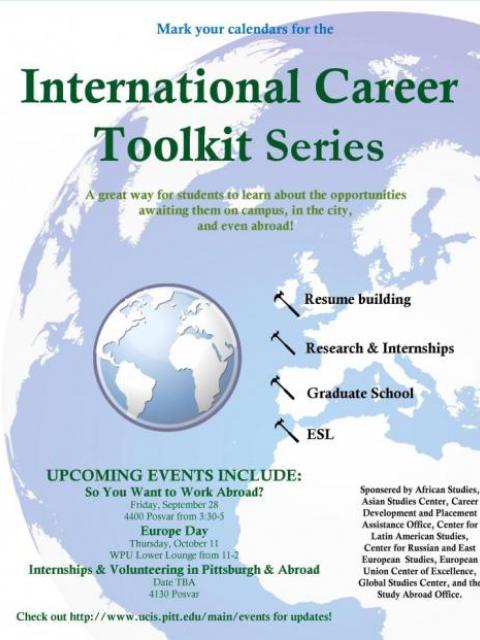
International Career Toolkit Series: So You Want to Work Abroad?
Location: 4400 Posvar Hall
A great way for students to learn about the opportunities awaiting them on campus, in the city, and even abroad!
Roses in Winter: How One Recipe Collection May Coax Us Beyond Shakespeare's Procreation Sonnets
Presenter: REBECCA LAROCHE (Uni of Colorado-Colorado Springs)
Location: Cathedral of Learning, Room 501G
Announced by:
on behalf of
In Roses in Winter Rebecca Laroche moves beyond recent readings of recipes, distillation and the procreation sonnets. Focusing closely on how one recipe book treats roses and various rose products, Laroche returns to the sonnets with a new appreciation of how roses in these poems are not merely distilled, but rather they grow. What is more, rose water and oil are not everlasting; they, too, fade, and, in their use, they must be replenished. This close, archivally-driven reading recognizes that the different moments of distillation function variously in the sonnets, as a recipe on distilling rose oil differs from a recipe for damask water and both differ from a recipe that has a water or an oil as an ingredient. The lecture as a whole makes a strong argument for more archival work with manuscripts from the early modern era.
REBECCA LAROCHE is Professor of English at the University of Colorado at Colorado Springs. Her publications include Medical Authority and and Englishwomen’s Herbal Texts, 1550-1650 (Ashgate, 2010) and Ecofeminist Approaches to Early Modernity (Palgrave, 2011), co-edited with Jennifer Munroe.
Thursday, September 27th, 2012
The Impact of Scientific Discoveries
Presenter: Adam Davis (Duquesne)
Location: Scaife Hall, Lecture Room 5
Announced by:
on behalf of
A corollary to the traveling exhibit from the National Library of Medicine: "Rewriting the Book of Nature: Charles Darwin and the Rise of Evolutionary Theory."
Too Much to Know: Information Management in Comparative Perspective & Tommaso Porcacchi
Presenter: Dennis Looney (French & Italian)
Location: Cathedral of Learning, Room 501G
Announced by:
on behalf of
Dennis Looney will lead an informal seminar on links between Ann Blair’s work (Too Much to Know:
“Information Management in Comparative Perspective") and his research on the systematization of history by Tommaso Porcacchi of the Giolito Press, in the 1560s and 1570s.
*Part of the yearlong series, “Speaking in Tongues”
Wednesday, September 26th, 2012
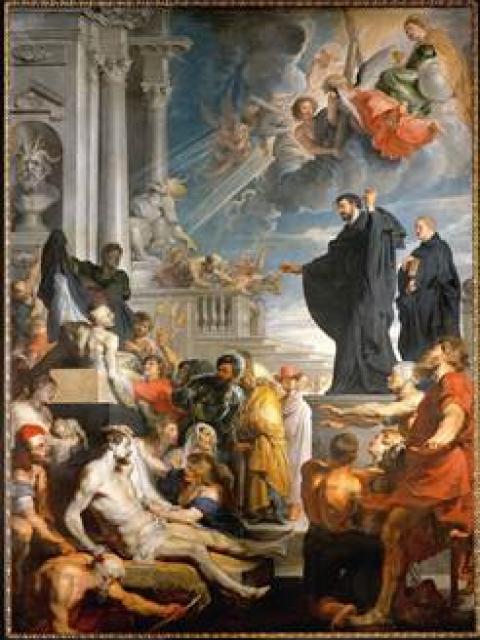
A Fallen Hindu Idol in Antwerp: Rubens’s Miracles of St. Francis Xavier and the Theme of Idol Smashing
Presenter: Rachel Miller (HAA)
Location: Room 203 Frick Fine Arts
Announced by:
on behalf of
The background of Peter Paul Rubens’s Miracles of St. Francis Xavier, painted in 1617 for the Jesuit church in Antwerp, contains a surprising detail - a horned Hindu idol that is being destroyed by rays of light emanating from an allegory of the Catholic Faith. Far from being meaningless exotica, the Hindu idol plays an important iconographic role in the larger decorative scheme of the Antwerp Jesuit church. Designed by Rubens in 1620 and executed by his assistants, the ceiling decoration of the side aisles and galleries contains several other images of the destruction of idols by early Christian saints such as St. Eugenia and St. John Chrysostom. There is no other Jesuit church in the world where the themes of iconoclasm and idol smashing are so prominent. This iconography must have had special significance for audiences in Antwerp. In the course of this presentation, I will demonstrate that the events of the late sixteenth century, including the iconoclasm of 1566 and the tyrannical governorship of the Duke of Alba, still resonated in Antwerp and led Rubens to make certain iconographic choices when confronted with the problem of how to depict the destruction of religious images in a city that was still recovering from wounds inflicted by revolt, oppression, mutiny, and war.
Tuesday, September 25th, 2012
Weimar Cinema Screenings (German Cinema 1919-1933)
Location: Lawrence Hall, Room 209
Announced by:
on behalf of
All films will have subtitles accessible to non-German speaking audiences. All film screenings are open to the public. All films will be DVD projection. Many of these films are rare and hard to find. I would encourage you to bring friends so they can take advantage of the experience.
Tuesday September 11
Nerven [Nerves] (Robert Reiner 1919)
Die Austernprinzessin [The Oyster Princess] (Ernst Lubitsch 1919)
Tuesday September 18
Schloß Vogeloed [Castle Vogeloed] (F.W. Murnau 1921)
Nosferatu (F,W. Murnau 1922)
Tuesday September 25
Die freudlose Gasse [Joyless Streets] (Georg Wilhelm Pabst 1925)
Asphalt (Joe May 1929)
Tuesday October 2
Die Elf Teufel [The Eleven Devils] (Zoltan Korda 1927)
König der Mittelstürmer [The Champion of the Stadium] (Fritz Freisler 1927)
Tuesday October 9
Metropolis (Fritz Lang 1927)
Algol (Hans Werckmeister 1920)
Wunder der Schöpfung [Our Heavenly Bodies] (Hanns Walter Kornblum 1925)
Tuesday October 16
Berlin, die Sinfonie der Großstadt [Berlin the Symphony of the Great City] (Walter Ruttmann 1927)
Die Abenteuer des Prinzen Achmed [The Adventures of Prince Achmed] (Lotte Reiniger, 1923-26)
Tuesday October 23
Büchse der Pandora [Pandora’s Box] (Georg Wilhelm Pabst 1929)
Der Letzte Mann [Last Laugh] (F. W. Murnau 1924)
Tuesday October 30
Der Blaue Engel [The Blue Angel] (Josef Von Sternberg 1930)
Tuesday November 6
Anders als die Andern [Different from the Others] (Richard Oswald 1919)
Mädchen in Uniform [Girls in Uniform] (Leontine Sagan 1931)
Tuesday November 13
Menschen am Sonntag [People on Sunday] (Robert Siodmak 1930)
Tuesday November 20
Die Dreigroschenoper [Three Penny Opera] (Georg Wlhelm Pabst 1931)
Tuesday November 27
Kuhle Wampe [To Whom Does the World Belong?] (Slatan Dudow 1932)
Tuesday December 4
Die Drei von der Tankstelle [Three Men and Lilian] (Wilhelm Thiele 1930)
Der Kongress Tanzt [The Congress Dances] (Erik Charell 1931)
Saturday, September 22nd, 2012
Linking Language and Literary-Cultural Content: A Multiliteracies Approach to Advanced Collegiate FL Teaching
Time: 10:00 am to 3:00 pm
Presenter: Heather Allen (Wisconsin)
Location: Martin Room, 4127 Sennott Square
*Lunch provided*
RSVP to losagio@pitt.edu by Monday, September 17, 2012
Graduate students and faculty are invited to participate in this workshop, which will provide training in the theory and application of the multiliteracies approach to teaching advanced-level foreign language courses. Participants will have the chance to develop their own teaching materials.
Heather Willis Allen is an Assistant Professor of French and Second Language Acquisition at the University of Wisconsin-Madison, where she also serves as Course Chair for the Elementary French program. Allen’s research interests include language-learning motivation, teacher development, and literacy-based approaches to teaching and learning. Her book-length publications include Educating the Future Foreign Language Professoriate for the 21st Century (Heinle Cengage, 2011), co-edited with Hiram H. Maxim, and Alliages culturels: La société française en transformation (in press, Heinle Cengage), a literacy-based introduction to French culture today textbook co-authored with Sebastien Dubreil. Allen’s research has also appeared in the ADFL Bulletin, Foreign Language Annals, the French Review, Frontiers: The Interdisciplinary Journal of Study Abroad, the Journal of Studies in International Education, the L2 Journal and the Modern Language Journal. Her next project, contracted with Pearson, is a co-authored introduction to foreign language teaching manual entitled A Multiliteracies Framework for Collegiate Foreign Language Teaching.
Thursday, September 20th, 2012
Too Much to Know: Information Management in Comparative Perspective- Ch.2 & 3 Seminar
Presenter: Dan Selcer (Duquesne)
Location: Jen Waldron's house
Announced by:
on behalf of
Dan Selcer will lead an informal seminar on chapters two & three of Ann Blair's Too Much to Know: "Information Management in Comparative Perspective," as a lead-up to the author's visit in October.
Email Jennifer Waldron for directions.
Colloquium- Evidence of Things Not Seen: History, Subjectivities, Music- Critical Musicological Reflections
Time: 12:30 pm to 2:00 pm
Presenter: Susan McClary (Case Western)
Location: Cathedral of Learning, Room 602
Announced by:
on behalf of
With responses by Nancy Condee (Global Studies), Kathryn Flannery (English), Andrew Weintraub (Music)
Susan McClary is Professor of Music at Case Western University. Her research focuses on the cultural criticism of music, both the European canon and contemporary popular genres. She is best known for her book Feminine Endings: Music, Gender, and Sexuality (1991), which examines cultural constructions of gender, sexuality, and the body in various musical repertories, ranging from early seventeenth-century opera to the songs of the pop queen Madonna. In her more recent publications, she explores the many ways in which subjectivities have been construed in music from the sixteenth-century onward. Modal Subjectivities: Renaissance Self-Fashioning in the Italian Madrigal (2004) won the Otto Kinkeldey Prize from the American Musicological Society in 2005, and its sequel — Desire and Pleasure in Seventeenth-Century Music — appeared in 2012.
Faculty and graduate students in Pitt Humanities departments can access colloquium papers two weeks before the event by logging in to , clicking on the tab “My Resources,” clicking on “Humanities Center,” and then clicking on “Colloquium Series” where there is a link to the pdf file. Anyone else wishing to access the readings may request the reading at humctr@pitt.edu.
Pizza and Politics: Paradigm Change in EU Migration-Foreign Policy Nexus
Time: 12:00 pm to 1:00 pm
The first in our Pizza and Politics Graduate Lecture Series for 2012-2013, EUCE/ESC Visiting Scholar Fatma Yilmaz (Turkey) will be lead a round table discussion about the logic behind EU migration policies toward third countries. Has there been any real change in traditional control-oriented migration policies in terms of foreign policy? Pizza will be served.
Wednesday, September 19th, 2012
Csárdás in ¾ Time: The Post-Imperial Cinema World in Interwar Austria and Hungary
Time: 12:00 pm to 1:30 pm
Presenter: Andrew Behrendt, Ph.D. Student, Department of History
Location: 4217 Posvar Hall
The Habsburg Monarchy disappeared in 1918, but many elements of its urban culture survived and even continued to evolve in the years to follow. In popular cinema of the interwar period, we can pick up what Nancy Condee has called, in other contexts, an "imperial trace" and begin to map out a common cultural space that continued to bridge the former twin seats of empire, Vienna and Budapest. For this talk, I will focus on three titles -- Frühjahrsparade (1934), Ernte/Die Julika (1936), and Maria Ilona (1939) -- helmed by Géza von Bolváry, one of the most prolific directors of the period. These films point the way toward a "post-imperial" cinema that both re-enacted and re-imagined the relationship between the Austrian and Hungarian halves of the vanished Dual Monarchy.
Tuesday, September 18th, 2012
Weimar Cinema Screenings (German Cinema 1919-1933)
Location: Lawrence Hall, Room 209
Announced by:
on behalf of
All films will have subtitles accessible to non-German speaking audiences. All film screenings are open to the public. All films will be DVD projection. Many of these films are rare and hard to find. I would encourage you to bring friends so they can take advantage of the experience.
Tuesday September 11
Nerven [Nerves] (Robert Reiner 1919)
Die Austernprinzessin [The Oyster Princess] (Ernst Lubitsch 1919)
Tuesday September 18
Schloß Vogeloed [Castle Vogeloed] (F.W. Murnau 1921)
Nosferatu (F,W. Murnau 1922)
Tuesday September 25
Die freudlose Gasse [Joyless Streets] (Georg Wilhelm Pabst 1925)
Asphalt (Joe May 1929)
Tuesday October 2
Die Elf Teufel [The Eleven Devils] (Zoltan Korda 1927)
König der Mittelstürmer [The Champion of the Stadium] (Fritz Freisler 1927)
Tuesday October 9
Metropolis (Fritz Lang 1927)
Algol (Hans Werckmeister 1920)
Wunder der Schöpfung [Our Heavenly Bodies] (Hanns Walter Kornblum 1925)
Tuesday October 16
Berlin, die Sinfonie der Großstadt [Berlin the Symphony of the Great City] (Walter Ruttmann 1927)
Die Abenteuer des Prinzen Achmed [The Adventures of Prince Achmed] (Lotte Reiniger, 1923-26)
Tuesday October 23
Büchse der Pandora [Pandora’s Box] (Georg Wilhelm Pabst 1929)
Der Letzte Mann [Last Laugh] (F. W. Murnau 1924)
Tuesday October 30
Der Blaue Engel [The Blue Angel] (Josef Von Sternberg 1930)
Tuesday November 6
Anders als die Andern [Different from the Others] (Richard Oswald 1919)
Mädchen in Uniform [Girls in Uniform] (Leontine Sagan 1931)
Tuesday November 13
Menschen am Sonntag [People on Sunday] (Robert Siodmak 1930)
Tuesday November 20
Die Dreigroschenoper [Three Penny Opera] (Georg Wlhelm Pabst 1931)
Tuesday November 27
Kuhle Wampe [To Whom Does the World Belong?] (Slatan Dudow 1932)
Tuesday December 4
Die Drei von der Tankstelle [Three Men and Lilian] (Wilhelm Thiele 1930)
Der Kongress Tanzt [The Congress Dances] (Erik Charell 1931)
Salome in the Court of Queen Christina
Presenter: Susan McClary (Case Western)
Location: Cathedral of Learning, Room 602
Announced by:
on behalf of
The lurid biblical story of John the Baptist, King Herod, and Herod’s precocious stepdaughter became an operatic hit in 1905 with Richard Strauss’ Salome. The lecture presents an earlier musical version of this character, la Figlia in Alessandro Stradella’s oratorio San Giovanni Battista (1675), and considers the reasons why femmes fatales ruled the operatic stage in the seventeenth no less than in the late nineteenth century.
Susan McClary is Professor of Music at Case Western University. Her research focuses on the cultural criticism of music, both the European canon and contemporary popular genres. She is best known for her book Feminine Endings: Music, Gender, and Sexuality (1991), which examines cultural constructions of gender, sexuality, and the body in various musical repertories, ranging from early seventeenth-century opera to the songs of the pop queen Madonna. In her more recent publications, she explores the many ways in which subjectivities have been construed in music from the sixteenth-century onward. Modal Subjectivities: Renaissance Self-Fashioning in the Italian Madrigal (2004) won the Otto Kinkeldey Prize from the American Musicological Society in 2005, and its sequel — Desire and Pleasure in Seventeenth-Century Music — appeared in 2012.
Friday, September 14th, 2012
Irish Studies End-of-Week Reception
Location: Lower lounge, Wm Pitt Union
To cap off the events of Irish Studies Week 2012, the EUCE/ESC will host a reception with live Irish music and information on the multiple opportunities to explore contemporary and historical Ireland while at the University of Pittsburgh. Refreshments provided. Open to the community.
Thursday, September 13th, 2012
Multi-disciplinary Study Abroad in Ireland
Health and Rehabilitation Sciences
Presenter: Dr. Janice Vance
Location: 4014 Forbes Tower
Dr. Janice Vance of the School of Health and Rehabilitation Sciences will discuss opportunities for and lessons learned from a unique study abroad program in Ireland. She directs a multi-disciplinary program which provides students with the opportunity to explore research, professional practice, and service provision models in Belfast (UK) and Dublin (Ireland) in a range of professions.
Film Screening: “We Carried Your Secrets”
Time: 12:00 pm to 2:00 pm
Presenter: Tony Novosel, Department of History
Location: 4217 Posvar Hall
“We Carried Your Secrets” is a film that chronicles the story of a unique and ground breaking form of theatrical performance called “Theatre of Witness.” It reflects on the very personal and inspirational stories of 7 people as they come to terms with their own legacy and that of their fathers, men who were all badly affected by over thirty years of conflict in Northern Ireland. A viewing of the film will be followed by a Skype discussion with one of the participants in the Theatre of Witness project.
Discussion led by Dr. Anthony Novosel, Dept of History
Wednesday, September 12th, 2012
The Bloody Poor Irish: Poverty and Identity in Ireland
Time: 12:00 pm to 1:30 pm
Presenter: Bernard Hagerty, Department of History
Location: 4217 Posvar Hall
Dr. Bernard Haggerty (Department of History) will present a lecture on cultural constructions of poverty in Irish history.
"Charles Darwin's Challenge to the Skeptics"
Presenter: Robert Olby (History & Philosophy of Science)
Location: Scaife Hall, Lecture Room 5
Announced by:
on behalf of
This lecture will explore the manner in which Darwin prepared his case and crafted his text to meet the skeptics. This analysis will raise questions about the criteria demanded for the acceptance of evidence and prompt reflection on the present state of the subject.
In conjunction with the traveling exhibit "Rewriting the Book of Nature: Charles Darwin and the Rise of Evolutionary Theory" from the National Library of Medicine.
The Prehistoriography of Mesopotamian Art
Presenter: Melissa Eppihimer (History of Art and Architecture)
Location: Room 203, Frick Fine Arts
Announced by:
on behalf of
The study of Mesopotamian art is often said to have begun in the 19th century, when spectacular sculptures were uncovered in the Assyrian capital cities of Nineveh, Nimrud and Khorsabad. However, examples of Mesopotamian art had been in European collections of art and antiquities since the Renaissance. During the 17th and 18th centuries, these artifacts, mostly cylinder and stamp seals, were not recognized as Mesopotamian. Instead, they were collected alongside the gems of Greece and Rome, among which they were thought to belong, or classified as Egyptian amulets. This talk examines the ideas, methods, and publications of the collectors and scholars who engaged with Mesopotamian art in the early modern period in order to explain their erroneous conclusions. The analysis of the history of the collections and the historiography of ancient art illuminates the prehistoriography of Mesopotamian art and demonstrates how this period of scholarship set the stage for later, better-known developments in the field.
Tuesday, September 11th, 2012
Weimar Cinema Screenings (German Cinema 1919-1933)
Location: Lawrence Hall, Room 209
Announced by:
on behalf of
All films will have subtitles accessible to non-German speaking audiences. All film screenings are open to the public. All films will be DVD projection. Many of these films are rare and hard to find. I would encourage you to bring friends so they can take advantage of the experience.
Tuesday September 11
Nerven [Nerves] (Robert Reiner 1919)
Die Austernprinzessin [The Oyster Princess] (Ernst Lubitsch 1919)
Tuesday September 18
Schloß Vogeloed [Castle Vogeloed] (F.W. Murnau 1921)
Nosferatu (F,W. Murnau 1922)
Tuesday September 25
Die freudlose Gasse [Joyless Streets] (Georg Wilhelm Pabst 1925)
Asphalt (Joe May 1929)
Tuesday October 2
Die Elf Teufel [The Eleven Devils] (Zoltan Korda 1927)
König der Mittelstürmer [The Champion of the Stadium] (Fritz Freisler 1927)
Tuesday October 9
Metropolis (Fritz Lang 1927)
Algol (Hans Werckmeister 1920)
Wunder der Schöpfung [Our Heavenly Bodies] (Hanns Walter Kornblum 1925)
Tuesday October 16
Berlin, die Sinfonie der Großstadt [Berlin the Symphony of the Great City] (Walter Ruttmann 1927)
Die Abenteuer des Prinzen Achmed [The Adventures of Prince Achmed] (Lotte Reiniger, 1923-26)
Tuesday October 23
Büchse der Pandora [Pandora’s Box] (Georg Wilhelm Pabst 1929)
Der Letzte Mann [Last Laugh] (F. W. Murnau 1924)
Tuesday October 30
Der Blaue Engel [The Blue Angel] (Josef Von Sternberg 1930)
Tuesday November 6
Anders als die Andern [Different from the Others] (Richard Oswald 1919)
Mädchen in Uniform [Girls in Uniform] (Leontine Sagan 1931)
Tuesday November 13
Menschen am Sonntag [People on Sunday] (Robert Siodmak 1930)
Tuesday November 20
Die Dreigroschenoper [Three Penny Opera] (Georg Wlhelm Pabst 1931)
Tuesday November 27
Kuhle Wampe [To Whom Does the World Belong?] (Slatan Dudow 1932)
Tuesday December 4
Die Drei von der Tankstelle [Three Men and Lilian] (Wilhelm Thiele 1930)
Der Kongress Tanzt [The Congress Dances] (Erik Charell 1931)
Grand Legacy? Ireland's Gaelic Revivals, Past and Present
Presenter: Professor Timothy McMahon, Marquette University
Location: 4217 Posvar Hall
Professor of History at Marquette University, Timothy McMahon will use this lecture to build upon a question that framed his book, Grand Opportunity: The Gaelic Revival and Irish Society. Inspired by a from a quotation from a revivalist who wondered whether his fellow revivalists recognized the grand opportunity that their work presented to them, Dr. McMahon uses this as a starting point for a reflection on the legacies of that earlier revival the state of the language today, particularly in the light of Ireland's relationship to Europe. Marie Young, Department of Linguistics, will serve as respondent.
Too Much to Know: Information Management in Comparative Perspective- Ch.1 Seminar
Presenter: Adam Shear (Humanities Center)
Announced by:
on behalf of
Adam Shear will lead an informal seminar on chapter one of Ann Blair's Too Much to Know: "Information Management in Comparative Perspective," as a lead-up to the author's visit in October.
Video Conference: Conversations on Europe: "Tiger in a Cage: Ireland and the New European Economy"
Time: 12:00 pm to 1:30 pm
Location: 4217 Wesley W. Posvar Hall
In January 2012, the EUCE/ESC launched the new speaker series, Conversations On Europe. Featuring some of the country's top experts on the European Union, this series will link participants and presenters via videoconferencing across several sites. Audiences at all sites will be able to ask questions of the experts. This event is open to the public.
The Conversations Continue Fall 2012 with "Tiger in a Cage: Ireland and the New European Economy" on Tuesday, September 11, 2012 at 12 Noon in 4217 Posvar Hall. Panelists will include:
Prof. Stephen Kinsella (Economics, University of Limerick)
Prof. James S. Donnelly (Emeritus, History, University of Wisconsin-Madison)
Prof. Klaus Larres (Political Science, University of North Carolina, Chapel Hill)
Mr. Vincent Browne, print and broadcast journalist for the Irish Times and TV3 Ireland.
Moderated by Ronald Linden, Director, EUCE/ESC
Monday, September 10th, 2012
From Royal Retainers to Public Servants, or how an Old Regime Family succeeded in Post-Revolutionary France
Presenter: Dena Goodman (University of Michigan-Ann Arbor)
Location: Cathedral of Learning, Room 602
Announced by:
on behalf of
Dena Goodman is the Lila Miller Collegiate Professor, History and Women’s Studies, University of Michigan. A leading specialist in the cultural and intellectual history of early modern France, her monographs include Becoming a Woman in the Age of Letters (2009) and The Republic of Letters: A Cultural History of the French Enlightenment (1994), both with Cornell University Press.
The Irish Diaspora: From the Emerald Isle to the Steel City
Presenter: David W. Miller, Carnegie Mellon University; Matt O'Brien, Franciscan University; Peter Gilmore, Carlow University
Location: 4130 Posvar Hall
A panel discussion of Irish migration since the 18th century with specific focus on the Irish experience in Pittsburgh. Featured panelists are Irish historians at Universities in the Pittsburgh region. James Lamb, Honorary Consul of Ireland will chair the discussion.
Lecture: University-Community Partnerships for Community and Economic Regeneration in Irish Cities
Time: 12:00 pm to 1:00 pm
Presenter: Prof. Tracy Soska, School of Social Work; Prof. Sabina Deitrick, GSPIA
Location: Cathedral of Learning, 20th Floor Conference Room
As part of the EUCE/ESC's Irish Studies Week, Profesors Sabina Deitrick (Associate Professor in GSPIA and Co-Director of UCSUR's Urban and Regional Planning Program) and Tracy Soska (Professor in the School of Social Work, COSA Chair, and Director of Continuing Education) will share their experiences visiting Ireland and Northern Ireland as co-Directors of Pitt's Community Outreach Partnership Center. They went to the island to meet, present to, consult with, and learn from university and community colleagues. During this session, they will share lessons learned and progress made in such sites as Dublin, Limerick, Cork, Derry and Belfast. Lunch will be provided.
Monday, September 10th, 2012 to Friday, September 14th, 2012
Irish Studies Week
Location: Various Locations
From September 10-14, 2012 the EUCE/ESC will host Irish Studies Week. The activities will include a video conference, center lectures on Gaelic Revivals, The Irish in Pittsburgh, the Idea of Poverty in Ireland, and Irish Culture. Please check back for a full list of programs.
Wednesday, September 5th, 2012
Welcome Back Reception - EUCE/ESC
Location: 4130 Posvar Hall
The European Union Center of Excellence and European Studies Center welcome back students and faculty and usher in the new academic year with refreshments and conversation. Wilkommen, bienvenue, welcome - we hope to see you there.
Transmitting EU Environmentalism to Latin America: What happens when European companies invest overseas?
Time: 12:00 pm to 1:00 pm
Presenter: Carolyn M. Dudek, Hofstra University
Location: 4217 Posvar Hall
Author of the first Pittsburgh Papers publication will give a lecture based on her research on the role of private companies in spreading EU based environmental norms.
Thursday, May 10th, 2012 to Saturday, May 12th, 2012
Joint Graduate Student Conference of the Universities of Pittsburgh and Augsburg
Crossing Borders: Ways of Constructing Identities
Location: University of Augsburg, Germany
This three-day symposium "Crossing Borders: Ways of Constructing Identities" will take place at the University of Augsburg as a joint graduate student conference between the University of Augsburg and the University of Pittsburgh. Fifteen total graduate students will present: five graduate students from the University of Pittsburgh and ten from the University of Augsburg will be giving individual presentations on topics related to their dissertation research. The Faculty of Philology and History at the University of Augsburg will provide conference rooms.
Wednesday, May 9th, 2012
Dr. Sbragia on "Essential Pittsburgh" (90.5 Essential Radio)
Time: 12:00 pm to 1:00 pm
Presenter: Alberta Sbragia (Vice-Provost, Political Science)
Announced by:
on behalf of
On Monday, François Hollande became the first French Socialist candidate elected president since 1981. He campaigned for higher government spending and taxation. Does this signal a new economic approach to Europe’s financial problems? What might happen to austerity? And what is the Socialist economic approach? Dr. Alberta Sbragia, University of Pittsburgh Vice Provost and former Director of the European Studies Center and the European Union Center of Excellence addresses these questions, and talks about the future of the EU.
Friday, May 4th, 2012 to Saturday, May 5th, 2012
Regulating Unregulated Migration: European and U.S. Reactions to Immigration
Location: Pittsburgh Athletic Association, 4215 5th Ave Pittsburgh, PA 15213
Regulating Unregulated Migration:
European and U.S. Reactions to Immigration
Friday, May 4th
9:00-9:30 Continental Breakfast
9:30-10:00 Welcome and Introductions
Suzanna Crage, Department of Sociology, University of Pittsburgh
Ronald Linden, Director, European Union Center of Excellence/European Studies Center
10-11:30 The EU & U.S.: Demographic trends
Martin Schain, Department of Politics, New York University
11:30-1:30 Lunch (for registered participants)
Presentation: Public opinion about migration in the US and selected European countries
Hamutal Bernstein, German Marshall Fund
1:45-3:15 US migration politics, Arizona immigration laws, US Courts
Marc Rosenblum, Congressional Research Service, U.S. Library of Congress
Luis F.B. Plascencia, Dept. of Social and Behavioral Sciences, Arizona State University
3:30-5:00 Approaches to controlling migration in Pennsylvania, Alabama, and Texas
Jan Ting, Beasley School of Law, Temple University
Shay Farlay, Alabama Appleseed Center for Law & Justice Inc., Montgomery, AL
Faye Kolly, De Mott, McChesney, Curtright & Armendáriz, LLP, Immigration and Criminal Defense Attorneys, Austin, Texas
Saturday, May 5th
8:30-9:00 Continental breakfast
9:00-10:30 EU politics, policies, and practices
Kris Pollet, European Council on Refugees and Exiles, Brussels, Belgium
Adam Luedtke, Political Science Dept., Stockton College
10:45-12:15 Migration control in the Mediterranean
Nick Vaughan-Williams, Dept. of Politics and International Studies, University of Warwick
Cetta Mainwaring, International Relations, Wadham College, Oxford University
All panels are free and open to the public.
Organized by Suzanna Crage, Dept of Sociology
Sunday, April 22nd, 2012
One-day conference - The Middle Ages and The Holocaust: Medieval Anti-Judaism in the Crucible Of Modern Thought
Presenter: Organized by Professor Hannah Johnson (English) and Nina Caputo (University of Florida)
From medieval pogroms to modern racial science, Jewish history in Europe has come to stand as a test case for thinking about problems of historical continuity and change, embodied most clearly in the tension between narratives emphasizing a timeless antisemitism and arguments for the distinctive mentalities associated with discrete historical periods. Our colloquium, “The Holocaust and the Middle Ages,” seeks to reexamine Jewish history as a multi-layered problem of narrative and conceptualization, in which deeply interested anti-Jewish narratives from the premodern world form points of explosive contact with modern literary and historical modes of analysis. Part of our work is to examine how later historical lenses, such as the interests of post-Reformation history and the consuming project of Holocaust history, have substantially dictated the terms of modern understanding of Jewish-Christian relations, often with distorting effects. At the same time, medieval paradigms of religious conflict continue to operate as the unacknowledged foundations for contemporary efforts to think about problems of political conflict rooted in religious difference.
Our objective is to bring together a small group of scholars and encourage significant interdisciplinary dialogue between medievalists and specialists in later fields, including particularly Reformation history and Holocaust studies. In doing so, we hope to move beyond generalities about the evolution of Western patterns of religious conflict to gain critical purchase on the ways in which our narratives for thinking about these problems are deeply imbricated in the assumptions, needs, and theories at work within discrete moments of historical thought.
For more information, please visit our website (www.medren.pitt.edu) or contact the Director, Professor Jennifer Waldron (jwaldron@pitt.edu).
Friday, April 20th, 2012
Examining the Effectiveness of Method of Instruction and Teacher- and Learner-Led Discourse in Morphosyntactic Development
Presenter: Lorraine Denman (French & Italian)
Announced by:
on behalf of
Europe and the Arab Spring: A Mediterranean Dialogue
Presenter: Neil Doshi (French & Italian), Jackie Smith (Sociology), Mark Haas (Political Science, Duquesne University), Nico Slate (History, Carnegie Mellon University), Ronald Judy (English), Sadia Abbas (Rutgers), Ahmed Jdey (University of Manouba, Tunisia)
Location: 4217 Posvar Hall
The events collectively described as the “Arab Spring” are marked, at the local level, by the invention of novel modes of social and political action. On a transnational scale, these events are reshaping global alliances and raising pressing questions about the relationships between international political institutions and social movements driving change in North Africa and the Middle East. In the context of this rapidly evolving political landscape, this conference considers the implications of the Arab Spring for European politics and cultures. As a way of promoting a broad and interdisciplinary dialogue, the conference sets the Mediterranean, conceived of as an “in-between” space of multiple cultural flows, as its conceptual center.
Wednesday, April 18th, 2012
Holocaust Survivor Testimony
Announced by:
on behalf of
International Holocaust Memorial Day Name Reading
Location: William Pitt Union, Front Lawn
Announced by:
on behalf of
Tuesday, April 17th, 2012
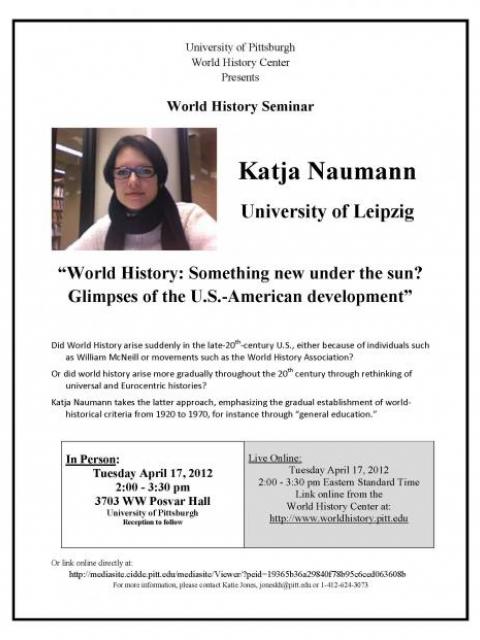
World History: Something new under the sun? Glimpses of the U.S.-American development
Presenter: Katja Naumann (University of Leipzig)
Location: 3703 WW Posvar Hall
Announced by:
on behalf of
Did World History arise suddenly in the late-20th-century U.S., either because of individuals such as William McNeill or movements such as the World History Association? Or did world history arise more gradually throughout the 20th century through rethinking of universal and Eurocentric histories?
Katja Naumann takes the latter approach, emphasizing the gradual establishment of world-historical criteria from 1920 to 1970, for instance through “general education.”
In Person:
3703 WW Posvar Hall
Reception to follow
Live Online:
Link from the
World History Center at:
http://www.worldhistory.pitt.edu
Falkland/Malvinas Anniversary Panel
Time: 12:00 pm to 1:30 pm
Location: 4217 Wesley W. Posvar Hall, University of Pittsburgh
Various speakers from the UK and Argentina meet through teleconference to talk about the Falkland/Malvinas conflict, then and now.
Saturday, April 14th, 2012
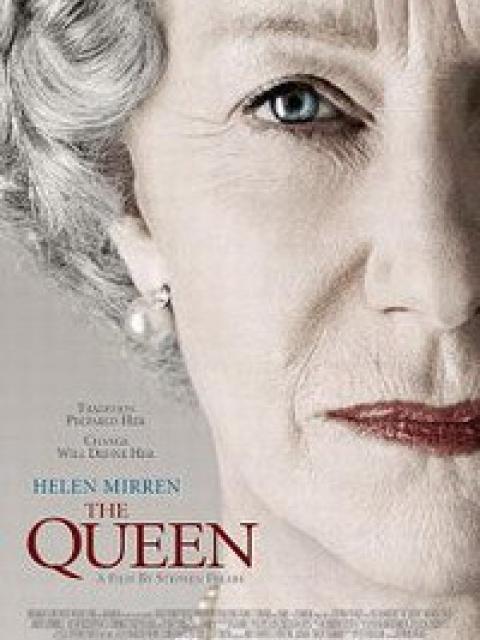
The Queen
Presenter: Stephen Frears (Director), Colin MacCabe (Film Studies)
Location: Alumni Hall Auditorium, 7th floor
Announced by:
on behalf of
Screening of THE QUEEN will be introduced by Director, Stephen Frears. Q&A session with Colin MacCabe.
Known for making provocative, stylized, and tightly budgeted films about people living on society's social and/or sexual fringes,
British director Stephen Frears is renowned as one of his country's most vibrant and recognizable filmmakers. Regarding his
tendency to make films that branch into unfamiliar territory, Frears has said that he likes "making films about different cultures...I'm interested in things that I've never encountered before. I try to put myself in the audience's position." Born in Leicester, Frears studied law at Cambridge University before turning to the arts. He became involved with London's Royal Court Theatre, where he served as an assistant to director Lindsay Anderson and to actor Albert Finney. He started his career in the film industry as an assistant director to Karel Reisz, with whom he worked from 1966 until 1972.
Scripted by Peter Morgan, 2006's THE QUEEN took a comic-yet-sympathetic look at the P.R. nightmare that
ensued after Princess Diana's death in 1997. Bolstered by Helen Mirren's universally acclaimed work as Queen
Elizabeth II, the film enjoyed a healthy arthouse run through awards season, when Frears found himself the recipient
of countless Best Director nominations from critics' organizations, as well as the Golden Globe Awards.
Friday, April 13th, 2012
Francesco Mochi and the Edge of Tradition
Presenter: Estelle Lingo (Art History, University of Washington)
Location: Frick Fine Arts Building, Room 202
Announced by:
on behalf of
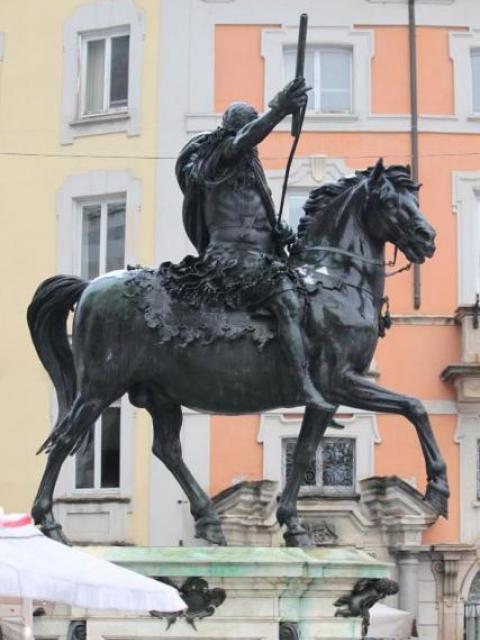
Prevailing accounts of the development of baroque sculpture take for granted the centrality of Gianlorenzo Bernini without probing the historical processes that led to the dominance of his art. The book Dr. Estelle Lingo is preparing takes the self-consciously ambitious sculptures of Bernini’s older contemporary, the Tuscan Francesco Mochi (1580-1654), as the entry point for an inquiry into the historical and cultural forces driving the transformation of sculpture in the first half of the seventeenth century. Mochi’s early biographer Giovanni Battista Passeri reported that the sculptor “always wanted to show himself a rigorous imitator of the Florentine manner.” Mochi’s determination to carry forward a Florentine and Michelangelesque tradition, while reconciling it with post-Tridentine religious imperatives, produced an extreme tension in his art that resulted in some of the most breathtaking sculptures of the century—though ultimately fracturing his career. In this lecture Dr. Lingo will present new work on Mochi’s highly unusual bronze equestrian monuments to Ranuccio I and Alessandro Farnese in Piacenza. The sculptures’ distinctive features, Lingo will argue, point to Mochi’s reflection upon Piacenza’s political circumstances and reveal unexpected aspects of the sculptor’s commitment to the Florentine tradition in a post-Tridentine climate of reform and censure.
Estelle Lingo is Associate Professor of Art History at the University of Washington. She specializes in early modern European art, especially sculpture. Her first book, François Duquesnoy and the Greek Ideal (Yale, 2007), examined seventeenth-century Flemish sculptor François Duquesnoy and his pursuit in Rome of a modern artistic practice in "the Greek manner." The study reconstructs the understanding of Greek art from 1550 to 1650 and the contributions of Duquesnoy's circle to the coalescence of the Greek ideal within European culture. This seventeenth-century vision of Greek art is shown to have formed the basis of Johann Joachim Winckelmann's early understanding of the formal perfections of Greek sculpture, overturning the longstanding assumption that no meaningful distinction between ancient Greek and Roman art was made prior to Winckelmann's work. Her current book project focuses on the Tuscan sculptor Francesco Mochi (1580-1654); the study takes Mochi's sculptures as the entry point for an inquiry into the historical and cultural forces reshaping sculpture at the beginning of the seventeenth century. Other research interests include Caravaggio, Gian Paolo Panini's Gallery Views, and the Italian perspective on the Grand Tour.
This talk is sponsored by the Department of the History of Art and Architecture and co-sponsored by the Program in Medieval and Renaissance Studies.
THE BANNED FILMS OF 1965-66 AND THE IRONIES OF EAST GERMAN FILM HISTORY
Presenter: Stephen Brockmann (CMU)
Location: David Lawrence Hall 105
Announced by:
on behalf of
Stephen Brockmann is president of the German Studies Association and Professor of German at Carnegie Mellon University. He is the author, most recently, of A Critical History of German Film (2010), as well as of Nuremberg: The Imaginary Capital (2006), German Literary Culture at the Zero Hour (2004), and Literature and German Reunification (1999). In 2007 he won the DAAD Prize for Distinguished Scholarship in German and European Studies/Humanities. From 2002-2007 he was the managing editor of the Brecht Yearbook.
In the event of an evacuation, the talk will move to WWPH, room 1700.
Thursday, April 12th, 2012
Should Turkey Integrate its Disaster Management with the EU
Presenter: Burcak Erkan, Middle East Technical University (METU)
Location: Pittsburgh Athletic Association, President’s Room
B. Burcak Basbug-Erkan is an assistant professor of Statistics at the Middle East Technical University (METU), Ankara. She acts as the director of the METU Disaster Management Research and Implementation Centre since 2008. She holds a B.Sc. in statistics, METU, a M.Sc. degree in statistics, University of Warwick, the UK and a Ph.D. in statistics at the London School of Economics and Political Science, the UK. Her main research interest is disaster risk management, extreme event modelling, insurance and actuarial analysis and financial risk management of disaster losses. She teaches disaster risk management, linear models, insurance and actuarial analysis, probability and stochastic processes.
Wednesday, April 11th, 2012
From Filmer and Locke to Burke and Gibbon: Cambridge Histories of Political Thought, 1950 – 2010
Presenter: J.G.A. Pocock (Johns Hopkins)
Location: Holiday Inn University Center, Panther Room
Announced by:
on behalf of
Next Wednesday (April 11), the Society and Honors College will proudly play host to a prominent intellectual historian of our generation: J.G.A. Pocock, author of Ancient Constitution and the Feudal Law, Machiavellian Moment, and a multi-volume work on Edward Gibbon. An emeritus professor at Johns Hopkins, Pocock is noted for developing a novel approach to the study of history often referred to as the Cambridge School of intellectual history. His work encompasses a broad range of intellectual endeavors, including not only history, but also political science, philosophy, and literature. Professor Pocock will lecture at 602 Cathedral of Learning at 4:00 PM, and we'd love for you to come along and help Pitt show its support for history as an intellectual exercise.
Tuesday, April 10th, 2012
Pizza & Politics: "Legal Professional Privilege: Comparing Different Approaches Within the United States and the European Union"
Time: 12:00 pm to 1:00 pm
Presenter: Matt Zwick (Law School) and David Rosenberg
Location: 4217 Posvar Hall
Matt Zwick, a student at the Law School, and local attorney David Rosenberg will present a paper they co-authored, entitled "Legal Professional Privilege: Comparing Different Approaches Within the United States and the European Union."
Monday, April 9th, 2012
'EVERYTHING WAS STRANGE AND NEW’: THE WORLD WAR II EVACUATION OF BRITISH CHILDREN
Presenter: Lee Talley (Rowan University)
Location: Cathedral of Learning, 324
Announced by:
on behalf of
Dr. Talley’s talk is part of a book-length project on the evacuation and children’s literature that has won grants from the National Endowment for the Humanities, the Children’s Literature Association, and the ALAN Foundation.
Dr. Lee Talley is Associate Professor of English at Rowan University where she teaches Victorian and children’s literature. She edited the Broadview edition of Anne Brontë’s The Tenant of Wildfell Hall and has most recently published in Children’s Literature and Keywords for Children’s Literature (edited by Philip Nel and Lissa Paul).
Prosodic Information in L2 (German & English) Comprehension and Production
Presenter: Carrie Jackson (Penn State)
Announced by:
on behalf of
From the earliest stages of language processing, people use prosodic information in word recognition and to predict and construct the syntactic structure of an utterance in their native language (L1) (e.g., Eckstein & Friederici, 2006; Friederich et al., 2004; Isel et al., 2005; Pauker et al., 2011; Steinhauer, 2003; see also Cutler et al., 1997; Wagner & Watson, 2010, for two reviews). Recently, researchers have begun to explore how prosodic and syntactic information interact in language processing among second language (L2) speakers (e.g., Dekydtspotter et al.,2008; Fernandez 2005, 2010; Fultz, 2007; Schmidt-Kassow et al., 2011). In this talk I will present findings from several recent studies in my lab that contribute to this line of research. In the first study we used a sentence-level gating task to demonstrate that English L2 learners of German recognize the importance of prosodic phrasing to predict sentence length in the L2, although their ability to do so is influenced by L2 proficiency and language environment (immersed vs. non-immersed context). In a second study we show that more proficient English L2 learners of German and German L2 learners of English use prosodic cues (pitch and duration) to disambiguate temporarily ambiguous sentences in an oral production task in both of their languages, but that neither group of L2 learners fully transfers these acoustic cues to disambiguation from their L1 to their L2. In a third study we investigate how cross-linguistic differences in lexical stress modulate cognate effects in L2 word naming among English L2 learners of German.
Friday, April 6th, 2012
2012 Jean Monnet Symposium "Empires of the Past and Present: Is the EU a New Empire?"
Presenter: Patrick Manning, Martha Chaiklin, and Peter Karsten, Magali Gravier, Josep Colomer and Joshua W. Walker
Location: Panther Room, Holiday Inn University Center
The 2012 Jean Monnet Symposium hosted by the European Union Center of Excellence and European Studies Center at the University of Pittsburgh will bring together historians and political scientists to discuss empires old and new. Its goal is to advance the current discussion of how to define empire, look at how empires have defined themselves in the past, and build upon our understanding of historical empires to refine new categories of analysis applicable to the European Union of the present. Featured presenters include Patrick Manning and Daniel Bisbee, Martha Chaiklin, and Peter Karsten from the Department of History at the University of Pittsburgh; along with Magali Gravier (Copenhagen Business School), Josep Colomer (George Washington University), and Joshua W. Walker (German Marshall Fund).
Co-sponsor: World History Center
Thursday, April 5th, 2012
Popes, Pirates, Espionage and Galley Slaves: Vasari's Lepanto Frescoes in the Sala Regia of the Vatican Palace
Presenter: Rick Scorza (Resident Research Scholar at the Morgan Library, New York)
Location: Frick Fine Arts Building, Room 202
Announced by:
on behalf of
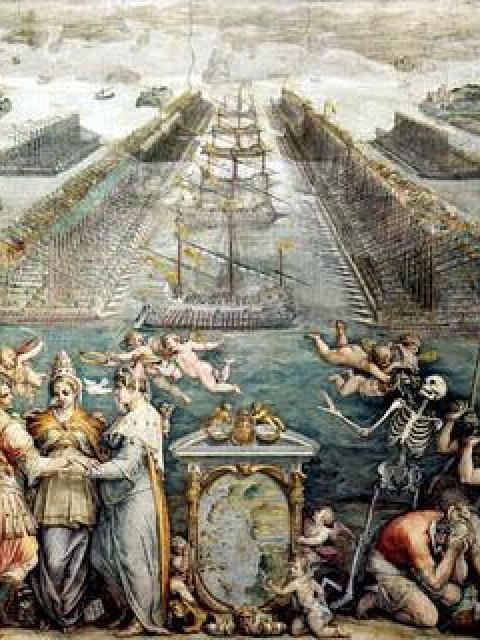
The great naval Battle of Lepanto of 1571 in which the Turkish armada was devastated by the combined fleet of the Papacy, Venice, and Spain was an event of enormous symbolic as well as military importance to the Catholic Church, because it briefly gained for the Christian Alliance control of most of the Mediterranean, temporarily eradicating the threat of the “infidel”. Several Italian and Spanish artists depicted the battle but none so splendidly as Giorgio Vasari (1511-1574) in the Sala Regia of the Vatican Palace. Despite its prominent location in the administrative heart of the papacy and the fame of Vasari, the literature on this huge fresco cycle was scant before Dr. Scorza published two recent articles. Dr. Scorza will explain this cycle with reference to the literary and visual sources available to Vasari when he painted it, ranging from prints, drawings of Venetian galleys which were smuggled to Rome, and above all the beautifully sculpted bronze medals commemorating the victory which were circulated by the Papal mint. The lecture will also discuss the plight of enslaved oarsmen, and how a former Christian galley slave in Muslim hands rose to become captain and ultimately Grand Admiral of the Turkish fleet, having totally outwitted his opposite number at Lepanto and returned triumphant to Istanbul with the battle standard of the Knights of Malta. Within three years Uluch Ali - a renegade Christian - regained Turkish dominance of the Mediterranean.
Dr. Scorza took his M Phil from the Warburg Institute in the Survival of the Classical Tradition and then completed a PhD in Art History at the Warburg. He has published significant articles on a variety of topics in The Burlington Magazine, the Journal of the Warburg and Courtauld Institutes, and elsewhere. He has also contributed to exhibition catalogues, most recently for the Giorgio Vasari exhibition in Arezzo celebrating the 500th anniversary of Vasari’s birth. He has given papers in several international conferences, including one titled “The Iconography of Slavery.”
This talk is sponsored by the Department of the History of Art and Architecture and co-sponsored by the Program in Medieval and Renaissance Studies, the Humanities Center, the History Department, and the Department of French and Italian.
White Collar Blues: Immaterial Labor and its Discontent
Time: 12:30 pm to 2:00 pm
Presenter: Sabine Von Dirke (German)
Location: Humanities Center, Cathedral of Learning, Room 602
Announced by:
on behalf of
Colloquium on Germany, Sabine Von Dirke (German), "White Collar Blues: Immaterial Labor and its Discontent,” with responses from Stephen Brockmann (Carnegie Mellon) and Lisa Brush (Sociology).
Wednesday, April 4th, 2012
Career and Internship Opportunities with the U.S. Dept. of State
Presenter: Tom Armbruster Senior, Foreign Service Officer, Diplomat in Residence, City College of New York
Location: 4130 Posvar Hall
INFORMATION SESSION: Career and Internship Opportunities with the U.S. Dept. of State
Tom Armbruster
Senior Foreign Service Officer
Diplomat in Residence
City College of New York
Date: April 4th, 2012
Time: 1:00
Place: 4130 Posvar Hall
Come see how you can contribute to and join Secretary Clinton’s foreign policy professionals who manage America’s relations with the world. The Foreign Service offers the opportunity for public service, challenge, lifelong learning, foreign language study, and the chance to live and work overseas. On Wednesday, April 4, Senior Foreign Service Officer Tom Armbruster, most recently U.S. Consul General in Vladivostok, Russia, will present a discussion on State Department internships, both in American embassies and consulates abroad, and at State Department headquarters in Washington. Mr. Armbruster will also describe the process for becoming a Foreign Service Officer and the 13 dimensions that successful candidates demonstrate. Foreign Service officers serve in these career tracks: Consular – touching the lives of others through American citizen service and visa adjudications; Management – making diplomacy work and keeping our Embassies and Consulates running; Economic – promoting economic partnerships, free markets and trade; Public Diplomacy – explaining American values and policies through speakers, exchanges, and cultural programming; Political - analyzing political events and advising Washington and the “country team” at the Embassy, headed by the Ambassador.
Tuesday, April 3rd, 2012
Making International Studies Work for You
Presenter: EUCE/ESC Alumni Panelists: Christopher Burdick, Benjamin Keller, Carrie Weintraub
Join us on Tuesday, April 3rd as three alumni of the European Studies Center discuss how their interests in
Foreign language and international studies have shaped their postgraduate lives. Panelists include Christopher Burdick, Policy Advisor for the U.S. Treasury; Benjamin Keller – lawyer for DLA Piper in N.Y.C.; Carrie Weintraub, International Relations graduate from the London School of Economics. Some of the issues to be discussed include: pursuing graduate studies in Europe, preparing for law/graduate school, the importance of networking, what it’s like working for law firms and/or the government, and what tips and suggestions they would offer undergraduates in European or international studies programs now. International Studies and pre law counselors from the Career Center will also be available to answer questions and provide information about resources and planning strategies. If you have questions about this event, please contact Steve Lund, Assistant Director of the European Studies Center, at slund@pitt.edu, 412-6248-7422.
Sponsored by: European Union Center of Excellence & European Studies Center
Friday, March 30th, 2012
Biography in Musical Scholarship Today
Presenter: Glenda Dawn Goss (Sibelius Academy)
Location: 132 Music Building
Announced by:
on behalf of
Biography – the story of a person’s life – is one of the most popular types of literature today. Yet biography also holds an important place in scholarship. Biographies invite us to consider what effect, if any, an individual may have on the larger course of events. Biographies of creative personalities bring up the further question of whether connections exist between a life and times and an individual’s music, art, or literary works and if so, what those connections might be.
In this presentation Prof. Glenda Dawn Goss considers aspects of writing musical biography, using the life of Jean Sibelius (1865–1957) as a case in point. She will discuss such questions as principles of writing biography, the qualifications of a biographer, the degree to which the wider context of a composer’s life belongs to serious biographical study, and, perhaps most important, how biography can contribute to our understanding of musical works.
Glenda Dawn Goss is an author and music historian with special interests in music and culture, early modernism, and European-American points of cultural contact. Formerly professor of musicology at the University of Georgia, she has served as the Editor-in-Chief of the Sibelius critical edition, for which she edited the four-volume Kullervo symphony and supervised other volumes. Currently, she is teaching in the doctoral program of the Sibelius Academy. Prof. Goss has produced an award-winning guide to Sibelius research, two scholarly editions of the composer’s letters, the first reception study of Sibelius, and a Sibelius Companion. Her recent biography, Sibelius: A Composer’s Life and the Awakening of Finland (University of Chicago Press, 2009) received an ASCAP Deems Taylor Award in 2010.
"Towards A New Comparative Literature"
Presenter: Su Fang Ng (Oklahoma)
Location: Humanities Center, Cathedral of Learning, Room 602
Announced by:
on behalf of
The pre-circulated text for discussion in this seminar will be Professor Ng's forthcoming article, "Dutch Wars, Global Trade, and the Heroic Poem:
Dryden's Annus Mirabilis (1666) and Amin's Sya'ir Perang Mengkasar (1670)." The essay is attached.
BIOGRAPHY:
Dr. Ng is Associate Professor of English at the University of Oklahoma.
She specializes in early modern literature with a secondary interest in postcolonial literatures. Her book, _Literature and the Politics of Family in Seventeenth-Century England_ (Cambridge University Press, 2007), examines how the putatively conservative analogy between state and family was used for radical political ends. Her second book project, "Global
Renaissance: Early Modern Classicism and Empire from the British Isles to the Malay Archipelago," explores how Greek and Roman models of empire became part of native histories of the early modern maritime kingdoms of England and in Southeast Asia.
“Europe: East & West” Undergraduate Research Symposium
Location: William Pitt Union
“Europe East & West” Undergraduate Research Symposium
Symposium Date: March 30, 2012
The Undergraduate Research Symposium is an annual event designed to provide undergraduate students from the University of Pittsburgh and other colleges and universities in the region with advanced research experiences and opportunities to develop presentation skills. The event is open to undergraduates from all majors and institutions who have written a research paper from a social science, humanities, or business perspective focusing on the study of Eastern, Western, or Central Europe, the European Union, Russia, or other countries of the former Soviet Union. The Symposium is held on the University of Pittsburgh-Oakland campus. After the initial submission of papers, selected participants are grouped into panels according to their research topics. The participants then give 10- to 15-minute presentations based on their research to a panel of faculty and graduate students. The presentations are open to the public.
Friday, March 30th, 2012 to Saturday, March 31st, 2012
Seventh Annual Graduate Student Conference on the European Union, 2012
Crisis, Cooperation, and Change in the EU
The Seventh Annual Graduate Student Conference on the European Union will welcome graduate students from around the world to present the research on "Crisis, Cooperation, and Change in the EU."
Thursday, March 29th, 2012
A Suitcase Full of Chocolate
Location: Frick Fine Arts Auditorium
Cost: $9 - general $8 - 65 and older and full-time college students with valid ID $7 - groups of 12+ (group tickets must be purchased in advance) $5 - 18 and under
2012 JFilm Festival
Pittsburgh Premiere
Director: Lincoln Mayorga
2011, USA, 93 minutes
Russian and English with subtitles
Lincoln Mayorga's poignant documentary tells the remarkable story of Sofia Cosma, a child prodigy, born in Latvia, who won renown in a Viennese piano competition in 1933. She witnessed Hitler's invasion of Austria in 1938 and was forced to return home where she spent seven years in a Soviet prison. Cosma’s indomitable spirit, humor, and love of music made it possible for her to move beyond her tragic past and embrace a full life, including a celebrated concert career. Director and Concert Pianist Lincoln Mayorga will speak and play following the film.
Sponsored by The University of Pittsburgh: Dean, Dietrich School of Arts and Sciences; Film Studies Program; Department of Slavic Languages and Literatures; Associate Dean, Undergraduate Studies, Dietrich School; Dean, University Honors College; European Union Center of Excellence/European Studies Center; Russian & East European Studies Center; Women’s Studies Program; World History Center; History Department; Jewish Studies Program; Humanities Center; Music Department; German Department
Speaking Transnationally: Early Modern European Cross-Cultural Exchanges with Islamic Southeast Asia
Presenter: Su Fang Ng (Oklahoma)
Location: Giant Eagle Auditorium, Baker Hall A51 Carnegie Mellon University
Announced by:
on behalf of
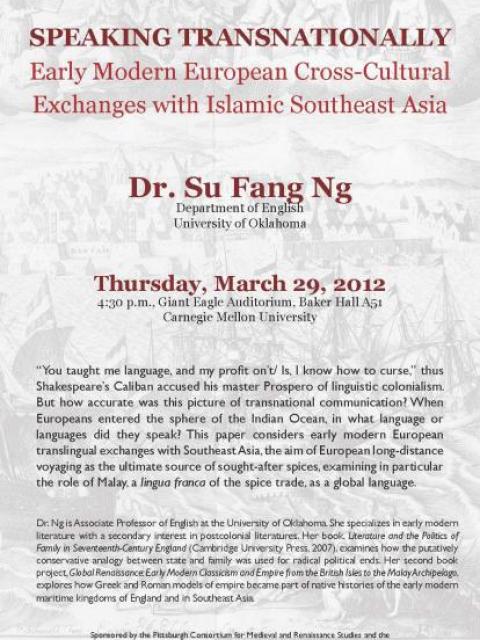
"You taught me language, and my profit on't/ Is, I know how to curse," thus Shakespeare's Caliban accused his master Prospero of linguistic colonialism. But how accurate was this picture of transnational communication? When Europeans entered the sphere of the Indian Ocean, in what language or languages did they speak? This paper considers early modern European translingual exchanges with Southeast Asia, the aim of European long-distance voyaging as the ultimate source of sought-after spices, examining in particular the role of Malay, a lingua franca of the spice trade, as a global language.
BIOGRAPHY:
Dr. Ng is Associate Professor of English at the University of Oklahoma.
She specializes in early modern literature with a secondary interest in postcolonial literatures. Her book, _Literature and the Politics of Family in Seventeenth-Century England_ (Cambridge University Press, 2007), examines how the putatively conservative analogy between state and family was used for radical political ends. Her second book project, "Global Renaissance: Early Modern Classicism and Empire from the British Isles to the Malay Archipelago," explores how Greek and Roman models of empire became part of native histories of the early modern maritime kingdoms of England and in Southeast Asia.
Wednesday, March 28th, 2012
“Microstates & Macroproblems: The Problematic and Complex Relations Between the EU and European Microstates and Autonomous Territories”
Time: 12:00 pm to 1:00 pm
Presenter: Paul Adams, University of Pittsburgh at Greensburg
Paul Adams is Assistant Professor of Political Science at the University of Pittsburgh at Greensburg. His research interests center around the relations between the European Union and Switzerland, Iceland, Norway, and the Microstates of Europe. He has also written articles on corporatism and comparative politics. Dr. Adams will be presenting this lecture, which is also on the program for the 2012 International Studies Association Convention in San Diego in April 2012.
Lunch will be served.