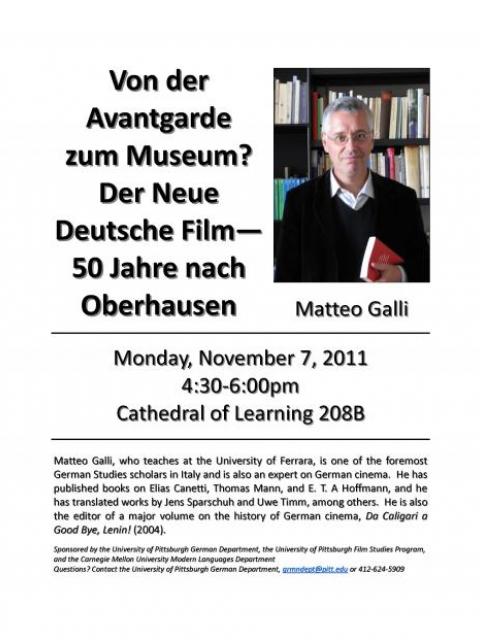
Saturday, March 17th, 2012

French Immersion Institute 2012
Time:
8:30 am to 1:30 pm
Location:
5200 Weslely W Posvar Hall
Sponsored by:
European Studies Center and European Union Center of Excellence along with American Association of Teachers of French and Allegheny Intermediate Unit
Cost:
$10
Contact:
Timothy Thompson
Contact Email:
tst@pitt.edu

French Immersion institutes are designed for middle and high school French teachers, as well as French majors to broaden their cultural understanding of current events and international studies regarding French-speaking countries, to strengthen their French listening and speaking skills, and to share strategies for the teaching of French language and culture. We will be offering the following workshop spring, 2012

Topic: "Les Elections Présidentielles et Législatives Françaises de 2012

With Jean-Dominique Le Garrec, Consul Honoraire de France and Jean Pierre Collet, Ancien Consul Honoraire de France

Program Director : Bonnie Adair-Hauck, Ph.D.
Time: 8:30 a.m.-1:30 p.m. Room: 5200 Posvar Hall
Cost: $10.00 per workshop
Includes: ACT 48 credit, workshop; continental breakfast; lunch

Pennsylvania ACT 48 credit available for participants.

*****************All activities are conducted in French*****************

Friday, March 16th, 2012

The Invitation to Love, From the Bible to Baudelaire
Time:
4:30 pm
Presenter:
Erik Gray (Columbia)
Location:
Cathedral of Learning, Room 501
Announced by:
European Studies Center on behalf of Department of English and Department of Philosophy

Dr. Erik Gray is Associate Professor of English and Comparative Literature at Columbia University. He is the author of The Poetry of Indifference: From the Romantics to the Rubáiyát (Massachusetts 2005) and Milton and the Victorians (Cornell 2009), as well as the editor of Tennyson's In Memoriam (Norton 2004) and Spenser's The Faerie Queene, Book 2 (Hackett 2006). He has also published articles on a range of poets including Virgil, Sidney, Donne, Milton, Pope, Gray, Wordsworth, Coleridge, Shelley, Keats, Tennyson, the Brownings, and Christina Rossetti. This talk is drawn from his current book project on love poetry.

Thursday, March 15th, 2012

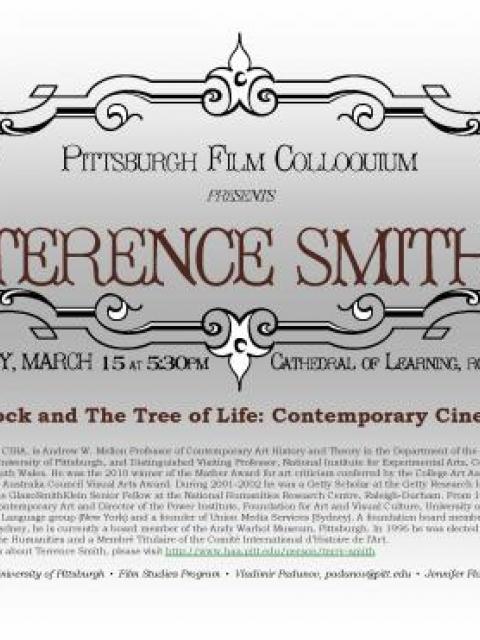
The Clock and The Tree of Life: Contemporary Cinema Art
Time:
5:30 pm
Presenter:
Terence Smith (HAA)
Location:
Cathedral of Learning 1228
Announced by:
European Studies Center on behalf of Film Studies Program
Contact:
Vladimir Padunov
Contact Email:
padunov@pitt.edu

"The Clock and The Tree of Life: Contemporary Cinema Art," Pittsburgh Film Studies Colloquium

Terry Smith, FAHA, CIHA, is Andrew W. Mellon Professor of Contemporary Art History and Theory in the Department of the History of Art and
Architecture at the University of Pittsburgh, and Distinguished Visiting Professor, National Institute for Experimental Arts, College of Fine Arts,
University of New South Wales. He was the 2010 winner of the Mather Award for art criticism conferred by the College Art Association (USA), and recipient of the 2010 Australia Council Visual Arts Award. During 2001-2002 he was a Getty Scholar at the Getty Research Institute, Los Angeles, and in 2007-8 the GlaxoSmithKlein Senior Fellow at the National Humanities Research Centre, Raleigh-Durham. From 1994–2001 he was Power Professor of Contemporary Art and Director of the Power Institute, Foundation for Art and Visual Culture, University of Sydney. He was a member of the Art & Language group (New York) and a founder of Union Media Services (Sydney). A foundation board member of the Museum of Contemporary Art, Sydney, he is currently a board member of the Andy Warhol Museum, Pittsburgh. In 1996 he was elected a Fellow of the Australian Academy of the Humanities and a Membré Titulaire of the Comité International d’Histoire de l’Art.

For more information about Terrence Smith, please visit http://www.haa.pitt.edu/person/terry-smith.

Sponsored by the University of Pittsburgh • Film Studies Program

The Art Collection of Christina of Sweden (1626-1689): Cleopatra rediscovered
Time:
4:00 pm to 5:30 pm
Presenter:
Enzo Borsellino, University ‘Roma Tre’
Location:
202 Frick Fine Arts Building
Sponsored by:
European Studies Center and European Union Center of Excellence

"The Art Collection of Christina of Sweden (1626-1689): Cleopatra rediscovered"
Enzo Borsellino, University ‘Roma Tre’

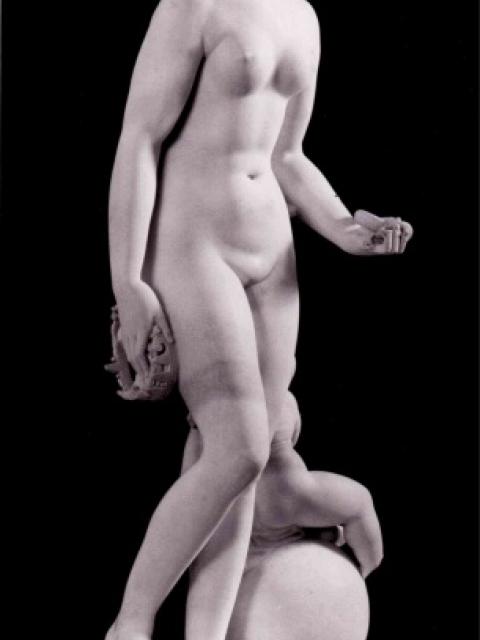
A XVI century marble statue representing a nude Cleopatra was hidden and forgotten for more than a century in the attic of Corsini Palace in Rome, formerly the Riario Palace. There, between 1659 and 1689, Christina of Sweden spent the end of her life, having famously decided to renounce her thrown to become Catholic and live in the city of Popes. During this time, she created a spectacular and important collection of ancient and modern art, unfortunately now dispersed worldwide. The piece in question is signed and dated 1574, a fact previously overlooked by everyone. Professor Borsellino will clarify the provenance of the statue and explain why it (fortunately) remained in the Riario-Corsini Palace until now. Long investigation has resulted in both the identification of the statue as a sculpture cited in two inventories of Christina’s art collection, where the figure was named for no reason “Venus” or “Nude woman”, and a careful reconstruction of the story of this marvelous and intriguing piece of art.

Professor Borsellino is visiting the University of Pittsburgh during the spring semester 2012 as a Distinguished Italian Fulbright Chair. He is an Associate Professor in Museology at the University ‘Roma Tre’ and has published over seventy books and articles on art history and museum studies.

This lecture made possible through generous support from the Delegation of the European Union.
University of Pittsburgh | University Center for International Studies | www.ucis.pitt.edu/euce
Requests to be added to our flyer distribution list should be sent to euce@pitt.edu.

Patterns of Childhood: The Children’s World War II
Time:
2:30 pm to 5:00 pm
Presenter:
Katie Trumpener (Yale)
Location:
1409 Cathedral of Learning
Announced by:
European Studies Center on behalf of Department of German
Contact:
Sabine von Dirke
Contact Email:
vondirke@pitt.edu

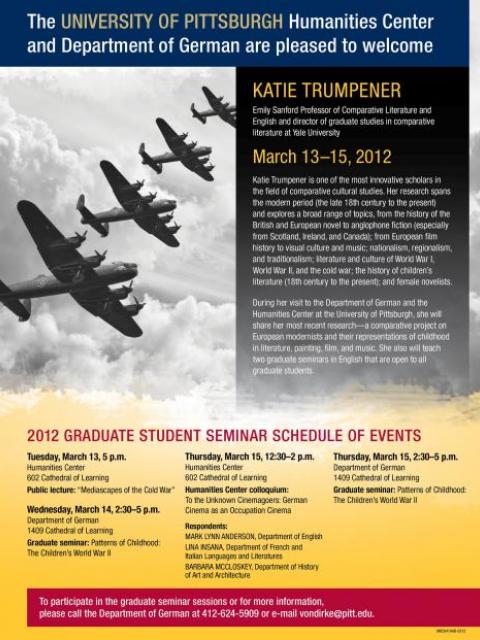
Katie Trumpener, Emily Sanford Professor of Comparative Literature and English and director of graduate studies in comparative literature at Yale University

This graduate seminar is in English and open to all graduate students.

Katie Trumpener is one of the most innovative scholars in the field of comparative cultural studies. Her research spans the modern period (the late 18th century to the present) and explores a broad range of topics, from the history of the British and European novel to Anglophone fiction (especially from Scotland, Ireland, and Canada); from European film history to visual culture and music; nationalism, regionalism, and traditionalism; literature and culture of World War I, World War II, and the Cold War; the history of children’s literature (18th century to the present); and female novelists.

To the Unknown Cinemagoers: German Cinema as an Occupation Cinema
Time:
12:30 pm to 2:00 pm
Presenter:
Mark Lynn Anderson (English), Lina Insana (French and Italian), and Barbara McCloskey (History of Art and Architecture)
Location:
602 Cathedral of Learning
Announced by:
European Studies Center on behalf of Humanities Center

Colloquium, “To the Unknown Cinemagoers: German Cinema as an Occupation Cinema,” with responses from Mark Lynn Anderson (English), Lina Insana (French and Italian) and Barbara McCloskey (History of Art and Architecture).

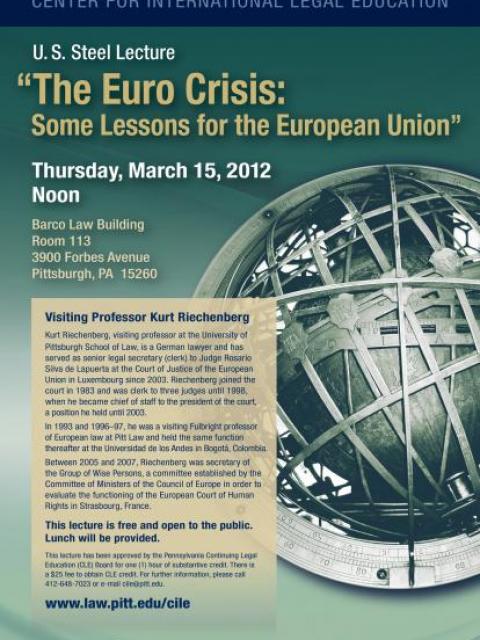
"The Euro Crisis: Some Lessons for the European Union"
Time:
12:00 pm
Presenter:
Visiting Professor Kurt Riechenberg
Location:
Room 113 Barco Law Building
Announced by:
European Studies Center on behalf of Center for International Legal Education

Kurt Riechenberg, Visiting Professor at the University of Pittsburgh School of Law, is a German lawyer and Senior Legal Secretary (Clerk) to Judge Silva de Lapuerta at the European Court of Justice in Luxembourg. He joined the Court in 1983 and was Clerk to three Judges until 1998, when he became Chief of Staff to the President of the Court, a position he held until taking his current post in 2003.

Lunch will be provided.

Wednesday, March 14th, 2012

Patterns of Childhood: The Children’s World War II
Time:
2:30 pm to 5:00 pm
Presenter:
Katie Trumpener (Yale)
Location:
1409 Cathedral of Learning
Announced by:
European Studies Center on behalf of Department of German
Contact:
Sabine von Dirke
Contact Email:
vondirke@pitt.edu

Katie Trumpener, Emily Sanford Professor of Comparative Literature and English and director of graduate studies in comparative literature at Yale University

This graduate seminar is in English and open to all graduate students.

Katie Trumpener is one of the most innovative scholars in the field of comparative cultural studies. Her research spans the modern period (the late 18th century to the present) and explores a broad range of topics, from the history of the British and European novel to Anglophone fiction (especially from Scotland, Ireland, and Canada); from European film history to visual culture and music; nationalism, regionalism, and traditionalism; literature and culture of World War I, World War II, and the Cold War; the history of children’s literature (18th century to the present); and female novelists.

Tuesday, March 13th, 2012

Rule of Law Around the World II
Time:
12:00 pm
Presenter:
LL.M. students
Location:
Room G-12
Announced by:
European Studies Center on behalf of School of Law

A group of this year's LL.M. students will discuss past struggles and future challenges related to the rule of law in their home countries. The second of two lectures, this event will feature discussions by Ivan Milosevic (Serbia), Cristian Minor (Mexico), Kustrim Tolaj (Kosovo), and Abeer Hashayka, Wael Lafee, and Mais Qandeel (Palestine).

Friday, March 2nd, 2012

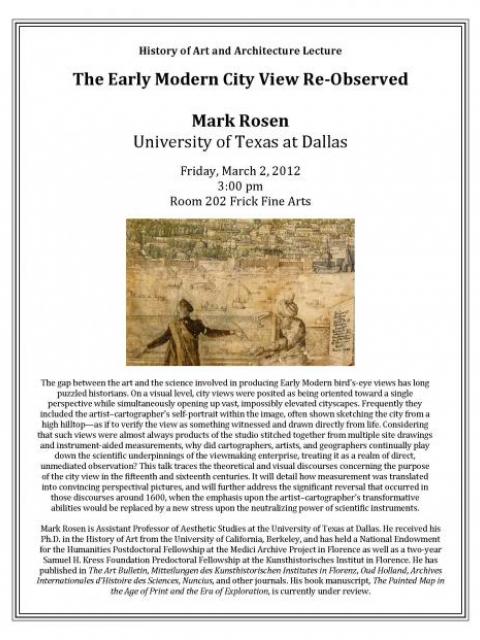
The Early Modern City View Re-Observed
Time:
3:00 pm
Presenter:
Mark Rosen (UT-Dallas)
Location:
Room 202 Frick Fine Arts
Announced by:
European Union Center of Excellence on behalf of History of Art and Architecture

The gap between the art and the science involved in producing Early Modern bird’s-eye views has long puzzled historians. On a visual level, city views were posited as being oriented toward a single perspective while simultaneously opening up vast, impossibly elevated cityscapes. Frequently they included the artist–cartographer’s self-portrait within the image, often shown sketching the city from a high hilltop—as if to verify the view as something witnessed and drawn directly from life. Considering that such views were almost always products of the studio stitched together from multiple site drawings and instrument-aided measurements, why did cartographers, artists, and geographers continually play down the scientific underpinnings of the viewmaking enterprise, treating it as a realm of direct, unmediated observation? This talk traces the theoretical and visual discourses concerning the purpose of the city view in the fifteenth and sixteenth centuries. It will detail how measurement was translated into convincing perspectival pictures, and will further address the significant reversal that occurred in those discourses around 1600, when the emphasis upon the artist–cartographer’s transformative abilities would be replaced by a new stress upon the neutralizing power of scientific instruments.

Mark Rosen is Assistant Professor of Aesthetic Studies at the University of Texas at Dallas. He received his Ph.D. in the History of Art from the University of California, Berkeley, and has held a National Endowment for the Humanities Postdoctoral Fellowship at the Medici Archive Project in Florence as well as a two-year Samuel H. Kress Foundation Predoctoral Fellowship at the Kunsthistorisches Institut in Florence. He has published in The Art Bulletin, Mitteilungen des Kunsthistorischen Institutes in Florenz, Oud Holland, Archives Internationales d’Histoire des Sciences, Nuncius, and other journals. His book manuscript, The Painted Map in the Age of Print and the Era of Exploration, is currently under review.

Thursday, March 1st, 2012

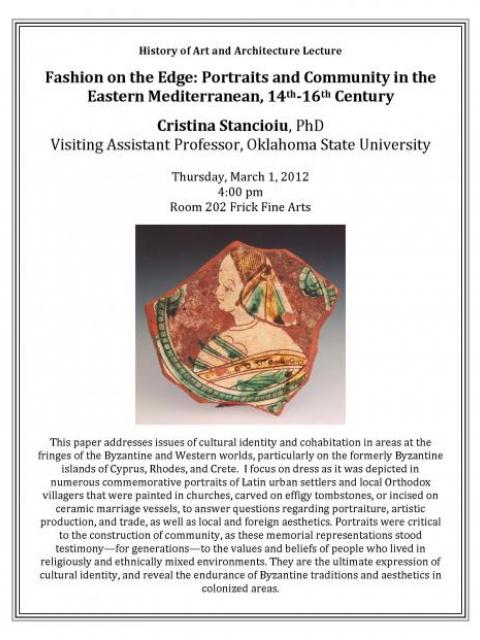
Fashion on the Edge: Portraits and Community in the Eastern Mediterranean, 14th-16th Century
Time:
4:00 pm
Presenter:
Cristina Stancioiu (Oklahoma State University)
Location:
Room 202 Frick Fine Arts
Announced by:
European Studies Center on behalf of Department of History of Art and Architecture

Cristina Stancioiu, PhD, Visiting Assistant Professor (Oklahoma State University)

This paper addresses issues of cultural identity and cohabitation in areas at the fringes of the Byzantine and Western worlds, particularly on the formerly Byzantine islands of Cyprus, Rhodes, and Crete. I focus on dress as it was depicted in numerous commemorative portraits of Latin urban settlers and local Orthodox villagers that were painted in churches, carved on effigy tombstones, or incised on ceramic marriage vessels, to answer questions regarding portraiture, artistic production, and trade, as well as local and foreign aesthetics. Portraits were critical to the construction of community, as these memorial representations stood testimony—for generations—to the values and beliefs of people who lived in religiously and ethnically mixed environments. They are the ultimate expression of cultural identity, and reveal the endurance of Byzantine traditions and aesthetics in colonized areas.

Pizza & Politics
Time:
12:00 pm to 1:30 pm
Presenter:
Galina Zapryanova
Location:
4217 Posvar Hall
Sponsored by:
European Studies Center and European Union Center of Excellence
Contact:
Allyson Delnore
Contact Phone:
412-624-5404
Contact Email:
adelnore@pitt.edu

Trust in political institutions is one of the key elements which make representative democracies work. Trust creates a connection between citizens and representative political institutions. Democratic governments which enjoy a large degree of trust also tend to have higher degrees of legitimacy and policy efficacy. In Europe's multi-level governance structure, it is imperative to learn more about the determinants of trust in EU institutions. With the increasing salience of EU issues, are domestic proxies still a key determinant of evaluating EU institutions? Are there differences across the institutions and across the member states?

Galina Zapryanova received her PhD in April 2011 from the University of Pittsburgh. She was a Max Weber Postdoctoral Fellow at the European University Institute in Florence Italy 2010-2011. Since receiving her doctorate, she has been working as a Visiting Assistant Professor of Political Science at Truman State University in Missouri. In June 2012, Dr. Zapryanova will begin a research fellowship at the Mannheim Center for European Social Research in Mannheim, Germany.

Wednesday, February 29th, 2012

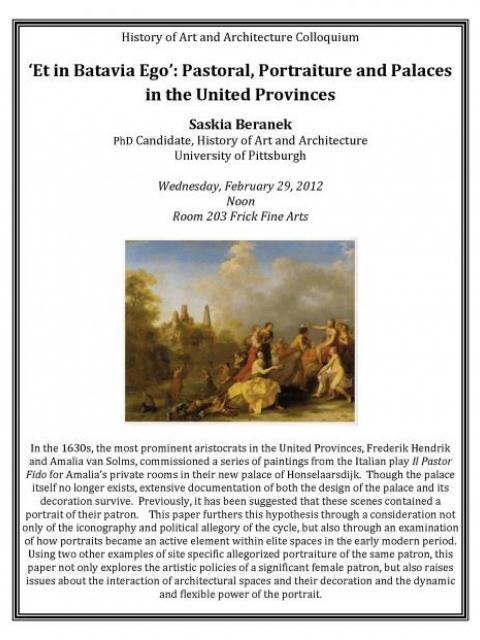
‘Et in Batavia Ego’: Pastoral, Portraiture and Palaces in the United Provinces
Time:
12:00 pm
Presenter:
Saskia Beranek (History of Art and Architecture)
Location:
Room 203 Frick Fine Arts
Announced by:
European Studies Center on behalf of Department of History of Art and Architecture

Saskia Beranek, PhD Candidate, History of Art and Architecture - University of Pittsburgh

In the 1630s, the most prominent aristocrats in the United Provinces, Frederik Hendrik and Amalia van Solms, commissioned a series of paintings from the Italian play Il Pastor Fido for Amalia’s private rooms in their new palace of Honselaarsdijk. Though the palace itself no longer exists, extensive documentation of both the design of the palace and its decoration survive. Previously, it has been suggested that these scenes contained a portrait of their patron. This paper furthers this hypothesis through a consideration not only of the iconography and political allegory of the cycle, but also through an examination of how portraits became an active element within elite spaces in the early modern period. Using two other examples of site specific allegorized portraiture of the same patron, this paper not only explores the artistic policies of a significant female patron, but also raises issues about the interaction of architectural spaces and their decoration and the dynamic and flexible power of the portrait.

Tuesday, February 28th, 2012

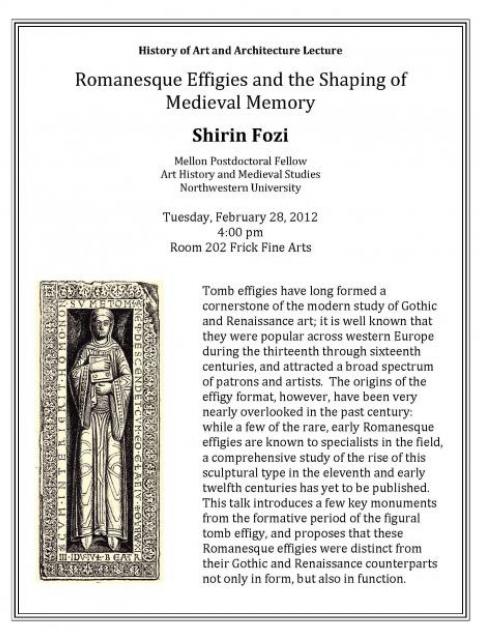
Romanesque Effigies and the Shaping of Medieval Memory
Time:
4:00 pm
Presenter:
Shirin Fozi (Northwestern University)
Location:
Room 202 Frick Fine Arts
Announced by:
European Studies Center on behalf of Department of History of Art and Architecture

Shirin Fozi, Mellon Postdoctoral Fellow, Northwestern University

Tomb effigies have long formed a cornerstone of the modern study of Gothic and Renaissance art; it is well known that they were popular across western Europe during the thirteenth through sixteenth centuries, and attracted a broad spectrum of patrons and artists. The origins of the effigy format, however, have been very nearly overlooked in the past century: while a few of the rare, early Romanesque effigies are known to specialists in the field, a comprehensive study of the rise of this sculptural type in the eleventh and early twelfth centuries has yet to be published. This talk introduces a few key monuments from the formative period of the figural tomb effigy, and proposes that these Romanesque effigies were distinct from their Gothic and Renaissance counterparts not only in form, but also in function.

Monday, February 27th, 2012

Film: Unveiled [Fremde haut]
Time:
6:00 pm to 8:00 pm
Presenter:
Women's Stidies Program
Location:
2201 Wesley W. Posvar Hall
Announced by:
European Studies Center on behalf of Gender, Sexuality, and Women's Studies Program

Unveiled (Fremde haut)

Director Angelina Maccarone (2005)

Part of the: QUEER & FEMINIST FILM, Public Film Series at the University of Pittsburgh
When: January 9 – April 9, 2012
Cost: Free!

All screenings are open to the public. Bring your friends!

For more information about the series: http://pittqueerfemfilm.wordpress.com/public-film-series/
To learn about the film: http://www.imdb.com/title/tt0428672/

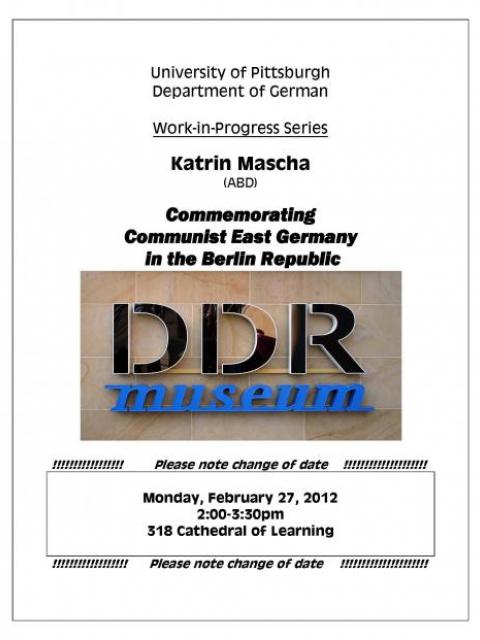
Commemorating Communist East Germany in the Berlin Republic
Time:
2:00 pm to 3:30 pm
Presenter:
Katrin Mascha (ABD)
Location:
318 Cathedral of Learning
Announced by:
European Studies Center on behalf of Department of German

Work-in-Progress Series, "Commemorating Communist East Germany in the Berlin Republic," Katrin Mascha (ABD)

Friday, February 24th, 2012

Bach, the Mass, and the Leipzig Lutheran Service
Time:
4:00 pm
Presenter:
Jeffrey S. Sposato (University of Houston)
Location:
132 Music Building
Announced by:
European Studies Center on behalf of Department of Music
Cost:
Free

Jeffrey S. Sposato, Associate Professor of Musicology
Moores School of Music, University of Houston

What can we learn about Johann Sebastian Bach’s church music practices by looking at his Leipzig successors? Scholars have previously assumed that when Gottlob Harrer took over as Thomaskantor after Bach’s death in 1750, he fundamentally rethought the musical priorities of the Leipzig service, increasing the importance of the concerted Latin mass and diminishing the role of the cantata. This paper uses Leipzig church diaries and the contents of Bach’s and Harrer’s libraries to demonstrate that the shift in musical focus from cantatas to masses attributed to Harrer was likely more gradual and began with Bach during the 1730s.

Jeffrey S. Sposato is Associate Professor of Musicology at the Moores School of Music, University of Houston. His most recent book, The Price of Assimilation: Felix Mendelssohn and the Nineteenth-Century Anti-Semitic Tradition (Oxford University Press, 2006), was named a Choice magazine Outstanding Academic Title for 2006 and a Royal Philharmonic Society Music Award finalist. He is currently working on a new book entitled Leipzig After Bach: Musical Life in a German City, 1750–1850. In 2011–2012, he is a Visiting Scholar at the University of Pittsburgh.

International Trade & Composition Of Capital Across Countries
Time:
2:00 pm to 3:30 pm
Presenter:
Piysha Mutriju (Syracuse University)
Location:
3911 Posvar Hall
Announced by:
European Studies Center on behalf of Graduate School of Public and International Affairs (GSPIA), Department of Economics, Carnegie Mellon University H. John Heinz College and International Trade & Development Seminar

Piyusha Mutreja, Syracuse University

International Trade & Composition Of Capital Across Countries

Thursday, February 23rd, 2012

What Would Dr. John Snow and the Reverend Henry Whitehead Have Done?
Time:
6:00 pm
Presenter:
John Bullock, MD, MPH, MSc (Wright State)
Location:
Scaife Hall, Lecture Room #5
Announced by:
European Studies Center on behalf of C.F. Reynolds Medical History Society and Health Sciences Library System Department of Internal Medicine
Cost:
Free Admission
Contact:
Dr. Jonathon Erlen
Contact Phone:
(412) 648-8927
Contact Email:
erlen@pitt.edu

One Book, One Community Lecture Series:

"The Worldwide Fusarium Keratitis Epidemic of 2004-2006: What Would Dr. John Snow and Dr. Henry Whitehead Have Done?"
John Bullock, MD, MPH, MSc. Bullock is an infectious diseases epidemiologist at Wright State School of Medicine.

Also, part of the C.F. Reynolds Medical History Society Lecture Series.

Thursday, February 23rd, 2012 to Saturday, February 25th, 2012

TOURNÉES FILM FESTIVAL
"Welcome," "La Belle Endormie," "Boarding Gate," "35 Rhums," & "Hadewijch"
Time:
(All day)
Location:
Alumni Hall Auditorium, 7th floor
Announced by:
European Studies Center on behalf of Film Studies Program, Department of French and Italian, University Honors College and Associate Dean for Undergraduate Studies
Cost:
Free Admission

The Tournées festival features a series of recent French films that will be screened in 35mm in Alumni Hall. It is an exciting group of films, and we hope you'll come and bring your friends, family, and students.

Feb. 23, 7:30 PM - "Welcome"
Feb. 24, 6:00 PM - "La Belle Endormie" (The Sleeping Beauty):
Feb. 24, 8:00 PM - "Boarding Gate"
Feb. 25, 7:00 PM- "35 Rhums" (35 Shots of Rum)
Feb. 25, 9:15 PM - "Hadewijch"

To view the full schedule & film descriptions: http://www.frenchanditalian.pitt.edu/documents/TourneesFrenchfilmseriesf...

Opening Reception to follow Welcome in the Alumni Hall Auditorium Lobby.

www.facecouncil.org

Wednesday, February 22nd, 2012

Social Movement Scenes and Occupied Spaces in Italy
Some Notes and Reflections
Time:
12:00 pm
Presenter:
Gianni Piazza (Univesity of Catania) & Alice Mattoni (Univesity of Pittbsurgh)
Location:
2432 Posvar Hall
Announced by:
European Studies Center on behalf of Department of Sociology and Pittsburgh Social Movements Forum

The squatting of physical spaces is an important form of protest in European social movements. From
the 1970s onwards, activists began to occupy abandoned buildings transforming them in spaces
where to experiment alternative lifestyles and elaborate radical politics. In Italy, squatted spaces,
usually named “Self-Managed Occupied Social Centers” and first established in the 1970s, became
the backbones of national and transnational social movements that emerged late in the 1990s. Far
from being dismissed, this form of collective action continues to be used in order to create spaces of
resistance and struggle in societies. Through a diachronic perspective, the meeting discusses: the
characteristics and ideological orientation of Social Centers; interactions between Social Centers and
public institutions; the role of Social Centers in social movement scenes.

Prof. Gianni Piazza is Professor of Political Science at the Faculty of Political Sciences, University of Catania. He
works on squatted spaces, territorial conflicts and social movements in Italy. Among his recent publications:
Which models of democracy? Internal and external decision-making processes of Italian Social Centers in a
comparative study (2011, CSPS-WP Series); Voices of the Valley. Voices of the Straits. How protest creates
communities (2008, with Donatella della Porta).

Dr. Alice Mattoni is a Postdoctoral Fellow at the Department of Sociology, University of Pittsburgh. She works on
media practices, precarious workers and social movements in Italy. Among her recent publications: Media
Practices and Protest Politics. How Precarious Workers Mobilise (2012); Mediation and Social Movements
(2012, with Bart Cammaerts and Patrick McCurdy, eds.).

Tuesday, February 21st, 2012

French Socialists and German Social Democrats Confront the Rise of the Far Right in the Bundesrepublik, 1950-1952
Time:
4:00 pm
Presenter:
Brian Shaev, Ph.D. Candidate, University of Pittsburgh
Location:
3703 WWPH
Announced by:
European Studies Center on behalf of Department of History and European Colloquium Series

French Socialists & German Social Democrats Confront the Rise of the Far Right in the Bundesrepublik, 1950-52
Brian Shaev, Ph.D. Candidate, University of Pittsburgh
4:00 p.m., 3703 Posvar Hall
Sponsored by: the European Union Center of Excellence/European Studies Center, The University of Pittsburgh European Colloquium Series, Department of History

Conversations on Europe: "A New Germany in a New EU?”
Time:
12:00 pm to 1:30 pm
Presenter:
Steven Sokol (World Affairs Council), Ronald H. Linden (EUCE Director), Gary Marks (UNC), Sabine Hake (UT-Austin), Alexander Privitera (AICGS)
Location:
4217 WWPH
Sponsored by:
European Studies Center and European Union Center of Excellence

TUESDAY FEBRUARY 21, 2012
Conversations on Europe: “A New Germany in a New EU?”
12 – 1:30 p.m., 4217 WWPH
The EUCE/ESC will host the second in its ongoing series of Conversations On Europe. This series links top experts on the European Union via videoconferencing across several sites. Audiences at all sites will be able to interact with experts on a contemporary topic related to Europe and the EU. This session will be devoted to the topic “A New Germany in a New EU?” and will address, among other issues: Is it a ‘new EU’? Is Germany the new dominant force? Has Germany’s relationship to the EU and other members fundamentally changed? Will we see further replication of the German economic approach at the EU level? What will be the impact of recent developments in Germany? The session will be moderated by Professor Ronald Linden, Director of the EUCE/ESC.

Friday, February 17th, 2012

Round Table Discussion with Dutch Ambassador Renee Jones-Bos
Time:
3:00 pm to 4:00 pm
Presenter:
Dutch Ambassador Renee Jones-Bos
Location:
4130 WWPH
Sponsored by:
European Studies Center and European Union Center of Excellence

FRIDAY FEBRUARY 17, 2012
Round Table Discussion with Dutch Ambassador Renee Jones-Bos
3 pm, 4130 WWPH
The EUCE/ESC invite you to participate in a round table discussion with Dutch Ambassador Renee Jones-Bos Friday February 17 at 3:00 p.m. in 4130 Wesley W. Posvar Hall. To participate in the round table please register with Karen Lautanen at kal70@pitt.edu. The Dutch Ambassador is visiting Pittsburgh to celebrate the opening of the 2012 Distinctly Dutch Festival hosted by the Pittsburgh Cultural Trust. The three-month festival will feature dance, theater, music, visual art, film, literature and architecture. More information on the festival can be found HERE: http://dutchfestival.pgharts.org

Unhappily Ever After: Visual Irony and Feminist Strategy in Agnes Varda’s Happiness
Time:
3:00 pm
Presenter:
Rebecca DeRoo
Location:
Room 202 Frick Fine Arts
Announced by:
European Studies Center on behalf of Department of History of Art and Architecture

Although Agnes Varda is recognized as an early avatar of feminist filmmaking, her 1965 film Happiness remains a misunderstood work, frequently criticized for its ostensibly anti-feminist message. This lecture excavates specific sources of imagery from French women’s magazines that idealized the daily drudgery of the housewife and explains how Varda applied this imagery to her characters to challenge feminine ideals. This lecture shows that Happiness expands visually and thematically on two influential texts: Simone de Beauvoir’s The Second Sex (1949) and Betty Friedan’s The Feminine Mystique (1963). As a director making feminist films in an unreceptive climate, Varda employed a sophisticated strategy of visual irony in Happiness that disputes the film’s narrative and traditional notions of domestic harmony. We can thus discern new depths in postwar feminism and appreciate Varda’s contribution to a complex, trans-Atlantic dialogue about the structure of domestic life.

Friday, February 17th, 2012 to Saturday, February 18th, 2012

Model European Union simulation for undergraduate students
Time:
(All day)
Presenter:
various
Location:
Washington & Jefferson College
Sponsored by:
European Studies Center and European Union Center of Excellence
Contact:
Timothy Thompson

This year's undergraduate Model EU will take place on the campus of Washington & Jefferson College. The following schools are sending students:
Bowling Green State University
Kent State University
John Carroll University
Washington & Jefferson College
University of Pittsburgh
University of Pittsburgh at Greensburg

Sylvia Kofler, from the Washington Delegation of the European Union will attend and give a presentation, as will EUCE Director Ron Linden.

Friday, February 10th, 2012

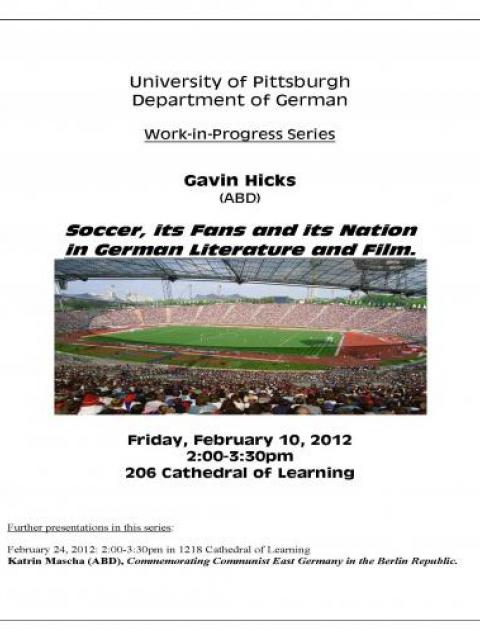
Soccer, its Fans and its Nation in German Literature and Film
Time:
2:00 pm to 3:30 pm
Presenter:
Gavin Hicks (ABD)
Location:
206 Cathedral of Learning
Announced by:
European Studies Center on behalf of Department of German

Work-in-Progress Series, "Soccer, its Fans and its Nation in German Literature and Film," Gavin Hicks (ABD)

Thursday, February 9th, 2012

Reading Herodotus in Renaissance Ferrara
Time:
5:00 pm
Presenter:
Dennis Looney
Location:
Cathedral of Learning, Room 501G
Announced by:
European Studies Center on behalf of The Program in Medieval and Renaissance Studies and Department of French and Italian

Dennis Looney is a professor of Italian at the University of Pittsburgh, with secondary appointments in Classics and Philosophy. Publications
include: Compromising the Classics (1996); Phaethon’s Children: The Este Court and Its Culture (2005); ‘My Muse will have a story to paint’:
Selected Prose of Ludovico Ariosto (2010); Freedom Readers: The African American Reception of Dante Alighieri and the Divine Comedy (2011). In his current project he considers the recovery and reception of ancient history and its representation in early modern thinking in Europe, examining the relation between history and literature, fact and fiction, storia and fabula.

Please join us for a reception after the talk!

International Connections
Connecting You to Your World
Time:
8:30 am to 1:00 pm
Presenter:
Angela Dunlap Ayukachale, Terrell Starr, Nick Hamilton-Archer, Col. Aaron Webster
Location:
William Pitt Union
Sponsored by:
Asian Studies Center, Center for Latin American Studies, Center for Russian East European and Eurasian Studies, European Studies Center, European Union Center of Excellence, Global Studies Center, International Business Center and Global Experiences Office along with World Affairs Council of Pittsburgh and Urban League of Greater Pittsburgh
Contact:
Gina Peirce
Contact Phone:
412-648-2290
Contact Email:
gbpeirce@pitt.edu

This annual event informs Pittsburgh-area high school students from underrepresented minority groups of international studies, study abroad, and internationally oriented career opportunities through panel presentations and small group discussions with African-American Pitt alumni and other international studies professionals.

Wednesday, February 8th, 2012

Maritime Orientalism, or, The Political Theory of Water
Time:
3:00 pm
Presenter:
Jonathan Scott
Location:
History Department Lounge, 3703 Posvar Hall
Announced by:
European Studies Center on behalf of Department of History

This talk revisits the concept of orientalism in a long chronological context, including 4th Century BC Athens, Elizabethan and Caroline England, Enlightenment Europe, and colonial and contemporary New Zealand.
It seeks to identify a specifically geographic component of this construct, which historians have neglected.

Jonathan Scott is Professor of History at the University of Auckland.
Among many other books and articles, he is the author of When The Waves Ruled Britannia: Geography and Political Identities, 1500-1800 (Cambridge, 2011), Commonwealth Principles: Republican Writing of the English Revolution (Cambridge, 2004), and England's Troubles: Seventeenth-Century English Political Instability in European Context (Cambridge, 2000).

Tuesday, February 7th, 2012

Security in the Greek House
Time:
4:30 pm
Presenter:
Barbara Tsakirgis (Vanderbilt)
Location:
Cathedral of Learning 335
Announced by:
European Studies Center on behalf of Department of Classics and Pittsburgh Society of the Archaeological Institute of America
Cost:
Free

Barbara Tsakirgis, Associate Professor of Classics and Art History; Chair, Department of Classical Studies, Vanderbilt University

Greek houses of the Classical and Hellenistic periods incorporated a number of features that were designed for the safe-keeping of the entire oikos, the homeowner, his family and slaves, and their possessions. While many of these security measures do not survive intact in the archaeological record, they can be reconstructed from both scant remains and from literary and epigraphical accounts.

The physical provisions for security in Greek houses were many, including stoutly built doors and window shutters. Such means served both to enhance the actual security and the impression of it.

Additionally, human and divine protection alike were features of domestic security. Slaves were stationed at the street door and images of Hermes were placed there to add to that protection. Still other divinities, including Herakles Alexikakos, were also called upon to protect the home. On the other hand, while Classical Athens possessed a police force of Scythian archers, there is no evidence that this police force was charged with protecting private property.

Outside of urban areas, householders in the countryside gained added protection from the towers which were a common feature of farmhouses. Square or round in section, these towers were used both to protect the family and as storage places for grain.

Thursday, February 2nd, 2012 to Thursday, March 1st, 2012

“EUROPE AT 8:00” Eurochannel Short Films Tour
Time:
8:00 pm to 9:30 pm
Location:
4130 WWPH
Sponsored by:
European Studies Center and European Union Center of Excellence

TUESDAYS & THURSDAYS, STARTING FEBRUARY 2, 2012
“EUROPE AT 8:00” Eurochannel Short Films Tour
8:00 – 9:30 p.m., 4130 WWPH
Discover the newest perspectives of the European film scene through a series of short films from fifty-four film directors. The Eurochannel Short Films Tour has a strong regional footprint, revealing the creative genius of how cinema can be very diverse and surprising. Shaped by geographical and cultural features, those shorts films are as much charming as a work of the director’s passion. Stories of love or friendship in an adult’s brutal world, paintings of childhood feelings, stories of war or poverty, and comedies with unpredictable humor, Europe at 8:00 brings you the complexity of humanity as the European artists of the new generation see it. This series reflects unknown and unfamiliar dimensions of European reality.
Sponsored by: the European Union Center of Excellence/European Studies Center, the Russian & East European Studies Center

Europe at 8:00 – Film Schedule

Thursday, February 2
From Luxembourg: X on a Map, by Jeff Desom 13 minutes
From Portugal: Alfama, by João Viana 15 minutes
From France: Port of Call, by Eléa Gobbé-Mévellec 6 minutes
From Belgium: The End of the World, by Michael Havenith 10 minutes
From Azerbaijan: Theatrical Life, by Ilqar Najaf 22 minutes
From Latvia: Signs of Light, by Ilze Kunga 18 minutes

Tuesday, February 7
From Switzerland: Scribbling & Tingling, by Amaury Berger 13 minutes
From England: I’ll Tell You, by Rachel Tillotson 10 minutes
From Spain: Worstward Ho, by Alex Brendemühl 12 minutes
From Scotland: A Cheeky 20, by Chris Fallen 3 minutes
From Austria: Little World, by Marco F. Zimprich 18 minutes
From Poland: Endless Beginners, by Justyna Nowak 30 minutes

Thursday, February 9
From Bosnia & Herzegovina: I Don’t Dream in German, by Ivana Lalovic 13 minutes
From Italy: The Other Half, by Pipo Mazzepesa 9 minutes
From France: Last Markdown, by Nicolas Slomka 14 minutes
From Georgia: The Highway, by Sandro Japaridze 10 minutes
From Slovakia: Viliam, by Veronika Obertová 8 minutes
From Russia: Nail, by Michael Lockshin 13 minutes
From Albania: Snowdrops, by Robert Budina 26 minutes

Tuesday, February 14
From Belgium: Marie, by Jozefien Scheepers 17 minutes
From Switzerland: Parents, by Fernando Tiberini 11 minutes
From Spain: Lala, by Esteban Crespo Garcia 19 minutes
From Kosovo: The Dinner, by Blerta Zeqiri 17 minutes
From the Netherlands: Cat & Mice, by Nova van Dijk 9 minutes

Thursday, February 16
From the Czech Republic: Saharan Sands, by Josef Tuka 18 minutes
From Croatia: That Little Hand of Yours, Sara Hribar 23 minutes
From Ireland: The Ballad of Kid Kanturk, by John Butler 12 minutes
From Italy: From the 41st Minute, by Matteo Pellegrini 9 minutes
From Hungary: With a Little Patience, Laszlo Nemes 14 minutes
From Denmark: Peaceforce, by Peter Gornstein 19 minutes

Tuesday, February 21
From Serbia: Old Mountain, by Goran Stankovic 18 minutes
From Malta: .303, by David Serge 11 minutes
From Spain: Let’s Go to Plan B, by Paz Piñar 14 minutes
From Turkey: Snow, by Erol Mintas 22 minutes
From Wales: Skimming Pebbles, by Tariq Ali 9 minutes
From Romania: The Cage, by Adrian Sitaru 17 minutes

Thursday, February 23
From Montenegro: Masks, by Andro Martinovic 13 minutes
From Germany: Lumen, by Philip Koch 29 minutes
From Sweden: The Last Things, by Levan Akin 20 minutes
From Lithuania: Grandpa, by Andrius Paskevicius 11 minutes
From Moldova: Sasa, Grisa & Ion, by Igor Cobileanski 11 minutes
From Macedonia: Glow, by Tamislav Aleksov 15 minutes

Tuesday, February 28
From Switzerland: Laterarius, by Marina Rosset 3 minutes
From Cyprus: Trachoni, by Nick Kapros 10 minutes
From Ukraine: Her Seat is Vacant, by Bohdana Smymova 17 minutes
From Northern Ireland: Paint, by Ryan Tohill 9 minutes
From Iceland: Safe Journey, David Óskar Ólafsson 22 minutes
From Norway: A Tale of Balloons, by Torfinn Iversen 14 minutes
From Spain: Duck Crossing, by Koldo Almandoz 12 minutes

Thursday, March 1
From Belarus: Life is Infinite Return, by Vladimir Piskunovic 17 minutes
From Armenia: Ararat, by Renaud Armanet 13 minutes
From Bulgaria: Someone Else’s Steps, by Neda Morfova 4 minutes
From Greece: Samurai, by Theo Papadoulakis 26 minutes
From Finland: Kirkonkyla Kyrkby, Elise Pietarila 14 minutes
From Estonia: Champion, by Kaupo Kruusiauk 13 minutes

Thursday, February 2nd, 2012

Aesthetics of Time: the Case of the Middle English Sir Orfeo
Time:
12:30 pm to 2:00 pm
Presenter:
James Knapp (English) and Peggy Knapp (Carnegie Mellon)
Location:
602 Cathedral of Learning
Announced by:
European Studies Center on behalf of Humanities Center

James Knapp (English) and Peggy Knapp (Carnegie Mellon) will present:

"Aesthetics of Time: the Case of the Middle English Sir Orfeo,"
with responses from Ryan McDermott (English) and Daniel Selcer (Duquesne).

Faculty and graduate students in Pitt Humanities departments can access colloquium papers two weeks before the event by logging in to , clicking on the tab “My Resources,” clicking on “Humanities Center,” and then clicking on “Colloquium Series” where there is a link to the pdf file. Participants may also request the reading at humctr@pitt.edu.

Graduate European Studies Group Meeting: "Hitting the Ground Running: Strategies for Getting the Most Out of Your Research Trip"
Time:
12:00 pm to 1:00 pm
Presenter:
Professor Ronald H Linden
Sponsored by:
European Studies Center and European Union Center of Excellence

Funding is tight and it can be hard to arrange trips abroad to do field or archival research. Once you have a budget and a set schedule, it is imperative that every moment of your trip counts to its fullest. Moreover, careful preparation can also be useful in convincing grant-giving institutions that your project is worth funding. In this meeting moderated by EUCE/ESC Director Ron Linden, a panel of graduate students will share their experiences researching abroad (what worked and what didn’t), answer questions, and offer practical advice.

Wednesday, February 1st, 2012

The Musée des Monuments français: Mirror of the Revolution (Alexandre Lenoir)
Reframing Knowledge, Constructing History, and Revolutionary Regeneration in the Museological Vision of Alexandre Lenoir
Time:
12:00 pm
Presenter:
Jennifer Donnelly (MA Candidate)
Location:
Room 203 Frick Fine Arts
Announced by:
European Studies Center on behalf of Department of History of Art and Architecture

During the French Revolution, all possessions of the church and former monarchy were declared to be the national property of the new French Republic. In order to deal with the influx of material, the government established storage dépôts in former monasteries and convents where the “objects of art and science” could be collected, sorted, and disseminated for public education. Under the direction of Alexandre Lenoir, the funerary monuments, sculpture, and architectural decoration stored at the Petits-Augustins dépôt evolved into the Musée des Monuments français. The artifacts were organized into a chronological sequence of “century rooms” representing the rise and fall of French arts and civilization. The symbolic memory of the monarchial and ecclesiastical past was embedded in the artifacts, and this material legacy needed to be reframed for the Revolutionary present. By prioritizing historical and temporal specificity rather than former purposes and contexts, Lenoir transformed the artifacts into “historic monuments” and organized them into a new symbolic history of France. For Lenoir, the chronological sequence was a layered political tool about the educational enlightenment of the individual, which he described as the “regeneration” of man. According to Lenoir, the overall “physiognomy” of each historical period was dominated by the ruling monarch, while the rise and decline of artistic development was indicated by the prevalence or lack of individual artistic achievements. The century room sequence was followed by the Élysée, a picturesque garden filled with tombs and monuments dedicated to great figures from French history. Within the chronological sequence of the century rooms, Lenoir created a container for the politically charged educational dissemination of the monarchial history of France. Enlightened by the rise and fall of individual accomplishment through the century rooms, the visitor left the monarchial past in the last century room and entered the atemporal Élysée, which represented the eternal Revolutionary present and which was dedicated to the timeless heroic deeds and intellectual accomplishments of exceptional historical figures. The Musée des Monuments français was an evocation of the progress of human agency.

Tuesday, January 31st, 2012

Civil Jurisdictions of European Courts over U.S. Parties
Time:
(All day)
Presenter:
Davor Babic (Uni of Zagreb)
Location:
Center for International Legal
Sponsored by:
European Studies Center and European Union Center of Excellence along with Center for International Legal Education
Contact:
Gina Huggins
Contact Email:
glclark@pitt.edu

*Part of the Jean Monnet Lecture Series on European Union Law*

Dr. Davor Babic was a visiting professor at the School of Law for the spring term 2012 (December 28, 2011-January 28, 2012). He taught European Private International Law (2 credits).

Monday, January 23rd, 2012

EU Simulation - Turkish Accession
Time:
8:30 pm
Location:
203 David Lawrence Hall
Announced by:
European Studies Center on behalf of International Relations Society

EU simulation on Turkish accession to the European Union.

Friday, January 20th, 2012

Temporary and Permanent Anatomy Theaters: the Stakes of Transition
Time:
3:00 pm
Presenter:
Cynthia Klestinec (English, Miami University of Ohio)
Location:
Cathedral of Learning, Room 208-B
Announced by:
European Studies Center on behalf of Humanities Center, World History Center, Medieval and Renaissance Studies Program, Working group on Medicine, Philosophy, and the Scientific Revolution, Center for Philosophy of Science, Department of History and Philosophy of Science and Indiana University-Bloomington Department of History and Philosophy of Science

In the Renaissance, studying nature meant (most of the time) encountering nature. But these encounters, as Peter Dear has indicated, tended to generate a discussion (in the period and in the historiography) between unmediated sensory experiences and experiences organized by prior conceptual categories. This paper focuses on anatomical encounters, when anatomists articulated that distinction with clarity, in order to reconsider the significance of ephemeral and permanent anatomy theaters.

The relationship between the two is usually described chronologically:
theaters were temporary before they were permanent. This has encouraged a second view, namely that temporary theaters initiated the study of anatomy through human and animal dissection (the encounter with nature), and permanent theaters further developed that study. This paper will argue against such a seamless transition. Even when the permanent anatomy theater was built and in use in Padua, temporary theaters continued to provide more immediate, sensory experiences for professors as well as students.

This talk is sponsored by the working group on Medicine, Philosophy, and the Scientific Revolution (http://www.pitt.edu/~pmd17/MPSR.html) and supported by the Center for Philosophy of Science. The event is free and open to the public.

Tuesday, January 17th, 2012

Conversations on Europe videoconference series
Is the Future of the Eurozone the Future of Europe?
Time:
12:00 pm to 1:30 pm
Presenter:
Dr. Alberta Sbragia, Dr. Christiane Lemke, and Larry Neal
Location:
David Lawrence Hall 211
Sponsored by:
European Studies Center and European Union Center of Excellence

On January 17th,2012, the European Union Center of Excellence/European Studies Center at the University of Pittsburgh will host an interactive videoconference devoted to the current European financial crisis. To be held from 12-1:30 p.m. in 211 David Lawrence Hall, the session is entitled “Is the Future of the Eurozone the Future of Europe?” This is the first in a series of “Conversations on Europe,” in which participants and audiences will be linked across several sites by video. This first session will feature some of the country’s top experts on the European Union, including Dr. Alberta Sbragia, Vice-Provost of Graduate Studies at the University of Pittsburgh; Dr. Christiane Lemke, Max Weber Chair in German and European Politics at New York University and Professor of Political Science at the Leibniz University of Hannover, Germany; and Larry Neal, Emeritus Professor of Economics at the University of Illinois at Urbana-Champaign and Visiting Professor at the London School of Economics. Audiences at all three sites will be able to ask questions of the experts. This event is open to the public.

Friday, January 13th, 2012

Repairs in the Dark: Measure for Measure and the End of Comedy
Time:
12:30 pm
Presenter:
Sarah Beckwith (Professor of English and Theatre Studies, Duke)
Location:
Humanities Center, 602 Cathedral of Learning
Announced by:
European Studies Center on behalf of The Program in Medieval and Renaissance Studies
Contact:
Professor Jennifer Waldron
Contact Email:
jwaldron@pitt.edu

Sarah Beckwith works on late medieval religious writing, medieval and early modern drama, and ordinary language philosophy. In this seminar, we will discuss chapter three of her most recent book, Shakespeare and the Grammar of Forgiveness (Cornell, 2011). Professor Beckwith is also the author of Signifying God: Social Relation and Symbolic Act in York's Play of Corpus Christi (Chicago, 2001), and Christ's Body: Identity, Religion and Society in Medieval English Writing (Routledge, 1993). She is currently working on a book about Shakespearean tragedy and about philosophy's love affair with the genre of tragedy.

Marianne Novy and Ryan McDermott will offer responses to the pre-circulated reading. Reply to this email in order to receive the reading attachment.

The text for discussion is “Repairs in the Dark: Measure for Measure and the End of Comedy.” If you have questions, please email Professor Jennifer Waldron (jwaldron@pitt.edu).

*Professor Beckwith will also give a lecture at Duquesne University on Thursday, January 12th at 4:00 in 324 Fisher Hall.*

Tuesday, January 10th, 2012

Moving Outside the Electoral Arena: Party and Party System Change in Parliaments
Time:
12:00 pm to 1:00 pm
Presenter:
Carol Mershon
Location:
4500 WWPH
Sponsored by:
European Studies Center and European Union Center of Excellence along with Department of Political Science

Tuesday, December 13th, 2011

Pizza & Politics: “Using the EU Archive at Pitt to Research Beyond Eurafrica”
Time:
12:00 pm
Presenter:
Philipe Lionnet
Location:
4217 WWPH
Sponsored by:
European Studies Center and European Union Center of Excellence

Mr. Lionnet’s thesis explores sovereignty, hegemony, and human rights in EU-ACP (African, Caribbean, and Pacific Group of States) relations. His project seeks to get beyond the ideology of Eurafrica to better understand development policies in the 1950s and 1960s. For his research, Mr. Lionnet has come to the University of Pittsburgh to make use of the European Union Delegation Collection housed at the University Library. The Collection is a virtually complete assemblage of official European Community documents published since the early 1950s. In his work on development, Mr. Lionnet has had occasion to work in European archives in addition to this one. He has generously agreed to speak with Pitt grad students about his experiences in the University’s Depository Collection, how it compares to others, what he has found, and how it all informs his larger research project. Please join us then for Pizza & Politics…& Archives.

Thursday, December 8th, 2011

Europeanization and the Migrant Debates
Time:
12:30 pm to 2:00 pm
Presenter:
Randall Halle
Location:
602 Cathedral of Learning, University of Pittsburgh
Sponsored by:
European Studies Center, European Union Center of Excellence and Global Studies Center along with Humanities Center
Contact Email:
humctr@pitt.edu

Randall Halle is the Klaus W. Jonas Professor of German Film and Cultural Studies at the University of Pittsburgh. He studied at the University of Wisconsin—Madison, the University of Freiburg, the University of Utrecht, and the Free University in Berlin. He received his PhD from Madison in 1995. Halle works primarily on film, visual culture, and social philosophy. He is currently pursuing two different projects tentatively entitled Interzone Europe: Social Philosophy and the Transnational Imagination as well as Visual Alterity: Seeing Difference. Halle has received numerous grants. Academic year 2004-2005 he was a Senior Fellow in the Berlin Program for Advanced German and European Studies at the Free University. In 2006 he was offered the honor of being the first occupant of the Jonas Chair at the University of Pittsburgh. Academic year 2009-2010 he was a Senior Fulbright Researcher in Berlin.

Wednesday, December 7th, 2011

Pizza & Politics: Historical Perspectives on French Socialism, German Social Democracy, and Crisis within the European Communities: From the Empty Chair Crisis to Financial Collapse, 1965-2011
Time:
12:00 pm
Presenter:
Brian Shaev
Location:
4625 WWPH
Sponsored by:
European Studies Center and European Union Center of Excellence

As the European Union confronts one of the deepest crises of its history, the frustration of a number of member states at the apparent hegemony of the “Franco-German couple" has become vocal and public. With elections approaching in 2012 in France and 2013 in Germany, it is worth considering what a transfer of power from the current governing parties to the major opposition parties, the Parti Socialiste (PS) and the Sozialdemokratische Partei Deutschlands (SPD), might harbor for the future of the European integration project. In this presentation, I examine how these parties handled past crises, both when in government and in opposition. I explore policy continuities and evolution over time through an examination of these parties’ roles in the Empty Chair Crisis, President Mitterand’s program for socialist transformation, German reunification, the proposal for a European constitution, and the current financial and debt crisis.

Tuesday, December 6th, 2011

Centrality and Perceptibility as Indicators of Dominance at Intersecting Religioscapes
From Anatolia to the Alentejo to the Andes
Time:
3:30 pm to 5:30 pm
Presenter:
Robert M. Hayden (Antropology, Pitt), Enrique Lopez-Hurtado (Instituto de Estudios Peruanos), Tugba Tanyeri-Erdemir (Middle East Technical University), Aykan Erdemir (Member of the Turkish Parliament)
Location:
3160 WW Posvar Hall
Announced by:
European Studies Center on behalf of Department of Anthropology

Monday, December 5th, 2011

The Generosity of Social Insurance: Unemployment Insurance Benefits in Comparative Perspective
Time:
12:30 pm to 2:00 pm
Presenter:
Lyle Scruggs
Location:
4500 Wesley W Posvar Hall
Sponsored by:
European Union Center of Excellence and European Union Studies Association along with Department of Political Science

Please join us for a talk: Lyle Scruggs is Associate Professor of Political Science at the University of Connecticut. He is a candidate for the senior position in comparative politics in the Department of Political Science.

Model European Union simulation for high school students
Time:
(All day)
Presenter:
various
Sponsored by:
European Studies Center and European Union Center of Excellence along with Global Solutions Pittsburgh

Friday, December 2nd, 2011

European Cultural Night
Time:
7:00 pm
Location:
Jozsa Hungarian Restaurant, Greenfield, Pittsburgh, PA
Announced by:
European Studies Center on behalf of GSPIA's EU and the World graduate student group

Cultural night out at Jozsa Hungarian restaurant for GSPIA graduate students.

Thursday, December 1st, 2011

Economic and Political Implications of the New Greek Debt Deal & European Debt Crisis
Time:
6:00 pm
Presenter:
Dr. James Maloy & Dr. Despina Alexiadou
Location:
5400 Posvar Hall
Announced by:
European Studies Center on behalf of International Relations Society

Dr. Maloy (Econ) & Dr. Alexiadou (Political Science) will be giving their take on the economic and social/political implications of the new Greek debt deal and the debt crisis in Europe in general.

Wednesday, November 30th, 2011

Obtaining an International Internship
Time:
1:30 pm
Location:
3800 Posvar Hall
Announced by:
European Studies Center on behalf of GSPIA's EU and the World graduate student group

Internship panel for GSPIA Master's students looking for internships abroad.

Monday, November 21st, 2011

Pizza & Politics: What’s Next For Italy?
Time:
12:00 pm to 1:00 pm
Presenter:
Dr. Alberta Sbragia
Location:
4217 Wesley W Posvar Hall
Sponsored by:
European Studies Center and European Union Center of Excellence

MONDAY, NOVEMBER 21
Pizza & Politics: What’s Next For Italy? A Conversation with Alberta Sbragia
Dr. Alberta Sbragia, Vice Provost, University of Pittsburgh
12:00 PM, 4217 WWPH
Alberta Sbragia, former EUCE/ESC Director and current Vice-Provost for Graduate Studies, will host a round table discussion about the current economic and political crisis in Italy. Please join us for pizza and a lively discussion about the implications for the Euro and the future of the European Union. As a Mark A. Nordenberg University Chair and the Jean Monnet Professor ad personam in the Department of Political Science, Dr. Sbragia served as the Director of the European Union Center of Excellence/European Studies Center from 1984-2010, as chair of the European Union Studies Association, now headquartered at the University of Pittsburgh, and as President of the Conference Group on Italian Politics.
Sponsored by: European Union Center of Excellence/European Studies Center

Wednesday, November 16th, 2011

Shakespeare's Sex
Time:
3:00 pm
Presenter:
Valerie Traub
Location:
Cathedral of Learning, 602
Sponsored by:
European Studies Center and European Union Center of Excellence along with Humanities Center, Gender, Sexuality, and Women's Studies Program, Medieval and Renaissance Studies Program and Department of English

A talk by influential senior scholar Valerie Traub of the University of Michigan entitled "Shakespeare's Sex" on Wednesday, November 16 at 3:00 in CL 332. Traub is Frederick G. L. Huetwell Professor of English and Women's Studies at the University of Michigan. She is the author of *The Renaissance of Lesbianism in Early Modern England*. Other books include *Desire & Anxiety: Circulations of Sexuality in Shakespearean Drama* (1992) and two co-edited collections: *Feminist Readings of Early Modern Culture: Emerging Subjects* (1996) and *Gay Shame* (2009).

Narrative and Translation in New York Public Library Spencer Collection ms. 22 and Related Manuscripts
Time:
12:00 pm to 1:00 pm
Presenter:
Julia Finch
Location:
203 Frick Fine Arts Building
Announced by:
European Studies Center on behalf of Department of History of Art and Architecture

Late medieval audiences read the Bible in different languages, including the language of pictorial narrative.... This paper focuses on two intimately related manuscripts - a late twelfth-century Spanish narrative picture Bible produced for Sancho el Fuerte of Navarre (Amiens, B.m. ms. 108) and a fourteenth-century, stylistically-updated version of the same visual narrative (New York Public Library, Spencer 22). With a focus on the relationship between Sancho's Bible and Spencer 22, I examine the genre of narrative picture Bibles and the role of the pictorial translator in the image-to-image translation of visual narrative from Romanesque Spain to Gothic France.

Tuesday, November 15th, 2011

Working Class History and the Benefits of Oral History: The Case of Eastern Central Europe
Time:
5:00 pm to 7:00 pm
Presenter:
Eszter Zsofia Toth and Ulf Brunnbauer
Location:
3703 WWPH
Announced by:
European Studies Center on behalf of Department of History

A workshop with Dr. Eszter Zsofia Toth (Hungarian State Archive) and Professor Ulf Brunnbauer (University of Regensburg, Germany). Dr. Toth is one of the leading historians of the history of everyday life of Communist countries. Her work includes her much acclaimed oral history study of a women's brigade in a socialist factory in Budapest, her PhD project which investigated the profound problems of gender, class, and life-styles in the Kadar era. Professor Ulf Brummbauer has worked extensively on the problems of social history, nationalism, identity constructions and historiography in South Eastern Europe, especially Bosnia, Macedonia, Albania, and the Western Balkan countries.

Monday, November 14th, 2011

Kristallnacht: Annual Commemoration
Time:
4:30 pm
Presenter:
Multiple (see description)
Location:
Cathedral of Learning 208B
Announced by:
European Studies Center on behalf of Jewish Studies Program, Department of German, Dietrich School of Arts and Sciences and Jack Sittsamer Holocaust Studies Enrichment Fund

The Annual Commemoration of Kristallnacht (The “Night of Broken Glass” on November 9-10, 1938)

Survivor’s Account by Ruth Drescher
Music by Susanne Ortner-Roberts (clarinetist)
Readings by Pitt Students

This program is made possible with the support of the Jack Sittsamer Holocaust Studies
Enrichment Fund in the Jewish Studies Program.

Saturday, November 12th, 2011

Farewell 1789: The Idea of France and the Idea of Revolution
Time:
5:00 pm to 6:30 pm
Presenter:
David Bell, Princeton University
Location:
University Club Ballroom A
Announced by:
European Studies Center on behalf of Department of History

The University of Pittsburgh presents David Bell of Princeton University. Introduction by Seymour Drescher, University of Pittsburgh, Department of History.

"Montesquieu est-il encore vivant?: Apparition et développement d'un contrôle de constitutionnalité des lois en France"
Time:
12:00 pm to 1:30 pm
Presenter:
Olivier Dutheillet de Lamothe (Président de la section sociale, Conseil d'État, France)
Sponsored by:
European Studies Center, European Union Center of Excellence and Global Studies Center along with Department of History, Department of French and Italian and Dietrich School of Arts and Sciences

Friday, November 11th, 2011

"Labors of Innocence in Early Modern England"
Seminar
Time:
12:30 pm to 2:00 pm
Presenter:
Joanna Picciotto, UC Berkeley
Announced by:
European Studies Center on behalf of Humanities Center, Department of History, Medieval and Renaissance Studies Program and Dietrich School of Arts and Sciences

Professor Picciotto pre-circulated her essay to facilitate discussion on the relationship between Protestantism, experimental science, the public sphere, and intellectual labor itself.

"The Jews Who Are Not One: French Intellectuals, Philosophy, and the Politics of Nationhood"
Time:
(All day)
Presenter:
Lawrence Kritzman, Dartmouth
Sponsored by:
European Studies Center, European Union Center of Excellence and Global Studies Center along with Department of History, Department of French and Italian and Dietrich School of Arts and Sciences

Thursday, November 10th, 2011

Foreign and Comparative Law in Courts Today
A Panel Discussion
Time:
6:00 pm to 10:00 pm
Presenter:
Vivian Curran (School of Law), Olivier Dutheillet de Lamothe (Conseil d'État, France), William A. Fletcher (U.S. Court of Appeals for the 9th Circuit)
Location:
Teplitz Courtroom
Announced by:
European Studies Center on behalf of School of Law

Professor Vivian Curran will moderate this panel discussion featuring Olivier Dutheillet de Lamothe, a judge on France's Council of State, the Supreme Court of Public Law and William A. Fletcher, a judge on the U.S. Court of Appeals for the 9th Circuit.

Implications of the Polish Presidency of the EU for Europe and Transatlantic Affairs
Time:
12:00 pm
Presenter:
Maciej Pisarski, Deputy Chief of Mission at the Embassy of the Republic of Poland
Location:
4217 WWPH
Sponsored by:
Center for Russian East European and Eurasian Studies, European Studies Center and European Union Center of Excellence along with Department of History
Contact:
Karen Lautanen
Contact Phone:
412-648-8517
Contact Email:
kal70@pitt.edu

Maciej Pisarski is the Deputy Chief of Mission at the Embassy of the Republic of Poland in Washington, DC, a post he has held since August 2010. Previously he worked as the acting director of the Department of Strategy and Policy Planning in the Ministry of Foreign Affairs in Warsaw, Poland. Mr. Pisarski has spent a considerable portion of his professional career working on Polish-American relations, including his work as a Deputy Director at the Department of the Americas, Political Officer at the Embassy of Poland in Washington, DC, and US Desk Officer at the Polish Foreign Ministry in Warsaw.

Thursday, November 10th, 2011 to Saturday, November 12th, 2011

The Idea of France
Time:
2:30 pm to 5:00 pm
Location:
Various locations on Pitt's campus
Sponsored by:
European Union Center of Excellence and Global Studies Center along with School of Law, Office of the Provost, Humanities Center, World History Center, Film Studies Program, Department of Sociology, Cultural Studies Program, Department of History, Jewish Studies Program, Department of French and Italian, University Honors College, Eighteenth-Century Studies at Pitt, School of Arts and Sciences-Faculty Research and Scholarship Program and Associate Dean for Undergraduate Studies
Cost:
Free for Pitt students, faculty, and staff; $25 ($20 for non-Pitt students)
Contact:
Todd Reeser
Contact Email:
reeser@pitt.edu

Over 75 papers will be delivered on topics from all fields (literature, history, political science, sociology, anthropology, law, religion, art, music, cultural studies, film studies, gender studies, etc.) that treat the question of the idea of France or Frenchness in any time period from the middle ages to the twenty-first century.

For a full version of the conference schedule, please visit the Web site.

Wednesday, November 9th, 2011

Dr. Sbragia on Bloomberg
Time:
9:00 pm
Announced by:
European Studies Center on behalf of

Dr. Alberta Sbragia appearence on Bloomberg TV.
http://www.washingtonpost.com/business/pomboy-says-surge-in-italy-bond-y...

Nov. 9 (Bloomberg) -- In response to recent developments in the European Debt Crisis, Stephanie Pomboy, president of MacroMavens LLC, Irene Finel-Honigman, adjunct professor of international and public affairs at Columbia University, Alberta Sbragia, a professor at University of Pittsburgh, and Stephen Wood, chief market strategist at Russell Investments, talked about Europe's sovereign debt crisis and its implications for the U.S. Treasuries. They spoke with Pimm Fox on Bloomberg Television's "Taking Stock."

Monday, November 7th, 2011

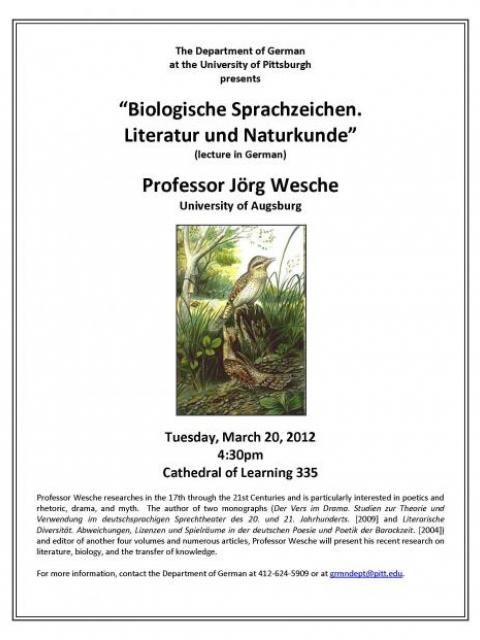
Von der Avantgarde zum Museum? Der Neue Deutsche FilmDeutsche Film——50 Jahre nach Oberhausen
Time:
4:30 pm to 6:00 pm
Presenter:
Matteo Galli (University of Ferrara)
Location:
Cathedral of Learning 208B
Announced by:
European Studies Center on behalf of Film Studies Program, Department of German and Carnegie Mellon University Department of Modern Languages
Contact Email:
grmndept@pitt.edu

Matteo Galli, who teaches at the University of Ferrara, is one of the foremost German Studies scholars in Italy and is also an expert on German cinema. He has published books on Elias Canetti, Thomas Mann, and E. T. A Hoffmann, and he has translated works by Jens Sparschuh and Uwe Timm, among others. He is also the editor of a major volume on the history of German cinema, Da Caligari a Good Bye, Lenin! (2004).

Thursday, November 3rd, 2011

The Freedom to be Racist-How the United States and Europe Struggle to Preserve Freedom and Combat Racism
Time:
12:30 pm
Presenter:
Eric Bleich
Location:
4500 WWPH
Announced by:
European Studies Center on behalf of Department of Political Science

Erik Bleich is a Professor of Political Science at Middlebury College and will give a talk based on his book on this subject published this year by Oxford University Press.

Thursday, October 27th, 2011

Holy Anatomy, Animate Substance: the Shrine Madonna as a Performing Object
Time:
4:00 pm
Presenter:
Elina Gertsman
Location:
Cathedral of Learning, 501G
Sponsored by:
European Studies Center and European Union Center of Excellence along with Department of History of Art and Architecture and Medieval and Renaissance Studies Program

Historian Elina Gertsman will present a lecture entitled "Holy Anatomy, Animate Substance: the Shrine Madonna as a Performing Object" on October 27, 2011. Elina's work combines more traditional methods of art historical scholarship with an interest in performance studies and cognitive science (or "embodied cognition"). She is the author of *The Dance of Death in the Middle Ages: Image, Text, Performance* (2010) and has also published several articles and edited the collection, *Visualizing Medieval Performance: Perspectives, Histories, Contexts* (2008).

Wednesday, October 26th, 2011

Bruce Venarde's Two Women of the Great Schism and The Rule of St. Benedict
History Department Book Symposia Series
Time:
4:00 pm to 6:00 pm
Presenter:
Renate Blumenfeld-Kosinski, Fiona Griffiths, Jan Ziolkowski
Location:
3703 Posvar Hall
Announced by:
European Studies Center on behalf of Department of History

History Department Book Symposia Series: On Wednesday, October 26, 2011, between 4:00 and 6:00 p.m. the Department of History will hold a symposium celebrating Bruce Venarde's Two Women of the Great Schism and The Rule of St. Benedict.

If the past is a foreign country, medieval Europe is for most of us another planet altogether. Two Women of the Great Schism and The Rule of St. Benedict are attempts to open up a world that is very different from ours but explicable on its own terms. They reflect Bruce Venarde’s commitment to making medieval European history and culture available to non-specialists, to deep and close reading of medieval Latin and other texts, and to collaborative work.

Does Foreign Ownership Matter? Evidence from Foreign Bank Ownership in Central and Eastern Europe during the Financial Crisis
Time:
3:00 pm
Presenter:
Rachel Epstein
Location:
4130 WWPH
Sponsored by:
Center for Russian East European and Eurasian Studies, European Studies Center and European Union Center of Excellence along with Department of Political Science

Rachel Epstein is associate professor of international political economy and European politics at the Josef Korbel School of International Studies at the University of Denver. She has PhD from the Department of Government at Cornell and an AB in International Relations from Stanford University.
Sponsored by: European Union Center of Excellence/European Studies Center, Russian and East European Studies Center (REES), Department of Political Science

All Roads Led to Rome
Processional Imagery and Paradigms of Pilgrimage in Late Medieval Lazio
Time:
12:00 pm to 1:00 pm
Presenter:
Rebekah Perry
Location:
203 Frick Fine Arts Building
Announced by:
European Studies Center on behalf of Department of History of Art and Architecture

This presentation examined a transformative moment for the traditional procession known as the Inchinata between the mid thirteenth and fourteenth century, a period characterized by the advent of the mendicant friars with their new models of personal devotion and do-it-yourself religion, the emergence of confraternities, the growing prominence of trade guilds, the solidifying of municipal government, the rise of the middle classes, and a new emphasis on penitential pilgrimage, especially to the city of Rome. Perry argues that within this context, Tivoli's ceremonial cult image took on a new allegorical identity of "Christ-as-pilgrim" and that the Inchinata procession functioned as a type of moving morality play that "performed" new models of bourgeois Christian conduct.

Wednesday, October 19th, 2011

The Present Situation of the European Union
Roundtable Discussion
Time:
12:30 pm
Presenter:
Dr. Bernhard Schloh, Professor Emeritus at Vrije Universiteit Brussel
Location:
4430 Posvar Hall
Sponsored by:
European Studies Center and European Union Center of Excellence

As a former Legal Counsellor at the Council of the European Union in Brussels, Dr BErnaard Schloh brings relevant perspective and insight to the current state of the European Union. Until his retirement in 1994, Dr. Schloh was also a faculty member of the School of Law at the Vrije Universiteit Brussels. He has also been a visiting faculty member at the University of Georgia, Saint Louis University, Washington and Lee University, Santa Clara University, and Tulane University.

The Emergence of SÚM
Collective Art Practice in Iceland, 1965-1978
Time:
12:00 pm to 1:00 pm
Presenter:
Nichole Pollentier
Location:
203 Frick Fine Arts Building
Announced by:
European Studies Center on behalf of Department of History of Art and Architecture

SÚM was a loosely affiliated artist's collective that was founded following a 1965 self-organized exhibition of works by Jón Gunnar Árnason, Hreinn Friofinnsson, Sigurjón Jóhannsson, and Haukur Sturluson. In this talk, Pollentier discusses the emergence of SÚM, provides a brief overview of the group's major projects, and examines how the collective practices of its members provided a critique of the political and cultural environment of the 1960s and 70s. She considers the lack of scholarly attention that SÚM has received and the unique challenges that assembling a history of the group presents, despite its significant position in the history of Icelandic art.

Tuesday, October 18th, 2011

The Present Situation of the European Union: Legal and Political Reflections
Jean Monnet Lecture
Time:
12:00 pm to 1:00 pm
Presenter:
Dr. Bernhard Schloh, Professor Emeritus at Vrije Universiteit Brussel
Location:
Alcoa Room, Pitt Law School
Sponsored by:
European Studies Center and European Union Center of Excellence along with Center for International Legal Education

Foreign Visiting Professor Dr. Bernhard Schloh will present the first of this year’s two annual Jean Monnet lectures on European Union Law. The lecture is titled “The Present Situation of the European Union: Legal and Political Reflections.” Professor Dr. Bernhard Schloh is a former member of the Legal Service of the Council of Ministers of the European Union and is Professor Emeritus at Vrije Universiteit Brussel in Belgium.

Saturday, October 15th, 2011

French Immersion Institute
La Société Française: Ça Bouge!!! L'adaptation des lois, des individus et des familles aux changements de nos jours
Time:
8:30 am to 1:30 pm
Presenter:
Myriam Gau, Centre Francophone de Pittsburgh
Location:
5200 Posvar Hall
Sponsored by:
European Studies Center and European Union Center of Excellence along with American Association of Teachers of French and Allegheny Intermediate Unit
Cost:
$10.00
Contact:
Timothy Thompson
Contact Email:
tst@pitt.edu

The French Immersion Institute, Directed by Bonnie Adair-Hauk, Ph.D., organized this workshop for middle and high school teachers to broaden their cultural understanding of current events and international studies regarding French-speaking countries, to strengthen their French listening and speaking skills, and to share strategies for teaching of French language and culture.

Wednesday, October 12th, 2011

"Postpartum and Menstuating Women and the Immutability of Natural Law: A Twelfth-Century Discussion"
Time:
4:00 pm to 5:30 pm
Presenter:
Atria A. Larson, Catholic University
Announced by:
European Studies Center on behalf of Department of History, Medieval and Renaissance Studies Program and Dietrich School of Arts and Sciences
Thomas Hirschhorn's Bijlmer Spinoza Festival: Untethering Stereotypes
Time:
12:00 pm to 1:00 pm
Presenter:
Brianne Cohen
Location:
203 Frick Fine Arts Building
Announced by:
European Studies Center on behalf of Department of History of Art and Architecture

Cohen argues that Hirschhorn's installations in banlieues of Amsterdam do not attempt to mobilize the precariat for legislative changes and civil rights, but instead, to redefine preexisting terms of attention/circulation concerning their widely stereotyped and marginalized publicity. In other words, the artist challenges the monocular, homogenizing vision of a dominant public and mediascape.

Pages