

A free in-person seminar for K-12 Educators
Funded by the Freeman Foundation and presented by the Asian Studies Center, University Center for International Studies, University of Pittsburgh and the National Consortium for Teaching About Asia
Why should you incorporate East Asia into your curriculum?
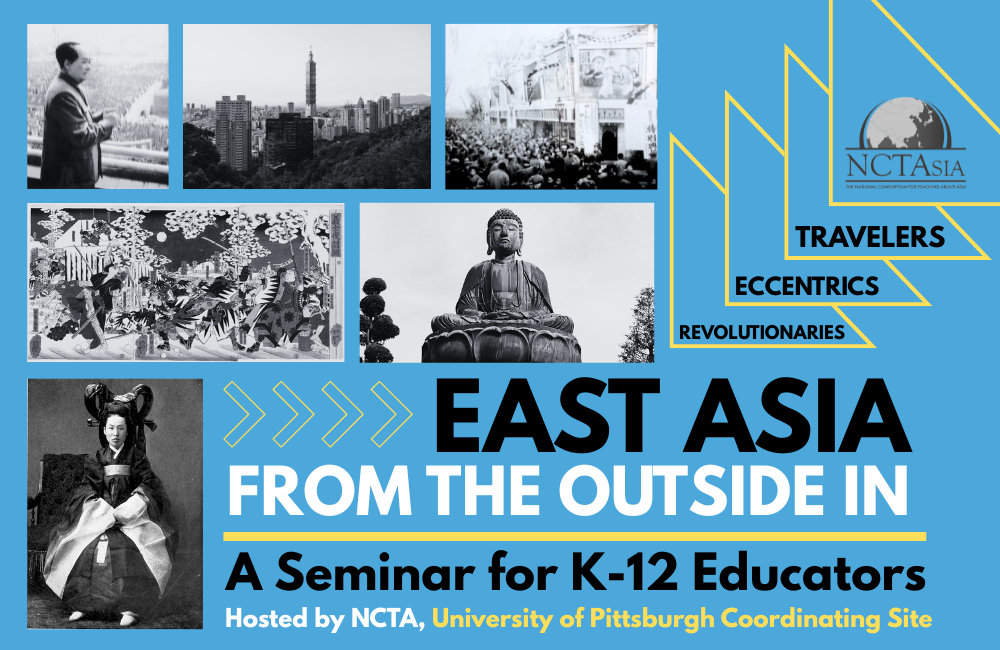
This free in-person seminar for K-12 educators will offer an outside-in, bottom-up approach to East Asia’s history and culture. Focusing on the everyday culture of ordinary people of China, Japan, Korea, and Vietnam, we will present lesson ideas and teaching strategies teachers can incorporate into their classes. Topics range from Japanese woodblock prints to contemporary Korean horror films and seminar presentations will include lectures and activities led by Pitt faculty, guest experts, and NCTA master teachers.

Application Deadline: August 24, 2026 or until course fills
2026 SCHEDULE
All classes are held in 4130 Posvar Hall at University of Pittsburgh Main Oakland campus.
Parking stickers will be provided for free parking.
Seminar Location: Room 4130 Wesley Posvar Hall, University of Pittsburgh Main Campus, Pittsburgh, PA 15260.
Time: 5:30-8:30 p.m. (Free Parking & Dinner provided)
Dates and Class Session Topics:
- Monday, August 31, 2026 - Introduction: Borders
- Monday, September 14 - Chinese Calligraphy & The Literature of Korean and Japanese Court Women
- Monday, September 28 - Buddhism in Conflict
- Monday, October 5 - Encounters on the Silk Road
- Monday, October 19 - Heroic Outlaws of China and Japan: The Water Margin and The 47 Ronin
- Monday, October 26 - Encounters with Europe and America
- Monday, November 2 - Understanding Global Modernity Through Detective Fiction
- Monday, November 9 - Twentieth Century Revolutionaries
- Monday, November 16 - Korean and Japanese Ghosts
- Monday, December 14 - East Asian Peripheries
- Monday, January 11, 2027 - Democracy and Disability in East Asia
An additional Follow-up Session (3 hours total) required in the Spring of 2027.
Benefits for Participants
Each participant who completes the course and course requirements will receive:
- $180 worth of teaching materials for your classroom, including the course textbook, additional materials such as a set of tangrams and a calligraphy set, and a $150 mini-grant for purchase of approved materials for your classroom. (The purpose of the mini-grant is to get teaching materials into “brick and mortar” schools. Due to the increasing variety of our seminar participants, not all participants may be able to receive a mini-grant. Please consult with us about this early in the course.)
- $300 stipend at the completion of all requirements including attendance at the follow up classes.
- Certificate of Completion: Participants who complete all requirements and attend all sessions will receive Act 48 hours and a Certificate of Completion.
-
NCTA alumni are eligible to apply for NCTA Summer Institutes to East Asia and are also eligible for small grants such as the Marie Wanek Fund, travel subsidies for conferences, and other benefits that we offer from time to time; NCTA alumni are also often given priority preference in competitive applications for summer institutes, Fulbright-Hayes study tours to East Asia and other programs. Our office also writes letters of recommendations for alumni who apply to competitive study tours and summer institutes. All alumni will receive a weekly NCTA email newsletter with information about free professional development programs and teaching resources.
Seminar Requirements
- Expressed commitment to integrating East Asia into your curriculum.
-
In addition, to complete the seminar and receive the benefits, you must fulfill the following requirements: Attend and participate in all sessions (36 contact hours, with 30 hours in the fall/winter and 6 hours in the spring) Complete all assignments and requirements, including designing a lesson plan that incorporates East Asian material into your curriculum, writing a “reflection paper” and completing a mini-grant form for your teaching materials. (A full list of assignments will be posted on our website.)
-
-
Each participant is expected to come to class prepared to participate in class discussions. Each week there will be a short writing assignment, or some other short assignment based on the readings for that class.
Application Deadline: August 31, 2026 or until course fills
Learn more about Pitt's NCTA Seminar Instructors
Seminar Leaders

Dr. Lisa Lackney is the Director for the NCTA University of Pittsburgh national coordinating site. Specializing in Japanese history, her research and dissertation focused on understanding the experience of modernity in Japan through mass cultural products such as films, detective fiction, and popular magazines. Prior to joining us at NCTA, Dr. Lackney served as the Program Associate for the East Asia National Resource Center at George Washington University that offered teacher training for K-12 educators, as well as public programming and additional resources for students and faculty.
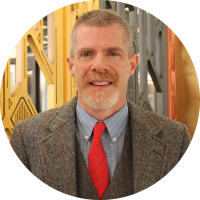
Dr. Patrick Hughes is the Assistant Director of the University of Pittsburgh's National Consortium for Teaching About Asia (NCTA). He has lead and facilitated NCTA K-12 educator study tours to China, Tibet, Japan, and most recently Central Asia. Dr. Hughes holds a PhD in religious studies and has taught courses at the University of Pittsburgh and other local universities. He has also taught a first year programs course at Pitt, which focused on Asian Studies.
Program Manager
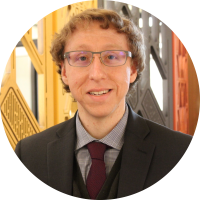
Stephen Wludarski is the Program Manager for the NCTA at the University of Pittsburgh's Asian Studies Center. He holds a Master of Library and Information Sciences (MLIS) degree with concentrations in the digital humanities, digital scholarship and applied data-driven methods from the University of Pittsburgh School of Computing and Information. Before joining the Asian Studies Center, he lived and worked in Kobe, Japan engaging in grassroots internationalization and English language education on the elementary and middle school levels. His area of study is pre-modern Japan and the utilization of digital humanities tools and online resources to enhance scholarship at all educational levels.